

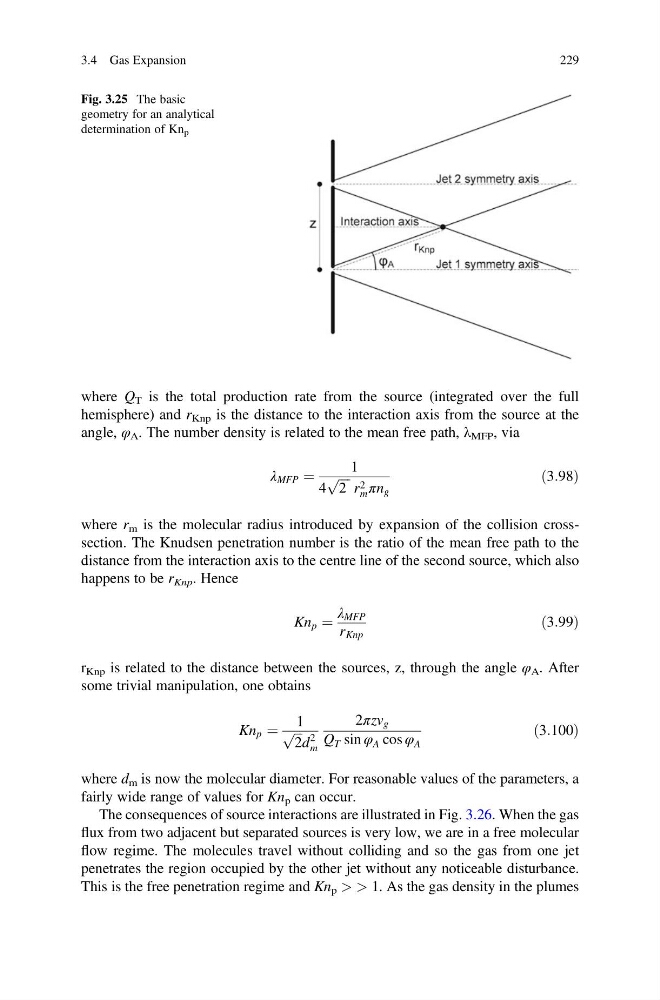
where Q T is the total production rate from the source (integrated over the full
hemisphere) and r Knp is the distance to the interaction axis from the source at the
angle, φ A . The number density is related to the mean free path, λ MFP , via
λ MFP ¼
1
4
ffiffiffiffi
2
p
r 2
m πn g
ð3:98Þ
where r m is the molecular radius introduced by expansion of the collision crosssection. The Knudsen penetration number is the ratio of the mean free path to the
distance from the interaction axis to the centre line of the second source, which also
happens to be r Knp . Hence
Kn p ¼
λ MFP
r Knp
ð3:99Þ
r Knp is related to the distance between the sources, z, through the angle φ A . After
some trivial manipulation, one obtains
Kn p ¼
1
ffiffi ffi
2
p
d
2
m
2πzv g
Q T sin φ A cos φ A
ð3:100Þ
where d m is now the molecular diameter. For reasonable values of the parameters, a
fairly wide range of values for Kn p can occur.
The consequences of source interactions are illustrated in Fig. 3.26. When the gas
flux from two adjacent but separated sources is very low, we are in a free molecular
flow regime. The molecules travel without colliding and so the gas from one jet
penetrates the region occupied by the other jet without any noticeable disturbance.
This is the free penetration regime and Kn p > > 1. As the gas density in the plumes
Fig. 3.25 The basic
geometry for an analytical
determination of Kn p
3.4 Gas Expansion
229
hemisphere) and r Knp is the distance to the interaction axis from the source at the
angle, φ A . The number density is related to the mean free path, λ MFP , via
λ MFP ¼
1
4
ffiffiffiffi
2
p
r 2
m πn g
ð3:98Þ
where r m is the molecular radius introduced by expansion of the collision crosssection. The Knudsen penetration number is the ratio of the mean free path to the
distance from the interaction axis to the centre line of the second source, which also
happens to be r Knp . Hence
Kn p ¼
λ MFP
r Knp
ð3:99Þ
r Knp is related to the distance between the sources, z, through the angle φ A . After
some trivial manipulation, one obtains
Kn p ¼
1
ffiffi ffi
2
p
d
2
m
2πzv g
Q T sin φ A cos φ A
ð3:100Þ
where d m is now the molecular diameter. For reasonable values of the parameters, a
fairly wide range of values for Kn p can occur.
The consequences of source interactions are illustrated in Fig. 3.26. When the gas
flux from two adjacent but separated sources is very low, we are in a free molecular
flow regime. The molecules travel without colliding and so the gas from one jet
penetrates the region occupied by the other jet without any noticeable disturbance.
This is the free penetration regime and Kn p > > 1. As the gas density in the plumes
Fig. 3.25 The basic
geometry for an analytical
determination of Kn p
3.4 Gas Expansion
229