

Finklenburg et al. (2011) compared the Euler approach with DSMC but showed
that the subsonic region close to the nucleus often needs to be simulated with DSMC.
As soon as smaller scale structures in a rarefied gas appear, the local Knudsen
number increases and the Euler equations become increasely unreliable.
Finally, it should be noted that, like the Euler equations, there are conservation
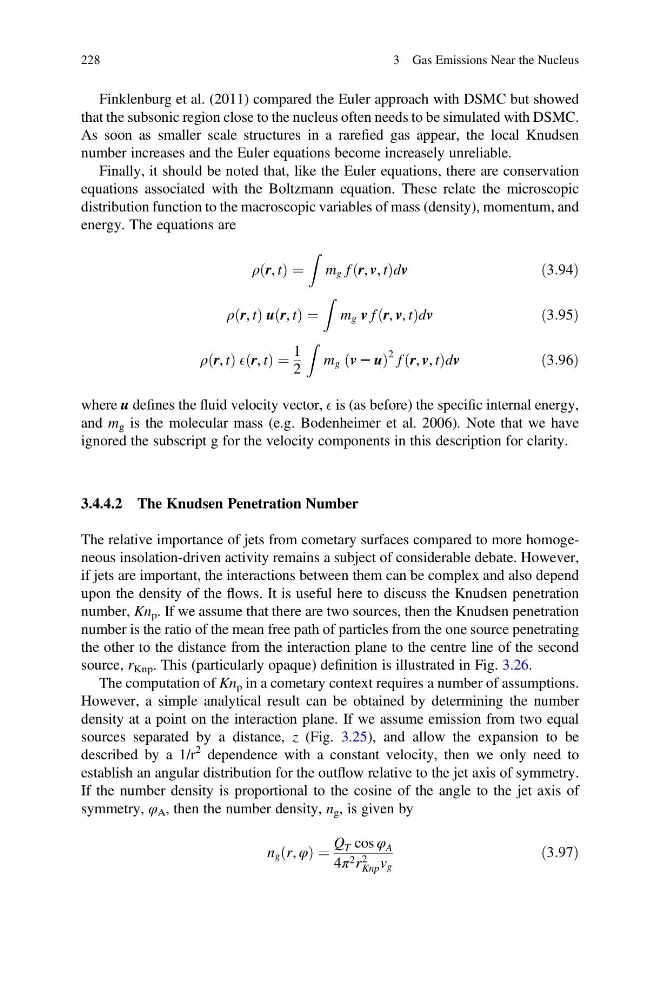
equations associated with the Boltzmann equation. These relate the microscopic
distribution function to the macroscopic variables of mass (density), momentum, and
energy. The equations are
ρ r, t
ð Þ ¼
Z
m g f r, v, t
ð
Þdv
ð3:94Þ
ρ r, t
ð Þ u r, t
ð Þ ¼
Z
m g v f r, v, t
ð
Þdv
ð3:95Þ
ρ r, t
ð Þ E r, t
ð Þ ¼
1
2
Z
m g v 2 u
ð
Þ
2 f r, v, t
ð
Þdv
ð3:96Þ
where u defines the fluid velocity vector, E is (as before) the specific internal energy,
and m g is the molecular mass (e.g. Bodenheimer et al. 2006). Note that we have
ignored the subscript g for the velocity components in this description for clarity.
3.4.4.2 The Knudsen Penetration Number
The relative importance of jets from cometary surfaces compared to more homogeneous insolation-driven activity remains a subject of considerable debate. However,
if jets are important, the interactions between them can be complex and also depend
upon the density of the flows. It is useful here to discuss the Knudsen penetration
number, Kn p . If we assume that there are two sources, then the Knudsen penetration
number is the ratio of the mean free path of particles from the one source penetrating
the other to the distance from the interaction plane to the centre line of the second
source, r Knp . This (particularly opaque) definition is illustrated in Fig. 3.26.
The computation of Kn p in a cometary context requires a number of assumptions.
However, a simple analytical result can be obtained by determining the number
density at a point on the interaction plane. If we assume emission from two equal
sources separated by a distance, z (Fig. 3.25), and allow the expansion to be
described by a 1/r
2 dependence with a constant velocity, then we only need to
establish an angular distribution for the outflow relative to the jet axis of symmetry.
If the number density is proportional to the cosine of the angle to the jet axis of
symmetry, φ A , then the number density, n g , is given by
n g r, φ
ð Þ ¼
Q T cos φ A
4π 2 r 2
Knp v g
ð3:97Þ
228
3 Gas Emissions Near the Nucleus
that the subsonic region close to the nucleus often needs to be simulated with DSMC.
As soon as smaller scale structures in a rarefied gas appear, the local Knudsen
number increases and the Euler equations become increasely unreliable.
Finally, it should be noted that, like the Euler equations, there are conservation
equations associated with the Boltzmann equation. These relate the microscopic
distribution function to the macroscopic variables of mass (density), momentum, and
energy. The equations are
ρ r, t
ð Þ ¼
Z
m g f r, v, t
ð
Þdv
ð3:94Þ
ρ r, t
ð Þ u r, t
ð Þ ¼
Z
m g v f r, v, t
ð
Þdv
ð3:95Þ
ρ r, t
ð Þ E r, t
ð Þ ¼
1
2
Z
m g v 2 u
ð
Þ
2 f r, v, t
ð
Þdv
ð3:96Þ
where u defines the fluid velocity vector, E is (as before) the specific internal energy,
and m g is the molecular mass (e.g. Bodenheimer et al. 2006). Note that we have
ignored the subscript g for the velocity components in this description for clarity.
3.4.4.2 The Knudsen Penetration Number
The relative importance of jets from cometary surfaces compared to more homogeneous insolation-driven activity remains a subject of considerable debate. However,
if jets are important, the interactions between them can be complex and also depend
upon the density of the flows. It is useful here to discuss the Knudsen penetration
number, Kn p . If we assume that there are two sources, then the Knudsen penetration
number is the ratio of the mean free path of particles from the one source penetrating
the other to the distance from the interaction plane to the centre line of the second
source, r Knp . This (particularly opaque) definition is illustrated in Fig. 3.26.
The computation of Kn p in a cometary context requires a number of assumptions.
However, a simple analytical result can be obtained by determining the number
density at a point on the interaction plane. If we assume emission from two equal
sources separated by a distance, z (Fig. 3.25), and allow the expansion to be
described by a 1/r
2 dependence with a constant velocity, then we only need to
establish an angular distribution for the outflow relative to the jet axis of symmetry.
If the number density is proportional to the cosine of the angle to the jet axis of
symmetry, φ A , then the number density, n g , is given by
n g r, φ
ð Þ ¼
Q T cos φ A
4π 2 r 2
Knp v g
ð3:97Þ
228
3 Gas Emissions Near the Nucleus