

here the technique used to determine the water vapour in a column between the
nucleus and the MIRO instrument on Rosetta (e.g. Fig. 3.4). The water vapour could
be a cold gas illuminated from behind by a warmer nucleus source if the nucleus is in
the field of view. Secondly, the cooling rate is dependent upon the number of degrees
of freedom of the gas. CO 2 may be initially colder when subliming from the surface
because its free sublimation temperature is lower than that of water. However, it also
cools more quickly as there is, relatively, less energy in the rotational degrees of
freedom. Thirdly, the expansion and velocity increase leads to a density drop with
distance that is far faster than the 1/r
2 expected from force-free radial outflow. This
density drop is close to being independent of the species in the fluid case.
The absence of collisions in the free molecular flow regime allows simplification.
The equation for force-free radial outflow from a point source (Eq. 3.1) was shown at
the beginning of this section. However, despite this being counter-intuitive, this
equation does not give the same result as free expansion from a finite, homogeneously subliming, sphere as was demonstrated analytically by Sone and Sugimoto
(1993). The solutions were calculated relative to an imaginary sub-surface reservoir
of gas molecules with a temperature, T 0 and a number density, n 0 . The number
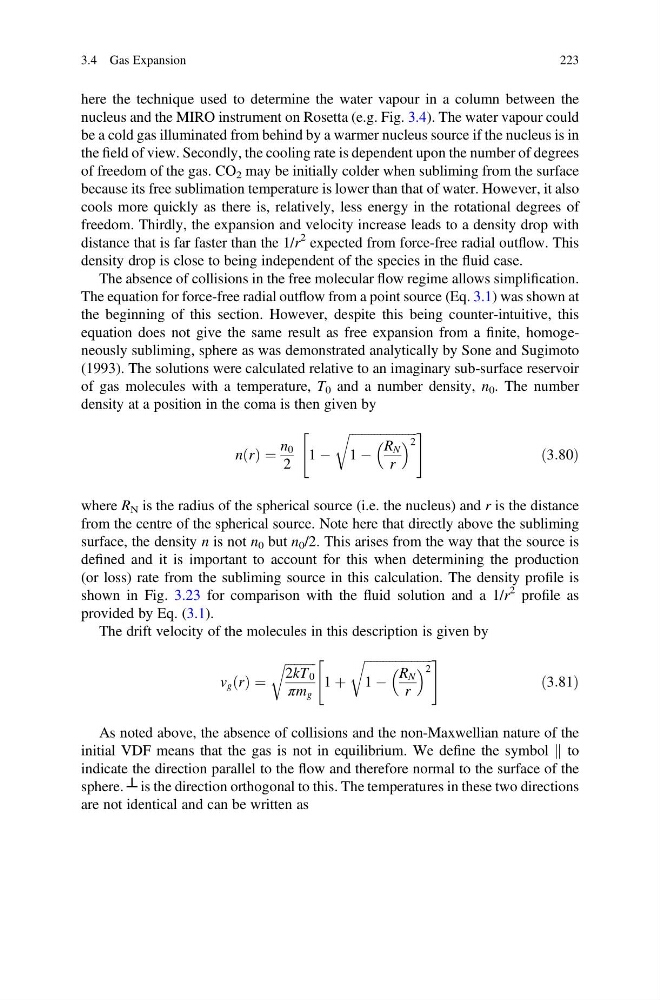
density at a position in the coma is then given by
n r
ð Þ ¼
n 0
2
1 À
ffiffiffiffiffiffiffiffiffiffiffiffiffiffiffiffiffiffiffiffiffi ffi
1 À
R N
r
2
r
"
#
ð3:80Þ
where R N is the radius of the spherical source (i.e. the nucleus) and r is the distance
from the centre of the spherical source. Note here that directly above the subliming
surface, the density n is not n 0 but n 0 /2. This arises from the way that the source is
defined and it is important to account for this when determining the production
(or loss) rate from the subliming source in this calculation. The density profile is
shown in Fig. 3.23 for comparison with the fluid solution and a 1/r
2 profile as
provided by Eq. (3.1).
The drift velocity of the molecules in this description is given by
v g r
ð Þ ¼
ffiffiffiffiffiffiffiffiffiffi
2kT 0
πm g
r
1 þ
ffiffiffiffiffiffiffiffiffiffiffiffiffiffiffiffiffiffiffiffiffi ffi
1 À
R N
r
2
r
"
#
ð3:81Þ
As noted above, the absence of collisions and the non-Maxwellian nature of the
initial VDF means that the gas is not in equilibrium. We define the symbol k to
indicate the direction parallel to the flow and therefore normal to the surface of the
sphere. ┴ is the direction orthogonal to this. The temperatures in these two directions
are not identical and can be written as
3.4 Gas Expansion
223
nucleus and the MIRO instrument on Rosetta (e.g. Fig. 3.4). The water vapour could
be a cold gas illuminated from behind by a warmer nucleus source if the nucleus is in
the field of view. Secondly, the cooling rate is dependent upon the number of degrees
of freedom of the gas. CO 2 may be initially colder when subliming from the surface
because its free sublimation temperature is lower than that of water. However, it also
cools more quickly as there is, relatively, less energy in the rotational degrees of
freedom. Thirdly, the expansion and velocity increase leads to a density drop with
distance that is far faster than the 1/r
2 expected from force-free radial outflow. This
density drop is close to being independent of the species in the fluid case.
The absence of collisions in the free molecular flow regime allows simplification.
The equation for force-free radial outflow from a point source (Eq. 3.1) was shown at
the beginning of this section. However, despite this being counter-intuitive, this
equation does not give the same result as free expansion from a finite, homogeneously subliming, sphere as was demonstrated analytically by Sone and Sugimoto
(1993). The solutions were calculated relative to an imaginary sub-surface reservoir
of gas molecules with a temperature, T 0 and a number density, n 0 . The number
density at a position in the coma is then given by
n r
ð Þ ¼
n 0
2
1 À
ffiffiffiffiffiffiffiffiffiffiffiffiffiffiffiffiffiffiffiffiffi ffi
1 À
R N
r
2
r
"
#
ð3:80Þ
where R N is the radius of the spherical source (i.e. the nucleus) and r is the distance
from the centre of the spherical source. Note here that directly above the subliming
surface, the density n is not n 0 but n 0 /2. This arises from the way that the source is
defined and it is important to account for this when determining the production
(or loss) rate from the subliming source in this calculation. The density profile is
shown in Fig. 3.23 for comparison with the fluid solution and a 1/r
2 profile as
provided by Eq. (3.1).
The drift velocity of the molecules in this description is given by
v g r
ð Þ ¼
ffiffiffiffiffiffiffiffiffiffi
2kT 0
πm g
r
1 þ
ffiffiffiffiffiffiffiffiffiffiffiffiffiffiffiffiffiffiffiffiffi ffi
1 À
R N
r
2
r
"
#
ð3:81Þ
As noted above, the absence of collisions and the non-Maxwellian nature of the
initial VDF means that the gas is not in equilibrium. We define the symbol k to
indicate the direction parallel to the flow and therefore normal to the surface of the
sphere. ┴ is the direction orthogonal to this. The temperatures in these two directions
are not identical and can be written as
3.4 Gas Expansion
223