

r
R N
¼
6 þ Ma
2
7
7
4
1
ffiffiffiffiffiffi ffi
Ma
p
ð3:75Þ
n g
n g
à ¼
7
6 þ Ma
2
3
ð3:76Þ
T
T
à ¼
7
6 þ Ma
2
ð3:77Þ
and using
Ma ¼ v
Ã
g ¼
ffiffiffiffiffiffiffiffiffiffiffiffi ffi
γ
k
m
T
Ã
r
ð3:78Þ
v g
ffiffiffiffiffiffiffiffiffiffiffi ffi
2
k
m T
Ã
q
¼
ffiffi ffi
2
3
r
Ma
ffiffiffiffiffiffiffiffiffiffiffiffiffiffiffiffiffi
7
6 þ Ma
2
r
¼ Ma
ffiffiffiffiffiffiffiffiffiffiffiffiffiffiffiffiffiffiffiffiffiffiffi ffi
14
3 6 þ Ma
2
À
Á
s
ð3:79Þ
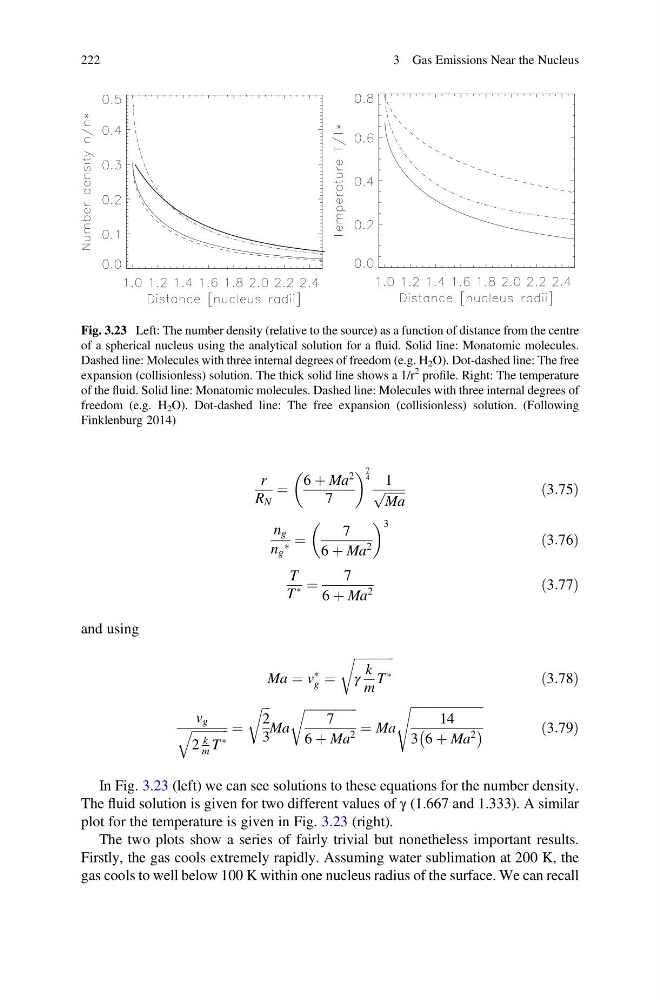
In Fig. 3.23 (left) we can see solutions to these equations for the number density.
The fluid solution is given for two different values of γ (1.667 and 1.333). A similar
plot for the temperature is given in Fig. 3.23 (right).
The two plots show a series of fairly trivial but nonetheless important results.
Firstly, the gas cools extremely rapidly. Assuming water sublimation at 200 K, the
gas cools to well below 100 K within one nucleus radius of the surface. We can recall
Fig. 3.23 Left: The number density (relative to the source) as a function of distance from the centre
of a spherical nucleus using the analytical solution for a fluid. Solid line: Monatomic molecules.
Dashed line: Molecules with three internal degrees of freedom (e.g. H 2 O). Dot-dashed line: The free
expansion (collisionless) solution. The thick solid line shows a 1/r
2 profile. Right: The temperature
of the fluid. Solid line: Monatomic molecules. Dashed line: Molecules with three internal degrees of
freedom (e.g. H 2 O). Dot-dashed line: The free expansion (collisionless) solution. (Following
Finklenburg 2014)
222
3 Gas Emissions Near the Nucleus
R N
¼
6 þ Ma
2
7
7
4
1
ffiffiffiffiffiffi ffi
Ma
p
ð3:75Þ
n g
n g
à ¼
7
6 þ Ma
2
3
ð3:76Þ
T
T
à ¼
7
6 þ Ma
2
ð3:77Þ
and using
Ma ¼ v
Ã
g ¼
ffiffiffiffiffiffiffiffiffiffiffiffi ffi
γ
k
m
T
Ã
r
ð3:78Þ
v g
ffiffiffiffiffiffiffiffiffiffiffi ffi
2
k
m T
Ã
q
¼
ffiffi ffi
2
3
r
Ma
ffiffiffiffiffiffiffiffiffiffiffiffiffiffiffiffiffi
7
6 þ Ma
2
r
¼ Ma
ffiffiffiffiffiffiffiffiffiffiffiffiffiffiffiffiffiffiffiffiffiffiffi ffi
14
3 6 þ Ma
2
À
Á
s
ð3:79Þ
In Fig. 3.23 (left) we can see solutions to these equations for the number density.
The fluid solution is given for two different values of γ (1.667 and 1.333). A similar
plot for the temperature is given in Fig. 3.23 (right).
The two plots show a series of fairly trivial but nonetheless important results.
Firstly, the gas cools extremely rapidly. Assuming water sublimation at 200 K, the
gas cools to well below 100 K within one nucleus radius of the surface. We can recall
Fig. 3.23 Left: The number density (relative to the source) as a function of distance from the centre
of a spherical nucleus using the analytical solution for a fluid. Solid line: Monatomic molecules.
Dashed line: Molecules with three internal degrees of freedom (e.g. H 2 O). Dot-dashed line: The free
expansion (collisionless) solution. The thick solid line shows a 1/r
2 profile. Right: The temperature
of the fluid. Solid line: Monatomic molecules. Dashed line: Molecules with three internal degrees of
freedom (e.g. H 2 O). Dot-dashed line: The free expansion (collisionless) solution. (Following
Finklenburg 2014)
222
3 Gas Emissions Near the Nucleus