

where v 1 is the terminal velocity, and can partially account for this effect. This
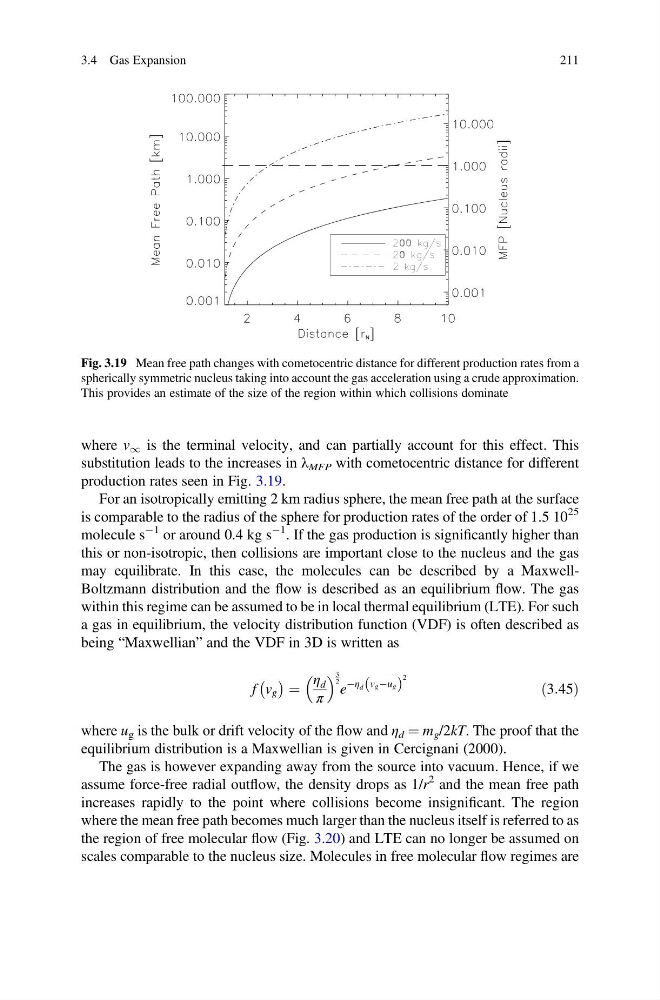
substitution leads to the increases in λ MFP with cometocentric distance for different
production rates seen in Fig. 3.19.
For an isotropically emitting 2 km radius sphere, the mean free path at the surface
is comparable to the radius of the sphere for production rates of the order of 1.5 10
25
molecule s
À1 or around 0.4 kg s
À1 . If the gas production is significantly higher than
this or non-isotropic, then collisions are important close to the nucleus and the gas
may equilibrate. In this case, the molecules can be described by a MaxwellBoltzmann distribution and the flow is described as an equilibrium flow. The gas
within this regime can be assumed to be in local thermal equilibrium (LTE). For such
a gas in equilibrium, the velocity distribution function (VDF) is often described as
being “Maxwellian” and the VDF in 3D is written as
f v g
À Á ¼
η d
π
3
2 e
Àη d v g Àu g
ð
Þ
2
ð3:45Þ
where u g is the bulk or drift velocity of the flow and η d ¼ m g /2kT. The proof that the
equilibrium distribution is a Maxwellian is given in Cercignani (2000).
The gas is however expanding away from the source into vacuum. Hence, if we
assume force-free radial outflow, the density drops as 1/r
2 and the mean free path
increases rapidly to the point where collisions become insignificant. The region
where the mean free path becomes much larger than the nucleus itself is referred to as
the region of free molecular flow (Fig. 3.20) and LTE can no longer be assumed on
scales comparable to the nucleus size. Molecules in free molecular flow regimes are
Fig. 3.19 Mean free path changes with cometocentric distance for different production rates from a
spherically symmetric nucleus taking into account the gas acceleration using a crude approximation.
This provides an estimate of the size of the region within which collisions dominate
3.4 Gas Expansion
211
substitution leads to the increases in λ MFP with cometocentric distance for different
production rates seen in Fig. 3.19.
For an isotropically emitting 2 km radius sphere, the mean free path at the surface
is comparable to the radius of the sphere for production rates of the order of 1.5 10
25
molecule s
À1 or around 0.4 kg s
À1 . If the gas production is significantly higher than
this or non-isotropic, then collisions are important close to the nucleus and the gas
may equilibrate. In this case, the molecules can be described by a MaxwellBoltzmann distribution and the flow is described as an equilibrium flow. The gas
within this regime can be assumed to be in local thermal equilibrium (LTE). For such
a gas in equilibrium, the velocity distribution function (VDF) is often described as
being “Maxwellian” and the VDF in 3D is written as
f v g
À Á ¼
η d
π
3
2 e
Àη d v g Àu g
ð
Þ
2
ð3:45Þ
where u g is the bulk or drift velocity of the flow and η d ¼ m g /2kT. The proof that the
equilibrium distribution is a Maxwellian is given in Cercignani (2000).
The gas is however expanding away from the source into vacuum. Hence, if we
assume force-free radial outflow, the density drops as 1/r
2 and the mean free path
increases rapidly to the point where collisions become insignificant. The region
where the mean free path becomes much larger than the nucleus itself is referred to as
the region of free molecular flow (Fig. 3.20) and LTE can no longer be assumed on
scales comparable to the nucleus size. Molecules in free molecular flow regimes are
Fig. 3.19 Mean free path changes with cometocentric distance for different production rates from a
spherically symmetric nucleus taking into account the gas acceleration using a crude approximation.
This provides an estimate of the size of the region within which collisions dominate
3.4 Gas Expansion
211