

thorough analysis, attributed this to fluorescence emission of two hot bands of CO 2
and emission from the isotopologue,
13 CO 2 (
16 O
13 C
16 O).
3.3 Minor Species
Table 3.1 shows some of the species found by the ROSINA instrument at 67P
(Le Roy et al. 2015; Rubin et al. 2019). Additional analysis of the mass spectrometer
data is still on-going. In situ mass spectrometry provides the primary means of
determining the parent species and the very high sensitivity allows identification of
many molecules although some care is needed. For larger molecules, the ion source
used to ionize the molecules coming into the experiment may also split the molecules
leading to confusion with less complex molecules. However, testing on ground can
be used to establish the branching ratios of the various fragmentation patterns (Gasc
et al. 2017). Despite this, other spaceborne techniques are still useful. Infrared
spectroscopy for example was used at 1P/Halley from onboard the Russian Vega
spacecraft and Combes et al. (1988) reported not only detection of the major species
(H 2 O, CO 2 , and CO) but also suggested that H 2 CO was present and possibly OCS.
The advantage of such detections is that, in the best case, spatial distributions can be
determined.
Detections from ground-based remote-sensing are also of importance and a
summary of discovered molecules has been provided by Bockelée-Morvan and
Biver (2017). In Fig. 3.18, a comparison of the ground-based measurements (from
many comets) with those obtained by ROSINA at 67P is made. With some exceptions (notably ammonia), the agreement is rather good. The comet detections are in
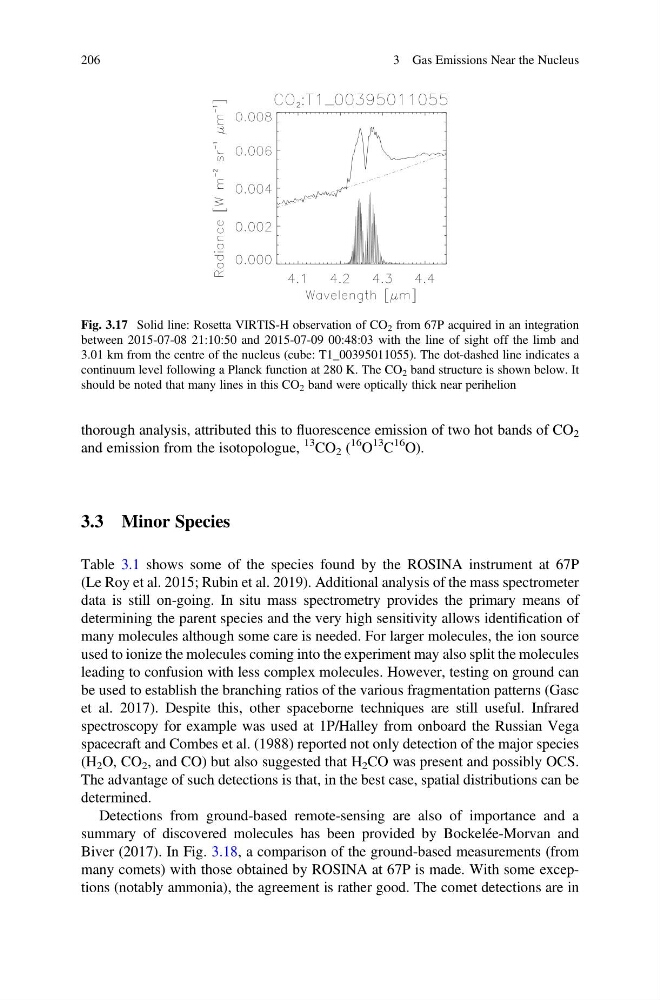
Fig. 3.17 Solid line: Rosetta VIRTIS-H observation of CO 2 from 67P acquired in an integration
between 2015-07-08 21:10:50 and 2015-07-09 00:48:03 with the line of sight off the limb and
3.01 km from the centre of the nucleus (cube: T1_00395011055). The dot-dashed line indicates a
continuum level following a Planck function at 280 K. The CO 2 band structure is shown below. It
should be noted that many lines in this CO 2 band were optically thick near perihelion
206
3 Gas Emissions Near the Nucleus
and emission from the isotopologue,
13 CO 2 (
16 O
13 C
16 O).
3.3 Minor Species
Table 3.1 shows some of the species found by the ROSINA instrument at 67P
(Le Roy et al. 2015; Rubin et al. 2019). Additional analysis of the mass spectrometer
data is still on-going. In situ mass spectrometry provides the primary means of
determining the parent species and the very high sensitivity allows identification of
many molecules although some care is needed. For larger molecules, the ion source
used to ionize the molecules coming into the experiment may also split the molecules
leading to confusion with less complex molecules. However, testing on ground can
be used to establish the branching ratios of the various fragmentation patterns (Gasc
et al. 2017). Despite this, other spaceborne techniques are still useful. Infrared
spectroscopy for example was used at 1P/Halley from onboard the Russian Vega
spacecraft and Combes et al. (1988) reported not only detection of the major species
(H 2 O, CO 2 , and CO) but also suggested that H 2 CO was present and possibly OCS.
The advantage of such detections is that, in the best case, spatial distributions can be
determined.
Detections from ground-based remote-sensing are also of importance and a
summary of discovered molecules has been provided by Bockelée-Morvan and
Biver (2017). In Fig. 3.18, a comparison of the ground-based measurements (from
many comets) with those obtained by ROSINA at 67P is made. With some exceptions (notably ammonia), the agreement is rather good. The comet detections are in
Fig. 3.17 Solid line: Rosetta VIRTIS-H observation of CO 2 from 67P acquired in an integration
between 2015-07-08 21:10:50 and 2015-07-09 00:48:03 with the line of sight off the limb and
3.01 km from the centre of the nucleus (cube: T1_00395011055). The dot-dashed line indicates a
continuum level following a Planck function at 280 K. The CO 2 band structure is shown below. It
should be noted that many lines in this CO 2 band were optically thick near perihelion
206
3 Gas Emissions Near the Nucleus