

emission from the Earth’s surface making it an important transition for studies of the
Earth’s greenhouse effect.
In the case of water vapour, the symmetric stretch is active because the molecule
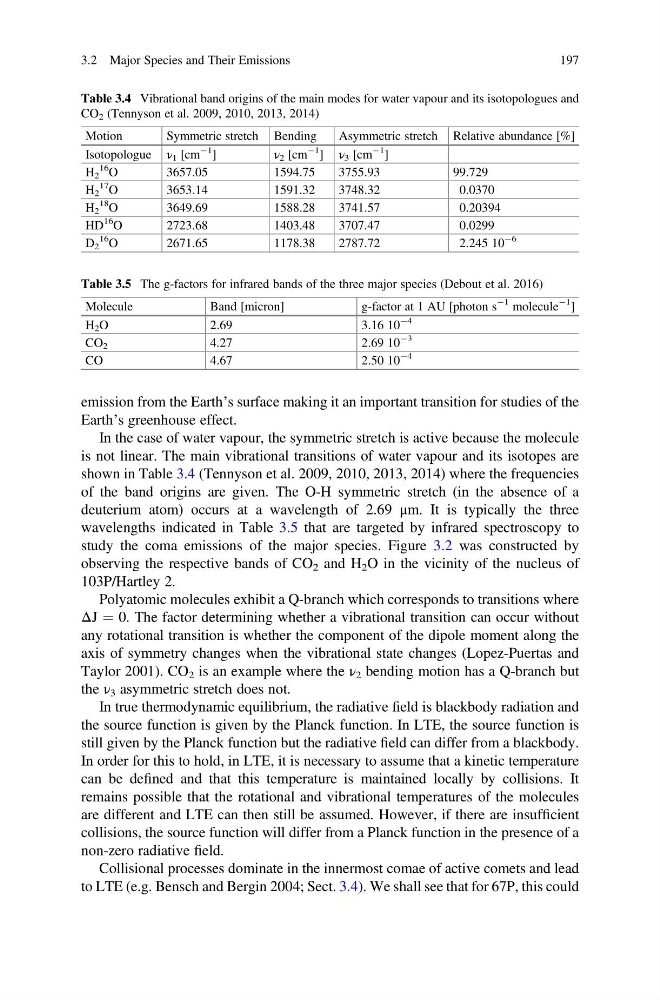
is not linear. The main vibrational transitions of water vapour and its isotopes are
shown in Table 3.4 (Tennyson et al. 2009, 2010, 2013, 2014) where the frequencies
of the band origins are given. The O-H symmetric stretch (in the absence of a
deuterium atom) occurs at a wavelength of 2.69 μm. It is typically the three
wavelengths indicated in Table 3.5 that are targeted by infrared spectroscopy to
study the coma emissions of the major species. Figure 3.2 was constructed by
observing the respective bands of CO 2 and H 2 O in the vicinity of the nucleus of
103P/Hartley 2.
Polyatomic molecules exhibit a Q-branch which corresponds to transitions where
ΔJ ¼ 0. The factor determining whether a vibrational transition can occur without
any rotational transition is whether the component of the dipole moment along the
axis of symmetry changes when the vibrational state changes (Lopez-Puertas and
Taylor 2001). CO 2 is an example where the ν 2 bending motion has a Q-branch but
the ν 3 asymmetric stretch does not.
In true thermodynamic equilibrium, the radiative field is blackbody radiation and
the source function is given by the Planck function. In LTE, the source function is
still given by the Planck function but the radiative field can differ from a blackbody.
In order for this to hold, in LTE, it is necessary to assume that a kinetic temperature
can be defined and that this temperature is maintained locally by collisions. It
remains possible that the rotational and vibrational temperatures of the molecules
are different and LTE can then still be assumed. However, if there are insufficient
collisions, the source function will differ from a Planck function in the presence of a
non-zero radiative field.
Collisional processes dominate in the innermost comae of active comets and lead
to LTE (e.g. Bensch and Bergin 2004; Sect. 3.4). We shall see that for 67P, this could
Table 3.4 Vibrational band origins of the main modes for water vapour and its isotopologues and
CO 2 (Tennyson et al. 2009, 2010, 2013, 2014)
Motion
Symmetric stretch Bending
Asymmetric stretch Relative abundance [%]
Isotopologue ν 1 [cm
À1
]
ν 2 [cm
À1
] ν 3 [cm
À1
]
H 2
16
O
3657.05
1594.75
3755.93
99.729
H 2
17
O
3653.14
1591.32
3748.32
0.0370
H 2
18
O
3649.69
1588.28
3741.57
0.20394
HD
16
O
2723.68
1403.48
3707.47
0.0299
D 2
16
O
2671.65
1178.38
2787.72
2.245 10
À6
Table 3.5 The g-factors for infrared bands of the three major species (Debout et al. 2016)
Molecule
Band [micron]
g-factor at 1 AU [photon s
À1 molecule
À1
]
H 2 O
2.69
3.16 10
À4
CO 2
4.27
2.69 10
À3
CO
4.67
2.50 10
À4
3.2 Major Species and Their Emissions
197
Earth’s greenhouse effect.
In the case of water vapour, the symmetric stretch is active because the molecule
is not linear. The main vibrational transitions of water vapour and its isotopes are
shown in Table 3.4 (Tennyson et al. 2009, 2010, 2013, 2014) where the frequencies
of the band origins are given. The O-H symmetric stretch (in the absence of a
deuterium atom) occurs at a wavelength of 2.69 μm. It is typically the three
wavelengths indicated in Table 3.5 that are targeted by infrared spectroscopy to
study the coma emissions of the major species. Figure 3.2 was constructed by
observing the respective bands of CO 2 and H 2 O in the vicinity of the nucleus of
103P/Hartley 2.
Polyatomic molecules exhibit a Q-branch which corresponds to transitions where
ΔJ ¼ 0. The factor determining whether a vibrational transition can occur without
any rotational transition is whether the component of the dipole moment along the
axis of symmetry changes when the vibrational state changes (Lopez-Puertas and
Taylor 2001). CO 2 is an example where the ν 2 bending motion has a Q-branch but
the ν 3 asymmetric stretch does not.
In true thermodynamic equilibrium, the radiative field is blackbody radiation and
the source function is given by the Planck function. In LTE, the source function is
still given by the Planck function but the radiative field can differ from a blackbody.
In order for this to hold, in LTE, it is necessary to assume that a kinetic temperature
can be defined and that this temperature is maintained locally by collisions. It
remains possible that the rotational and vibrational temperatures of the molecules
are different and LTE can then still be assumed. However, if there are insufficient
collisions, the source function will differ from a Planck function in the presence of a
non-zero radiative field.
Collisional processes dominate in the innermost comae of active comets and lead
to LTE (e.g. Bensch and Bergin 2004; Sect. 3.4). We shall see that for 67P, this could
Table 3.4 Vibrational band origins of the main modes for water vapour and its isotopologues and
CO 2 (Tennyson et al. 2009, 2010, 2013, 2014)
Motion
Symmetric stretch Bending
Asymmetric stretch Relative abundance [%]
Isotopologue ν 1 [cm
À1
]
ν 2 [cm
À1
] ν 3 [cm
À1
]
H 2
16
O
3657.05
1594.75
3755.93
99.729
H 2
17
O
3653.14
1591.32
3748.32
0.0370
H 2
18
O
3649.69
1588.28
3741.57
0.20394
HD
16
O
2723.68
1403.48
3707.47
0.0299
D 2
16
O
2671.65
1178.38
2787.72
2.245 10
À6
Table 3.5 The g-factors for infrared bands of the three major species (Debout et al. 2016)
Molecule
Band [micron]
g-factor at 1 AU [photon s
À1 molecule
À1
]
H 2 O
2.69
3.16 10
À4
CO 2
4.27
2.69 10
À3
CO
4.67
2.50 10
À4
3.2 Major Species and Their Emissions
197