

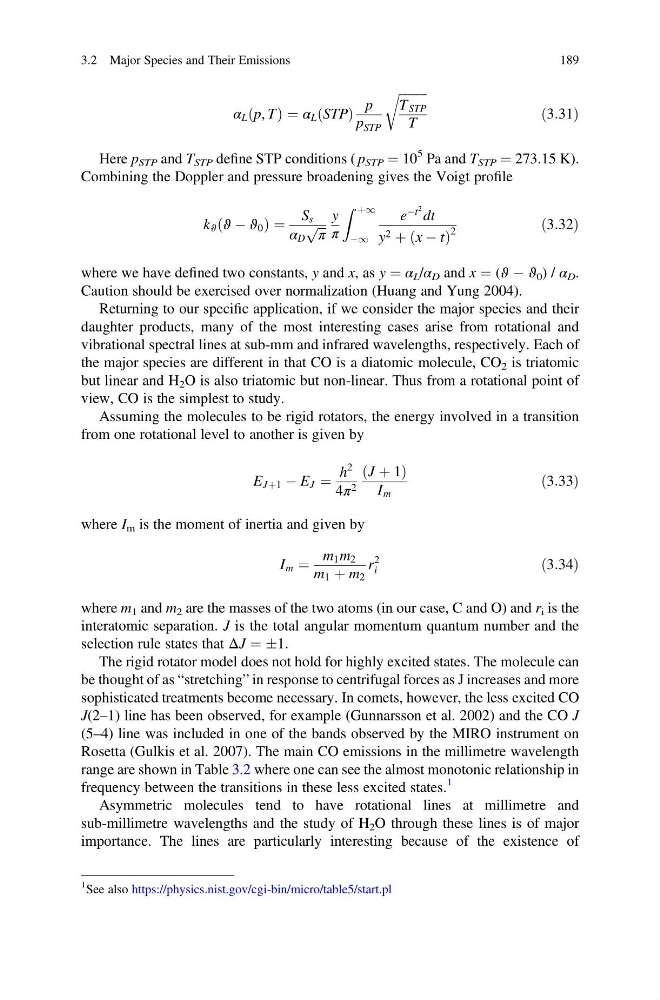
α L p, T
ð
Þ ¼ α L STP
ð
Þ
p
p STP
ffiffiffiffiffiffiffiffiffi
T STP
T
r
ð3:31Þ
Here p STP and T STP define STP conditions ( p STP ¼ 10
5 Pa and T STP ¼ 273.15 K).
Combining the Doppler and pressure broadening gives the Voigt profile
k ϑ ϑ À ϑ 0
ð
Þ¼
S s
α D
ffiffiffi
π
p
y
π
Z þ1
À1
e
Àt
2 dt
y 2 þ x À t
ð
Þ
2
ð3:32Þ
where we have defined two constants, y and x, as y ¼ α L /α D and x ¼ (ϑ À ϑ 0 ) / α D .
Caution should be exercised over normalization (Huang and Yung 2004).
Returning to our specific application, if we consider the major species and their
daughter products, many of the most interesting cases arise from rotational and
vibrational spectral lines at sub-mm and infrared wavelengths, respectively. Each of
the major species are different in that CO is a diatomic molecule, CO 2 is triatomic
but linear and H 2 O is also triatomic but non-linear. Thus from a rotational point of
view, CO is the simplest to study.
Assuming the molecules to be rigid rotators, the energy involved in a transition
from one rotational level to another is given by
E Jþ1 À E J ¼
h
2
4π 2
J þ 1
ð
Þ
I m
ð3:33Þ
where I m is the moment of inertia and given by
I m ¼
m 1 m 2
m 1 þ m 2
r
2
i
ð3:34Þ
where m 1 and m 2 are the masses of the two atoms (in our case, C and O) and r i is the
interatomic separation. J is the total angular momentum quantum number and the
selection rule states that ΔJ ¼ Æ1.
The rigid rotator model does not hold for highly excited states. The molecule can
be thought of as “stretching” in response to centrifugal forces as J increases and more
sophisticated treatments become necessary. In comets, however, the less excited CO
J(2–1) line has been observed, for example (Gunnarsson et al. 2002) and the CO J
(5–4) line was included in one of the bands observed by the MIRO instrument on
Rosetta (Gulkis et al. 2007). The main CO emissions in the millimetre wavelength
range are shown in Table 3.2 where one can see the almost monotonic relationship in
frequency between the transitions in these less excited states.
1
Asymmetric molecules tend to have rotational lines at millimetre and
sub-millimetre wavelengths and the study of H 2 O through these lines is of major
importance. The lines are particularly interesting because of the existence of
1 See also https://physics.nist.gov/cgi-bin/micro/table5/start.pl
3.2 Major Species and Their Emissions
189
ð
Þ ¼ α L STP
ð
Þ
p
p STP
ffiffiffiffiffiffiffiffiffi
T STP
T
r
ð3:31Þ
Here p STP and T STP define STP conditions ( p STP ¼ 10
5 Pa and T STP ¼ 273.15 K).
Combining the Doppler and pressure broadening gives the Voigt profile
k ϑ ϑ À ϑ 0
ð
Þ¼
S s
α D
ffiffiffi
π
p
y
π
Z þ1
À1
e
Àt
2 dt
y 2 þ x À t
ð
Þ
2
ð3:32Þ
where we have defined two constants, y and x, as y ¼ α L /α D and x ¼ (ϑ À ϑ 0 ) / α D .
Caution should be exercised over normalization (Huang and Yung 2004).
Returning to our specific application, if we consider the major species and their
daughter products, many of the most interesting cases arise from rotational and
vibrational spectral lines at sub-mm and infrared wavelengths, respectively. Each of
the major species are different in that CO is a diatomic molecule, CO 2 is triatomic
but linear and H 2 O is also triatomic but non-linear. Thus from a rotational point of
view, CO is the simplest to study.
Assuming the molecules to be rigid rotators, the energy involved in a transition
from one rotational level to another is given by
E Jþ1 À E J ¼
h
2
4π 2
J þ 1
ð
Þ
I m
ð3:33Þ
where I m is the moment of inertia and given by
I m ¼
m 1 m 2
m 1 þ m 2
r
2
i
ð3:34Þ
where m 1 and m 2 are the masses of the two atoms (in our case, C and O) and r i is the
interatomic separation. J is the total angular momentum quantum number and the
selection rule states that ΔJ ¼ Æ1.
The rigid rotator model does not hold for highly excited states. The molecule can
be thought of as “stretching” in response to centrifugal forces as J increases and more
sophisticated treatments become necessary. In comets, however, the less excited CO
J(2–1) line has been observed, for example (Gunnarsson et al. 2002) and the CO J
(5–4) line was included in one of the bands observed by the MIRO instrument on
Rosetta (Gulkis et al. 2007). The main CO emissions in the millimetre wavelength
range are shown in Table 3.2 where one can see the almost monotonic relationship in
frequency between the transitions in these less excited states.
1
Asymmetric molecules tend to have rotational lines at millimetre and
sub-millimetre wavelengths and the study of H 2 O through these lines is of major
importance. The lines are particularly interesting because of the existence of
1 See also https://physics.nist.gov/cgi-bin/micro/table5/start.pl
3.2 Major Species and Their Emissions
189