

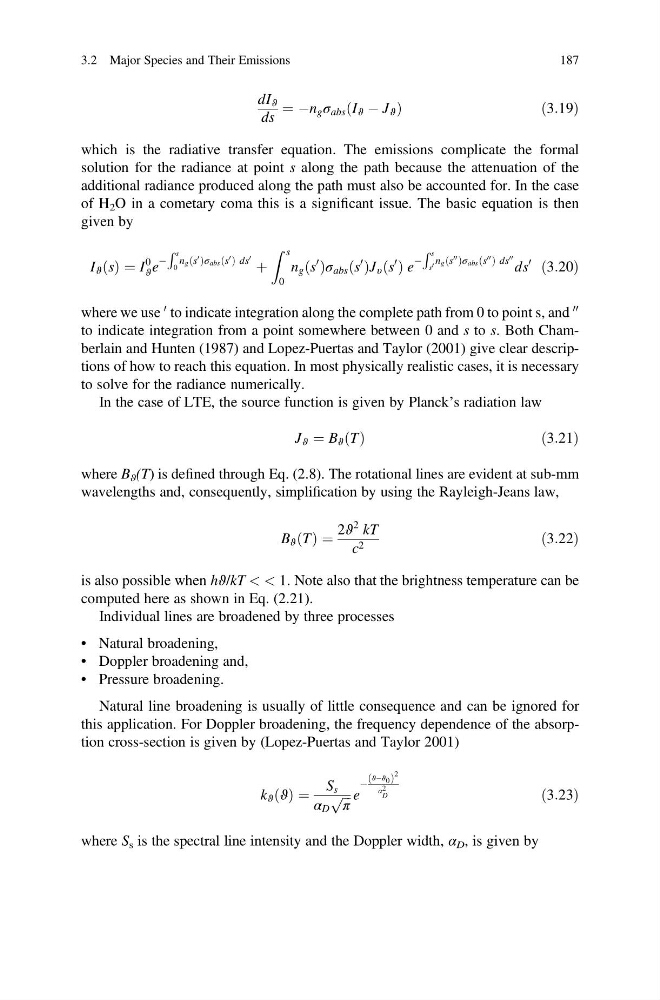
dI ϑ
ds
¼ Àn g σ abs I ϑ À J ϑ
ð
Þ
ð3:19Þ
which is the radiative transfer equation. The emissions complicate the formal
solution for the radiance at point s along the path because the attenuation of the
additional radiance produced along the path must also be accounted for. In the case
of H 2 O in a cometary coma this is a significant issue. The basic equation is then
given by
I ϑ s
ð Þ ¼ I
0
ϑ e
À
R s
0
n g s
0
ð Þσ abs s
0
ð Þ ds
0 þ
Z s
0
n g s
0
ð Þσ abs s
0
ð ÞJ υ s
0
ð Þ e
À
R s
s 0
n g s
00
ð Þσ abs s
00
ð Þ ds
00
ds
0
ð3:20Þ
where we use
0 to indicate integration along the complete path from 0 to point s, and
00
to indicate integration from a point somewhere between 0 and s to s. Both Chamberlain and Hunten (1987) and Lopez-Puertas and Taylor (2001) give clear descriptions of how to reach this equation. In most physically realistic cases, it is necessary
to solve for the radiance numerically.
In the case of LTE, the source function is given by Planck’s radiation law
J ϑ ¼ B ϑ T
ð Þ
ð3:21Þ
where B ϑ (T) is defined through Eq. (2.8). The rotational lines are evident at sub-mm
wavelengths and, consequently, simplification by using the Rayleigh-Jeans law,
B ϑ T
ð Þ ¼
2ϑ
2 kT
c 2
ð3:22Þ
is also possible when hϑ/kT < < 1. Note also that the brightness temperature can be
computed here as shown in Eq. (2.21).
Individual lines are broadened by three processes
• Natural broadening,
• Doppler broadening and,
• Pressure broadening.
Natural line broadening is usually of little consequence and can be ignored for
this application. For Doppler broadening, the frequency dependence of the absorption cross-section is given by (Lopez-Puertas and Taylor 2001)
k ϑ ϑ
ð Þ ¼
S s
α D
ffiffiffi
π
p e
À
ϑÀϑ 0
ð
Þ
2
α 2
D
ð3:23Þ
where S s is the spectral line intensity and the Doppler width, α D , is given by
3.2 Major Species and Their Emissions
187
ds
¼ Àn g σ abs I ϑ À J ϑ
ð
Þ
ð3:19Þ
which is the radiative transfer equation. The emissions complicate the formal
solution for the radiance at point s along the path because the attenuation of the
additional radiance produced along the path must also be accounted for. In the case
of H 2 O in a cometary coma this is a significant issue. The basic equation is then
given by
I ϑ s
ð Þ ¼ I
0
ϑ e
À
R s
0
n g s
0
ð Þσ abs s
0
ð Þ ds
0 þ
Z s
0
n g s
0
ð Þσ abs s
0
ð ÞJ υ s
0
ð Þ e
À
R s
s 0
n g s
00
ð Þσ abs s
00
ð Þ ds
00
ds
0
ð3:20Þ
where we use
0 to indicate integration along the complete path from 0 to point s, and
00
to indicate integration from a point somewhere between 0 and s to s. Both Chamberlain and Hunten (1987) and Lopez-Puertas and Taylor (2001) give clear descriptions of how to reach this equation. In most physically realistic cases, it is necessary
to solve for the radiance numerically.
In the case of LTE, the source function is given by Planck’s radiation law
J ϑ ¼ B ϑ T
ð Þ
ð3:21Þ
where B ϑ (T) is defined through Eq. (2.8). The rotational lines are evident at sub-mm
wavelengths and, consequently, simplification by using the Rayleigh-Jeans law,
B ϑ T
ð Þ ¼
2ϑ
2 kT
c 2
ð3:22Þ
is also possible when hϑ/kT < < 1. Note also that the brightness temperature can be
computed here as shown in Eq. (2.21).
Individual lines are broadened by three processes
• Natural broadening,
• Doppler broadening and,
• Pressure broadening.
Natural line broadening is usually of little consequence and can be ignored for
this application. For Doppler broadening, the frequency dependence of the absorption cross-section is given by (Lopez-Puertas and Taylor 2001)
k ϑ ϑ
ð Þ ¼
S s
α D
ffiffiffi
π
p e
À
ϑÀϑ 0
ð
Þ
2
α 2
D
ð3:23Þ
where S s is the spectral line intensity and the Doppler width, α D , is given by
3.2 Major Species and Their Emissions
187