

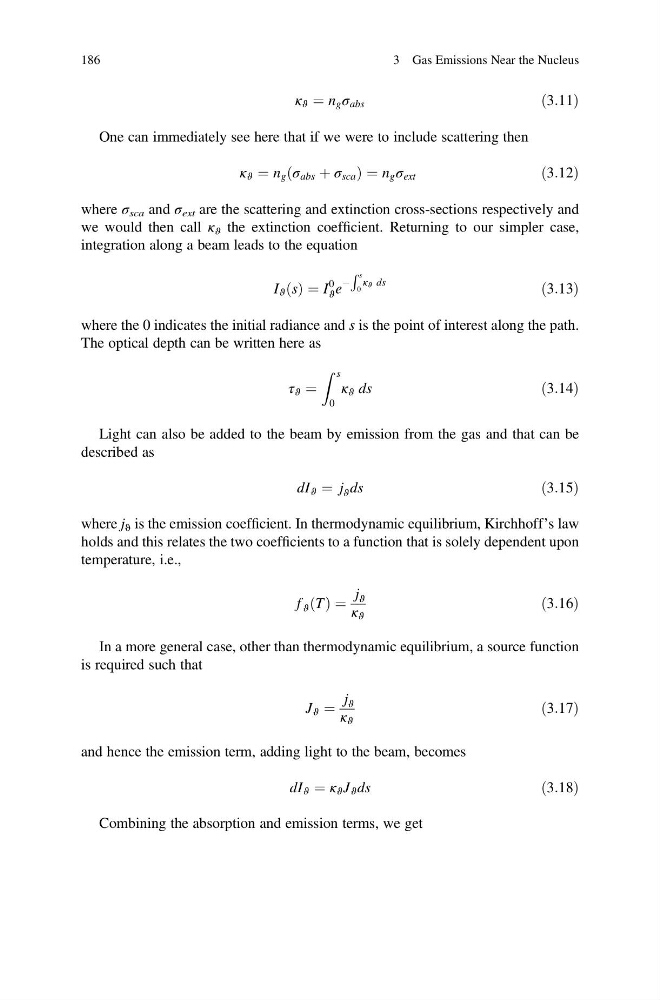
κ ϑ ¼ n g σ abs
ð3:11Þ
One can immediately see here that if we were to include scattering then
κ ϑ ¼ n g σ abs þ σ sca
ð
Þ¼n g σ ext
ð3:12Þ
where σ sca and σ ext are the scattering and extinction cross-sections respectively and
we would then call κ ϑ the extinction coefficient. Returning to our simpler case,
integration along a beam leads to the equation
I ϑ s
ð Þ ¼ I
0
ϑ e
À
R s
0
κ ϑ ds
ð3:13Þ
where the 0 indicates the initial radiance and s is the point of interest along the path.
The optical depth can be written here as
τ ϑ ¼
Z s
0
κ ϑ ds
ð3:14Þ
Light can also be added to the beam by emission from the gas and that can be
described as
dI ϑ ¼ j ϑ ds
ð3:15Þ
where j ϑ is the emission coefficient. In thermodynamic equilibrium, Kirchhoff’s law
holds and this relates the two coefficients to a function that is solely dependent upon
temperature, i.e.,
f ϑ T
ð Þ ¼
j ϑ
κ ϑ
ð3:16Þ
In a more general case, other than thermodynamic equilibrium, a source function
is required such that
J ϑ ¼
j ϑ
κ ϑ
ð3:17Þ
and hence the emission term, adding light to the beam, becomes
dI ϑ ¼ κ ϑ J ϑ ds
ð3:18Þ
Combining the absorption and emission terms, we get
186
3 Gas Emissions Near the Nucleus
ð3:11Þ
One can immediately see here that if we were to include scattering then
κ ϑ ¼ n g σ abs þ σ sca
ð
Þ¼n g σ ext
ð3:12Þ
where σ sca and σ ext are the scattering and extinction cross-sections respectively and
we would then call κ ϑ the extinction coefficient. Returning to our simpler case,
integration along a beam leads to the equation
I ϑ s
ð Þ ¼ I
0
ϑ e
À
R s
0
κ ϑ ds
ð3:13Þ
where the 0 indicates the initial radiance and s is the point of interest along the path.
The optical depth can be written here as
τ ϑ ¼
Z s
0
κ ϑ ds
ð3:14Þ
Light can also be added to the beam by emission from the gas and that can be
described as
dI ϑ ¼ j ϑ ds
ð3:15Þ
where j ϑ is the emission coefficient. In thermodynamic equilibrium, Kirchhoff’s law
holds and this relates the two coefficients to a function that is solely dependent upon
temperature, i.e.,
f ϑ T
ð Þ ¼
j ϑ
κ ϑ
ð3:16Þ
In a more general case, other than thermodynamic equilibrium, a source function
is required such that
J ϑ ¼
j ϑ
κ ϑ
ð3:17Þ
and hence the emission term, adding light to the beam, becomes
dI ϑ ¼ κ ϑ J ϑ ds
ð3:18Þ
Combining the absorption and emission terms, we get
186
3 Gas Emissions Near the Nucleus