

the radial outflow of the gas coma by dumping, fresh, slow moving molecules into a
rapidly expanding flow field.
While CO 2 may be less influenced by these effects, evidence that a major fraction
of CO in the coma was coming from an extended source was already apparent at the
time of Giotto (Eberhardt et al. 1987) with other supporting observations seen at, for
example, 29P/Schwassmann-Wachmann 1 (Gunnarsson et al. 2002) where the
extended source was a factor of >3 higher than the nucleus source at distances out
to 20,000 km from the nucleus. The splitting of polymerised organics on dust grains
in the coma is widely assumed to be responsible although release of CO from
dissociation of more complex, less volatile molecules subliming from the particles
remains a plausible alternative (Brucato et al. 1997).
Probing of these major species can be achieved by spectroscopic measurements.
The electronic states of atoms and molecules are, of course, quantized. Molecules
with two or more atoms can also store energy through the additional degrees of
freedom arising from vibration and rotation. The vibrational and rotational levels are
also quantized. Relaxation from an excited state to a lower energy state can occur
with release of a photon.
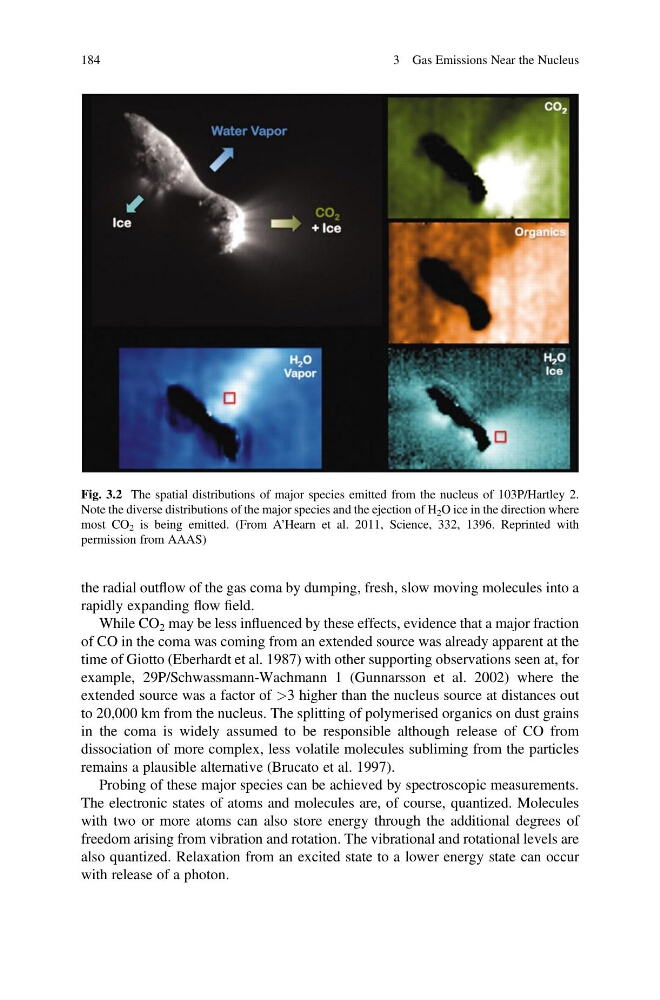
Fig. 3.2 The spatial distributions of major species emitted from the nucleus of 103P/Hartley 2.
Note the diverse distributions of the major species and the ejection of H 2 O ice in the direction where
most CO 2 is being emitted. (From A’Hearn et al. 2011, Science, 332, 1396. Reprinted with
permission from AAAS)
184
3 Gas Emissions Near the Nucleus
rapidly expanding flow field.
While CO 2 may be less influenced by these effects, evidence that a major fraction
of CO in the coma was coming from an extended source was already apparent at the
time of Giotto (Eberhardt et al. 1987) with other supporting observations seen at, for
example, 29P/Schwassmann-Wachmann 1 (Gunnarsson et al. 2002) where the
extended source was a factor of >3 higher than the nucleus source at distances out
to 20,000 km from the nucleus. The splitting of polymerised organics on dust grains
in the coma is widely assumed to be responsible although release of CO from
dissociation of more complex, less volatile molecules subliming from the particles
remains a plausible alternative (Brucato et al. 1997).
Probing of these major species can be achieved by spectroscopic measurements.
The electronic states of atoms and molecules are, of course, quantized. Molecules
with two or more atoms can also store energy through the additional degrees of
freedom arising from vibration and rotation. The vibrational and rotational levels are
also quantized. Relaxation from an excited state to a lower energy state can occur
with release of a photon.
Fig. 3.2 The spatial distributions of major species emitted from the nucleus of 103P/Hartley 2.
Note the diverse distributions of the major species and the ejection of H 2 O ice in the direction where
most CO 2 is being emitted. (From A’Hearn et al. 2011, Science, 332, 1396. Reprinted with
permission from AAAS)
184
3 Gas Emissions Near the Nucleus