

The immediate source of a particular species in the coma is sometimes unclear.
The nucleus is, of course, the source of all the mass in the coma. However, a
particular gas species may be released from, for example, dust that has already left
the nucleus. In such a case, the species is described as coming from an extended
source. H 2 O and CO 2 are widely assumed to be emitted from the nucleus itself. In the
case of water vapour, this assumption is not entirely straightforward. For example,
there might be a minor contribution to the water vapour in the coma resulting from
the release of water of hydration. The major concern, however, is in the release of
H 2 O from icy particles or “chunks” emitted from the nucleus through activity.
Observations of 103P/Hartley 2 demonstrated that emission of CO 2 , which has a
lower sublimation temperature, may drag out chunks of water ice (Fig. 3.2) which
then sublime in the coma rather than at the nucleus itself. This emission from an
extended source can have profound effects by both increasing the total gas production relative to simple surface sublimation (the subliming area is larger) and slowing
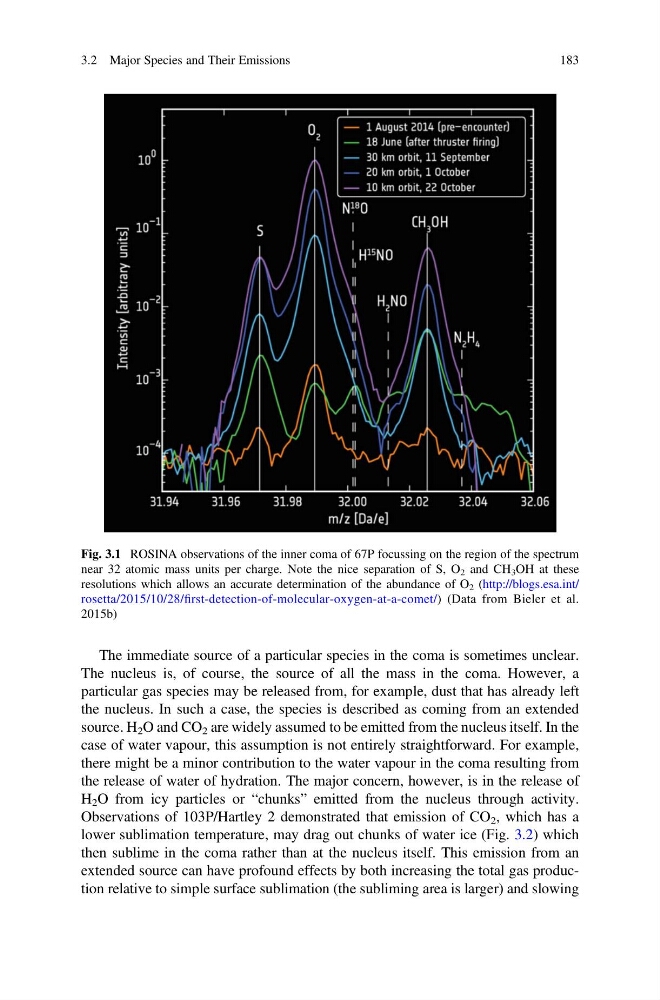
Fig. 3.1 ROSINA observations of the inner coma of 67P focussing on the region of the spectrum
near 32 atomic mass units per charge. Note the nice separation of S, O 2 and CH 3 OH at these
resolutions which allows an accurate determination of the abundance of O 2 (http://blogs.esa.int/
rosetta/2015/10/28/first-detection-of-molecular-oxygen-at-a-comet/) (Data from Bieler et al.
2015b)
3.2 Major Species and Their Emissions
183
The nucleus is, of course, the source of all the mass in the coma. However, a
particular gas species may be released from, for example, dust that has already left
the nucleus. In such a case, the species is described as coming from an extended
source. H 2 O and CO 2 are widely assumed to be emitted from the nucleus itself. In the
case of water vapour, this assumption is not entirely straightforward. For example,
there might be a minor contribution to the water vapour in the coma resulting from
the release of water of hydration. The major concern, however, is in the release of
H 2 O from icy particles or “chunks” emitted from the nucleus through activity.
Observations of 103P/Hartley 2 demonstrated that emission of CO 2 , which has a
lower sublimation temperature, may drag out chunks of water ice (Fig. 3.2) which
then sublime in the coma rather than at the nucleus itself. This emission from an
extended source can have profound effects by both increasing the total gas production relative to simple surface sublimation (the subliming area is larger) and slowing
Fig. 3.1 ROSINA observations of the inner coma of 67P focussing on the region of the spectrum
near 32 atomic mass units per charge. Note the nice separation of S, O 2 and CH 3 OH at these
resolutions which allows an accurate determination of the abundance of O 2 (http://blogs.esa.int/
rosetta/2015/10/28/first-detection-of-molecular-oxygen-at-a-comet/) (Data from Bieler et al.
2015b)
3.2 Major Species and Their Emissions
183