

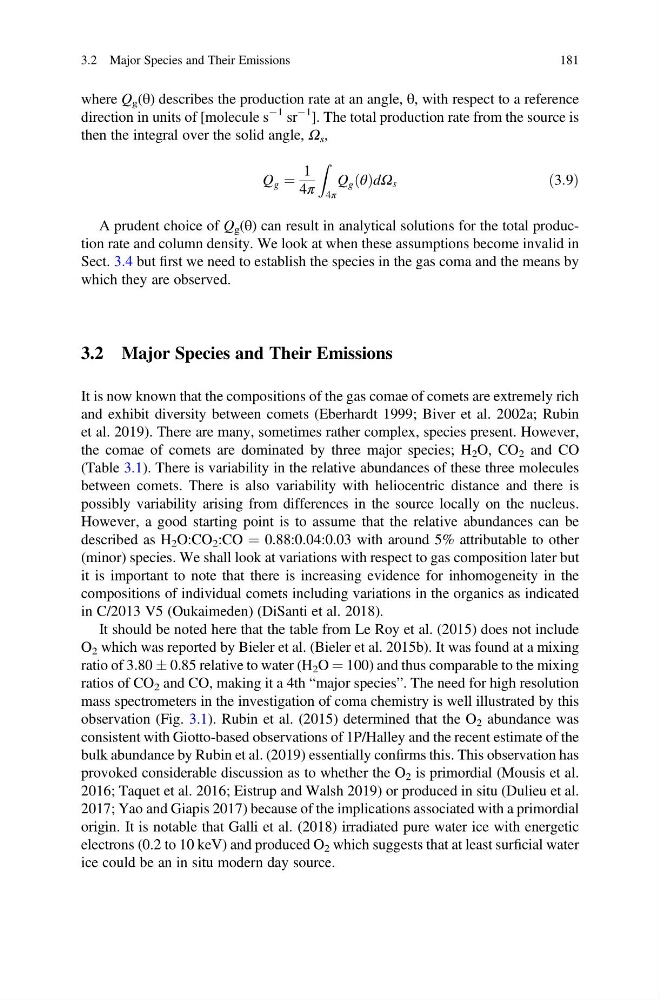
where Q g (θ) describes the production rate at an angle, θ, with respect to a reference
direction in units of [molecule s
À1 sr
À1 ]. The total production rate from the source is
then the integral over the solid angle, Ω s ,
Q g ¼
1
4π
Z
4π
Q g θ
ð ÞdΩ s
ð3:9Þ
A prudent choice of Q g (θ) can result in analytical solutions for the total production rate and column density. We look at when these assumptions become invalid in
Sect. 3.4 but first we need to establish the species in the gas coma and the means by
which they are observed.
3.2 Major Species and Their Emissions
It is now known that the compositions of the gas comae of comets are extremely rich
and exhibit diversity between comets (Eberhardt 1999; Biver et al. 2002a; Rubin
et al. 2019). There are many, sometimes rather complex, species present. However,
the comae of comets are dominated by three major species; H 2 O, CO 2 and CO
(Table 3.1). There is variability in the relative abundances of these three molecules
between comets. There is also variability with heliocentric distance and there is
possibly variability arising from differences in the source locally on the nucleus.
However, a good starting point is to assume that the relative abundances can be
described as H 2 O:CO 2 :CO ¼ 0.88:0.04:0.03 with around 5% attributable to other
(minor) species. We shall look at variations with respect to gas composition later but
it is important to note that there is increasing evidence for inhomogeneity in the
compositions of individual comets including variations in the organics as indicated
in C/2013 V5 (Oukaimeden) (DiSanti et al. 2018).
It should be noted here that the table from Le Roy et al. (2015) does not include
O 2 which was reported by Bieler et al. (Bieler et al. 2015b). It was found at a mixing
ratio of 3.80 Æ 0.85 relative to water (H 2 O ¼ 100) and thus comparable to the mixing
ratios of CO 2 and CO, making it a 4th “major species”. The need for high resolution
mass spectrometers in the investigation of coma chemistry is well illustrated by this
observation (Fig. 3.1). Rubin et al. (2015) determined that the O 2 abundance was
consistent with Giotto-based observations of 1P/Halley and the recent estimate of the
bulk abundance by Rubin et al. (2019) essentially confirms this. This observation has
provoked considerable discussion as to whether the O 2 is primordial (Mousis et al.
2016; Taquet et al. 2016; Eistrup and Walsh 2019) or produced in situ (Dulieu et al.
2017; Yao and Giapis 2017) because of the implications associated with a primordial
origin. It is notable that Galli et al. (2018) irradiated pure water ice with energetic
electrons (0.2 to 10 keV) and produced O 2 which suggests that at least surficial water
ice could be an in situ modern day source.
3.2 Major Species and Their Emissions
181
direction in units of [molecule s
À1 sr
À1 ]. The total production rate from the source is
then the integral over the solid angle, Ω s ,
Q g ¼
1
4π
Z
4π
Q g θ
ð ÞdΩ s
ð3:9Þ
A prudent choice of Q g (θ) can result in analytical solutions for the total production rate and column density. We look at when these assumptions become invalid in
Sect. 3.4 but first we need to establish the species in the gas coma and the means by
which they are observed.
3.2 Major Species and Their Emissions
It is now known that the compositions of the gas comae of comets are extremely rich
and exhibit diversity between comets (Eberhardt 1999; Biver et al. 2002a; Rubin
et al. 2019). There are many, sometimes rather complex, species present. However,
the comae of comets are dominated by three major species; H 2 O, CO 2 and CO
(Table 3.1). There is variability in the relative abundances of these three molecules
between comets. There is also variability with heliocentric distance and there is
possibly variability arising from differences in the source locally on the nucleus.
However, a good starting point is to assume that the relative abundances can be
described as H 2 O:CO 2 :CO ¼ 0.88:0.04:0.03 with around 5% attributable to other
(minor) species. We shall look at variations with respect to gas composition later but
it is important to note that there is increasing evidence for inhomogeneity in the
compositions of individual comets including variations in the organics as indicated
in C/2013 V5 (Oukaimeden) (DiSanti et al. 2018).
It should be noted here that the table from Le Roy et al. (2015) does not include
O 2 which was reported by Bieler et al. (Bieler et al. 2015b). It was found at a mixing
ratio of 3.80 Æ 0.85 relative to water (H 2 O ¼ 100) and thus comparable to the mixing
ratios of CO 2 and CO, making it a 4th “major species”. The need for high resolution
mass spectrometers in the investigation of coma chemistry is well illustrated by this
observation (Fig. 3.1). Rubin et al. (2015) determined that the O 2 abundance was
consistent with Giotto-based observations of 1P/Halley and the recent estimate of the
bulk abundance by Rubin et al. (2019) essentially confirms this. This observation has
provoked considerable discussion as to whether the O 2 is primordial (Mousis et al.
2016; Taquet et al. 2016; Eistrup and Walsh 2019) or produced in situ (Dulieu et al.
2017; Yao and Giapis 2017) because of the implications associated with a primordial
origin. It is notable that Galli et al. (2018) irradiated pure water ice with energetic
electrons (0.2 to 10 keV) and produced O 2 which suggests that at least surficial water
ice could be an in situ modern day source.
3.2 Major Species and Their Emissions
181