

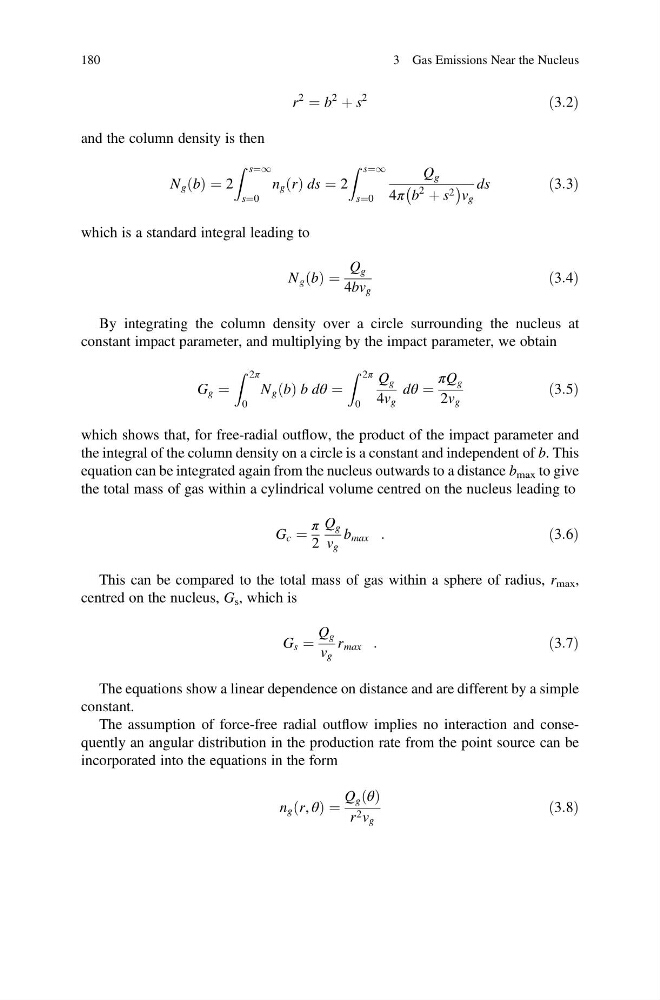
r
2
¼ b
2
þ s
2
ð3:2Þ
and the column density is then
N g b
ð Þ ¼ 2
Z s¼1
s¼0
n g r
ð Þ ds ¼ 2
Z s¼1
s¼0
Q g
4π b
2
þ s 2
À
Á
v g
ds
ð3:3Þ
which is a standard integral leading to
N g b
ð Þ ¼
Q g
4bv g
ð3:4Þ
By integrating the column density over a circle surrounding the nucleus at
constant impact parameter, and multiplying by the impact parameter, we obtain
G g ¼
Z 2π
0
N g b
ð Þ b dθ ¼
Z 2π
0
Q g
4v g
dθ ¼
πQ g
2v g
ð3:5Þ
which shows that, for free-radial outflow, the product of the impact parameter and
the integral of the column density on a circle is a constant and independent of b. This
equation can be integrated again from the nucleus outwards to a distance b max to give
the total mass of gas within a cylindrical volume centred on the nucleus leading to
G c ¼
π
2
Q g
v g
b max :
ð3:6Þ
This can be compared to the total mass of gas within a sphere of radius, r max ,
centred on the nucleus, G s , which is
G s ¼
Q g
v g
r max :
ð3:7Þ
The equations show a linear dependence on distance and are different by a simple
constant.
The assumption of force-free radial outflow implies no interaction and consequently an angular distribution in the production rate from the point source can be
incorporated into the equations in the form
n g r, θ
ð Þ ¼
Q g θ
ð Þ
r 2 v g
ð3:8Þ
180
3 Gas Emissions Near the Nucleus
2
¼ b
2
þ s
2
ð3:2Þ
and the column density is then
N g b
ð Þ ¼ 2
Z s¼1
s¼0
n g r
ð Þ ds ¼ 2
Z s¼1
s¼0
Q g
4π b
2
þ s 2
À
Á
v g
ds
ð3:3Þ
which is a standard integral leading to
N g b
ð Þ ¼
Q g
4bv g
ð3:4Þ
By integrating the column density over a circle surrounding the nucleus at
constant impact parameter, and multiplying by the impact parameter, we obtain
G g ¼
Z 2π
0
N g b
ð Þ b dθ ¼
Z 2π
0
Q g
4v g
dθ ¼
πQ g
2v g
ð3:5Þ
which shows that, for free-radial outflow, the product of the impact parameter and
the integral of the column density on a circle is a constant and independent of b. This
equation can be integrated again from the nucleus outwards to a distance b max to give
the total mass of gas within a cylindrical volume centred on the nucleus leading to
G c ¼
π
2
Q g
v g
b max :
ð3:6Þ
This can be compared to the total mass of gas within a sphere of radius, r max ,
centred on the nucleus, G s , which is
G s ¼
Q g
v g
r max :
ð3:7Þ
The equations show a linear dependence on distance and are different by a simple
constant.
The assumption of force-free radial outflow implies no interaction and consequently an angular distribution in the production rate from the point source can be
incorporated into the equations in the form
n g r, θ
ð Þ ¼
Q g θ
ð Þ
r 2 v g
ð3:8Þ
180
3 Gas Emissions Near the Nucleus