

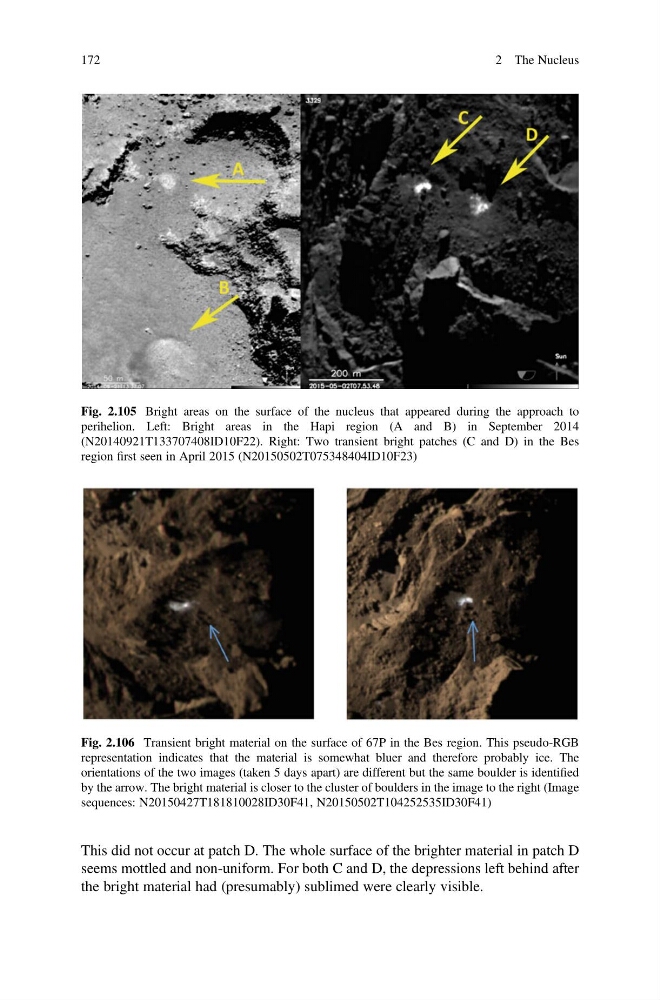
This did not occur at patch D. The whole surface of the brighter material in patch D
seems mottled and non-uniform. For both C and D, the depressions left behind after
the bright material had (presumably) sublimed were clearly visible.
Fig. 2.105 Bright areas on the surface of the nucleus that appeared during the approach to
perihelion. Left: Bright areas in the Hapi region (A and B) in September 2014
(N20140921T133707408ID10F22). Right: Two transient bright patches (C and D) in the Bes
region first seen in April 2015 (N20150502T075348404ID10F23)
Fig. 2.106 Transient bright material on the surface of 67P in the Bes region. This pseudo-RGB
representation indicates that the material is somewhat bluer and therefore probably ice. The
orientations of the two images (taken 5 days apart) are different but the same boulder is identified
by the arrow. The bright material is closer to the cluster of boulders in the image to the right (Image
sequences: N20150427T181810028ID30F41, N20150502T104252535ID30F41)
172
2 The Nucleus
seems mottled and non-uniform. For both C and D, the depressions left behind after
the bright material had (presumably) sublimed were clearly visible.
Fig. 2.105 Bright areas on the surface of the nucleus that appeared during the approach to
perihelion. Left: Bright areas in the Hapi region (A and B) in September 2014
(N20140921T133707408ID10F22). Right: Two transient bright patches (C and D) in the Bes
region first seen in April 2015 (N20150502T075348404ID10F23)
Fig. 2.106 Transient bright material on the surface of 67P in the Bes region. This pseudo-RGB
representation indicates that the material is somewhat bluer and therefore probably ice. The
orientations of the two images (taken 5 days apart) are different but the same boulder is identified
by the arrow. The bright material is closer to the cluster of boulders in the image to the right (Image
sequences: N20150427T181810028ID30F41, N20150502T104252535ID30F41)
172
2 The Nucleus