

u th ¼
ffiffiffiffiffiffiffiffiffiffiffiffiffiffiffiffiffiffiffiffiffiffiffiffiffiffiffiffiffiffiffiffiffiffiffiffiffiffiffiffi ffi
A V 2σ ps ga þ
γ c
2ρ g a
s
ð2:135Þ
where A V is a modified dimensionless velocity threshold, and γ c is an empirical
constant describing the cohesive forces. This revised equation leads to the values for
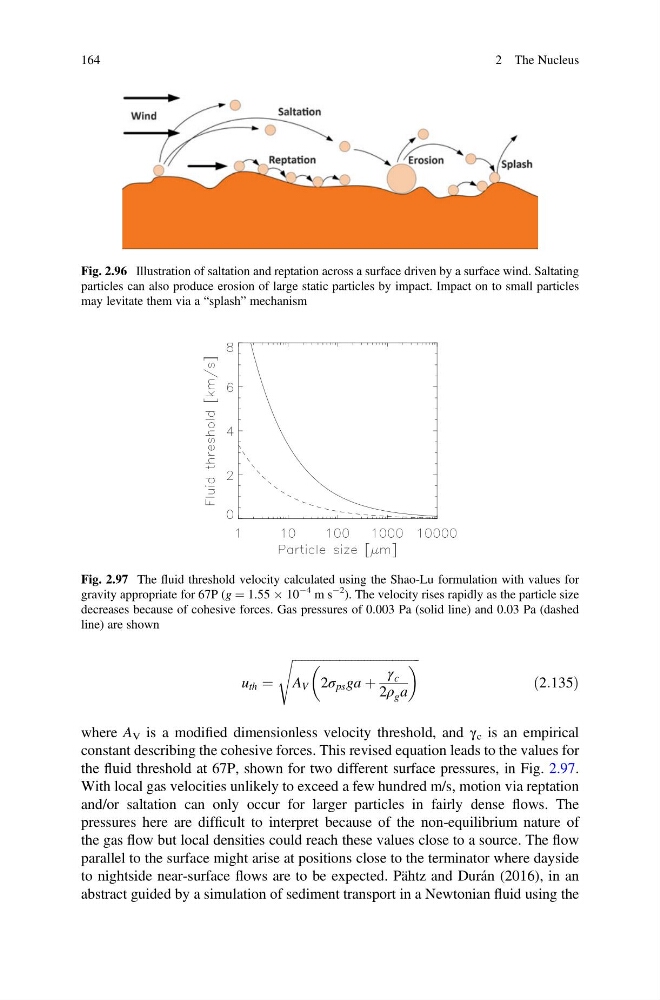
the fluid threshold at 67P, shown for two different surface pressures, in Fig. 2.97.
With local gas velocities unlikely to exceed a few hundred m/s, motion via reptation
and/or saltation can only occur for larger particles in fairly dense flows. The
pressures here are difficult to interpret because of the non-equilibrium nature of
the gas flow but local densities could reach these values close to a source. The flow
parallel to the surface might arise at positions close to the terminator where dayside
to nightside near-surface flows are to be expected. Pähtz and Durán (2016), in an
abstract guided by a simulation of sediment transport in a Newtonian fluid using the
Fig. 2.96 Illustration of saltation and reptation across a surface driven by a surface wind. Saltating
particles can also produce erosion of large static particles by impact. Impact on to small particles
may levitate them via a “splash” mechanism
Fig. 2.97 The fluid threshold velocity calculated using the Shao-Lu formulation with values for
gravity appropriate for 67P (g ¼ 1.55 Â 10
À4 m s
À2
). The velocity rises rapidly as the particle size
decreases because of cohesive forces. Gas pressures of 0.003 Pa (solid line) and 0.03 Pa (dashed
line) are shown
164
2 The Nucleus
ffiffiffiffiffiffiffiffiffiffiffiffiffiffiffiffiffiffiffiffiffiffiffiffiffiffiffiffiffiffiffiffiffiffiffiffiffiffiffiffi ffi
A V 2σ ps ga þ
γ c
2ρ g a
s
ð2:135Þ
where A V is a modified dimensionless velocity threshold, and γ c is an empirical
constant describing the cohesive forces. This revised equation leads to the values for
the fluid threshold at 67P, shown for two different surface pressures, in Fig. 2.97.
With local gas velocities unlikely to exceed a few hundred m/s, motion via reptation
and/or saltation can only occur for larger particles in fairly dense flows. The
pressures here are difficult to interpret because of the non-equilibrium nature of
the gas flow but local densities could reach these values close to a source. The flow
parallel to the surface might arise at positions close to the terminator where dayside
to nightside near-surface flows are to be expected. Pähtz and Durán (2016), in an
abstract guided by a simulation of sediment transport in a Newtonian fluid using the
Fig. 2.96 Illustration of saltation and reptation across a surface driven by a surface wind. Saltating
particles can also produce erosion of large static particles by impact. Impact on to small particles
may levitate them via a “splash” mechanism
Fig. 2.97 The fluid threshold velocity calculated using the Shao-Lu formulation with values for
gravity appropriate for 67P (g ¼ 1.55 Â 10
À4 m s
À2
). The velocity rises rapidly as the particle size
decreases because of cohesive forces. Gas pressures of 0.003 Pa (solid line) and 0.03 Pa (dashed
line) are shown
164
2 The Nucleus