

candidate. This idea has been discussed as the reason why the southern part of the
neck (region Sobek) is not dust covered despite being deep in the gravitational
well—the area is highly active during southern summer through perihelion. However, the concept of preventing dust accumulation locally by gas emission in
Imhotep remains unproven.
The edge of the smooth surface in Imhotep drops via a set of layers (terraces)
down to rougher terrain (Imhotep sub-region c). This appears to be similar to the
smooth material seen on 9P/Tempel 1 (i.e. the olive green terrains in Fig. 2.48).
Hence this type of surface may be generic but there are subtle differences. For
example, the edges of this layered terrain on 9P/Tempel 1 were seen to be a source of
jet activity (Farnham et al. 2007, 2013). This has not been observed at Imhotep.
While Imhotep provides the most remarkable evidence of quasi-circular structure
development and evolution in a dusty surface, it is by no means the only example.
Structures of similar appearance were seen in the Hapi and Anubis regions
(Fig. 2.92). The structures in Hapi began to appear 8 months before perihelion. At
this time the northern hemisphere was well illuminated although the total heat input
was still quite low because of the heliocentric distance. Nonetheless, the appearances
of the structures are quite similar to those seen in Imhotep. There does appear to be
evidence of wall collapse in both the Hapi and Anubis structures with talus seen as
the bases of the steepest sides.
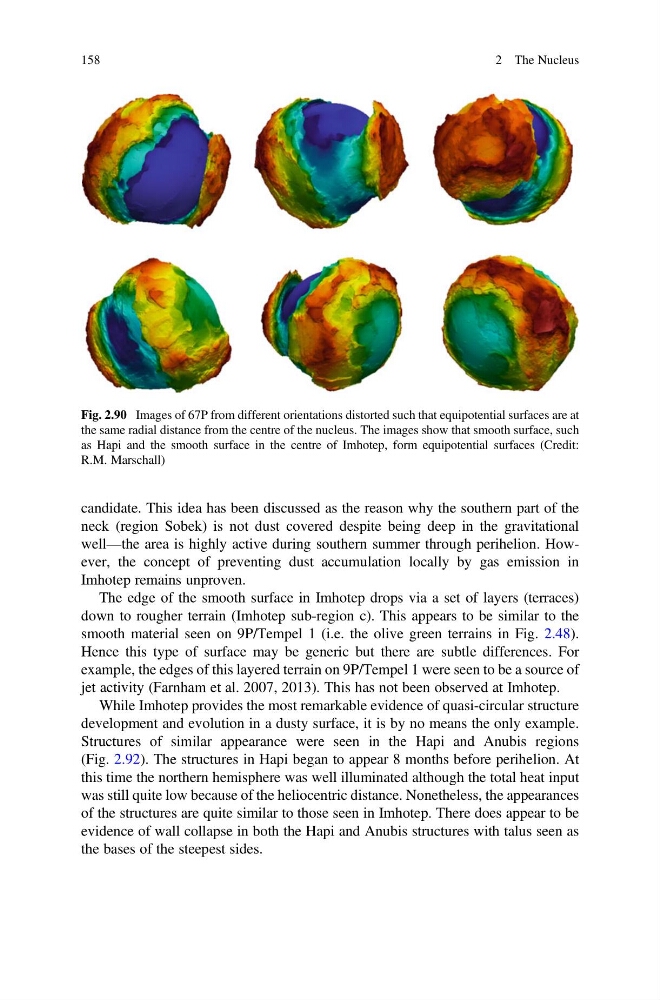
Fig. 2.90 Images of 67P from different orientations distorted such that equipotential surfaces are at
the same radial distance from the centre of the nucleus. The images show that smooth surface, such
as Hapi and the smooth surface in the centre of Imhotep, form equipotential surfaces (Credit:
R.M. Marschall)
158
2 The Nucleus
neck (region Sobek) is not dust covered despite being deep in the gravitational
well—the area is highly active during southern summer through perihelion. However, the concept of preventing dust accumulation locally by gas emission in
Imhotep remains unproven.
The edge of the smooth surface in Imhotep drops via a set of layers (terraces)
down to rougher terrain (Imhotep sub-region c). This appears to be similar to the
smooth material seen on 9P/Tempel 1 (i.e. the olive green terrains in Fig. 2.48).
Hence this type of surface may be generic but there are subtle differences. For
example, the edges of this layered terrain on 9P/Tempel 1 were seen to be a source of
jet activity (Farnham et al. 2007, 2013). This has not been observed at Imhotep.
While Imhotep provides the most remarkable evidence of quasi-circular structure
development and evolution in a dusty surface, it is by no means the only example.
Structures of similar appearance were seen in the Hapi and Anubis regions
(Fig. 2.92). The structures in Hapi began to appear 8 months before perihelion. At
this time the northern hemisphere was well illuminated although the total heat input
was still quite low because of the heliocentric distance. Nonetheless, the appearances
of the structures are quite similar to those seen in Imhotep. There does appear to be
evidence of wall collapse in both the Hapi and Anubis structures with talus seen as
the bases of the steepest sides.
Fig. 2.90 Images of 67P from different orientations distorted such that equipotential surfaces are at
the same radial distance from the centre of the nucleus. The images show that smooth surface, such
as Hapi and the smooth surface in the centre of Imhotep, form equipotential surfaces (Credit:
R.M. Marschall)
158
2 The Nucleus