

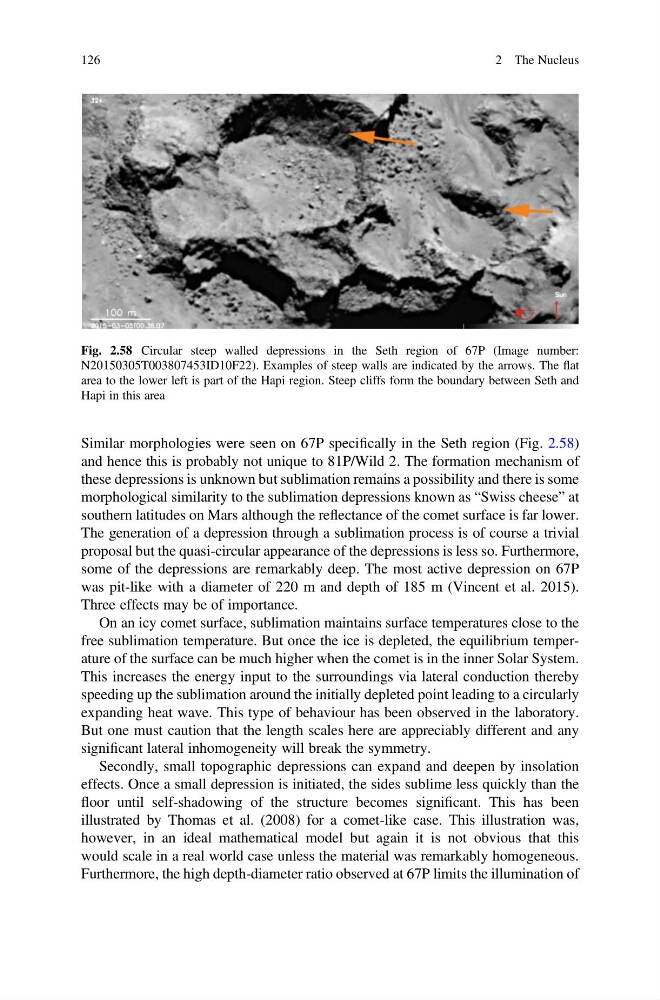
Similar morphologies were seen on 67P specifically in the Seth region (Fig. 2.58)
and hence this is probably not unique to 81P/Wild 2. The formation mechanism of
these depressions is unknown but sublimation remains a possibility and there is some
morphological similarity to the sublimation depressions known as “Swiss cheese” at
southern latitudes on Mars although the reflectance of the comet surface is far lower.
The generation of a depression through a sublimation process is of course a trivial
proposal but the quasi-circular appearance of the depressions is less so. Furthermore,
some of the depressions are remarkably deep. The most active depression on 67P
was pit-like with a diameter of 220 m and depth of 185 m (Vincent et al. 2015).
Three effects may be of importance.
On an icy comet surface, sublimation maintains surface temperatures close to the
free sublimation temperature. But once the ice is depleted, the equilibrium temperature of the surface can be much higher when the comet is in the inner Solar System.
This increases the energy input to the surroundings via lateral conduction thereby
speeding up the sublimation around the initially depleted point leading to a circularly
expanding heat wave. This type of behaviour has been observed in the laboratory.
But one must caution that the length scales here are appreciably different and any
significant lateral inhomogeneity will break the symmetry.
Secondly, small topographic depressions can expand and deepen by insolation
effects. Once a small depression is initiated, the sides sublime less quickly than the
floor until self-shadowing of the structure becomes significant. This has been
illustrated by Thomas et al. (2008) for a comet-like case. This illustration was,
however, in an ideal mathematical model but again it is not obvious that this
would scale in a real world case unless the material was remarkably homogeneous.
Furthermore, the high depth-diameter ratio observed at 67P limits the illumination of
Fig. 2.58 Circular steep walled depressions in the Seth region of 67P (Image number:
N20150305T003807453ID10F22). Examples of steep walls are indicated by the arrows. The flat
area to the lower left is part of the Hapi region. Steep cliffs form the boundary between Seth and
Hapi in this area
126
2 The Nucleus
and hence this is probably not unique to 81P/Wild 2. The formation mechanism of
these depressions is unknown but sublimation remains a possibility and there is some
morphological similarity to the sublimation depressions known as “Swiss cheese” at
southern latitudes on Mars although the reflectance of the comet surface is far lower.
The generation of a depression through a sublimation process is of course a trivial
proposal but the quasi-circular appearance of the depressions is less so. Furthermore,
some of the depressions are remarkably deep. The most active depression on 67P
was pit-like with a diameter of 220 m and depth of 185 m (Vincent et al. 2015).
Three effects may be of importance.
On an icy comet surface, sublimation maintains surface temperatures close to the
free sublimation temperature. But once the ice is depleted, the equilibrium temperature of the surface can be much higher when the comet is in the inner Solar System.
This increases the energy input to the surroundings via lateral conduction thereby
speeding up the sublimation around the initially depleted point leading to a circularly
expanding heat wave. This type of behaviour has been observed in the laboratory.
But one must caution that the length scales here are appreciably different and any
significant lateral inhomogeneity will break the symmetry.
Secondly, small topographic depressions can expand and deepen by insolation
effects. Once a small depression is initiated, the sides sublime less quickly than the
floor until self-shadowing of the structure becomes significant. This has been
illustrated by Thomas et al. (2008) for a comet-like case. This illustration was,
however, in an ideal mathematical model but again it is not obvious that this
would scale in a real world case unless the material was remarkably homogeneous.
Furthermore, the high depth-diameter ratio observed at 67P limits the illumination of
Fig. 2.58 Circular steep walled depressions in the Seth region of 67P (Image number:
N20150305T003807453ID10F22). Examples of steep walls are indicated by the arrows. The flat
area to the lower left is part of the Hapi region. Steep cliffs form the boundary between Seth and
Hapi in this area
126
2 The Nucleus