

This shows that although impact cratering dominates the surfaces of inactive
objects such as asteroids, its effect on cometary surfaces is more subtle. Impact
cratering might be important locally in modifying the density and structure at or
close to the impact site but their surface manifestations are erased by sublimation on
short timescales.
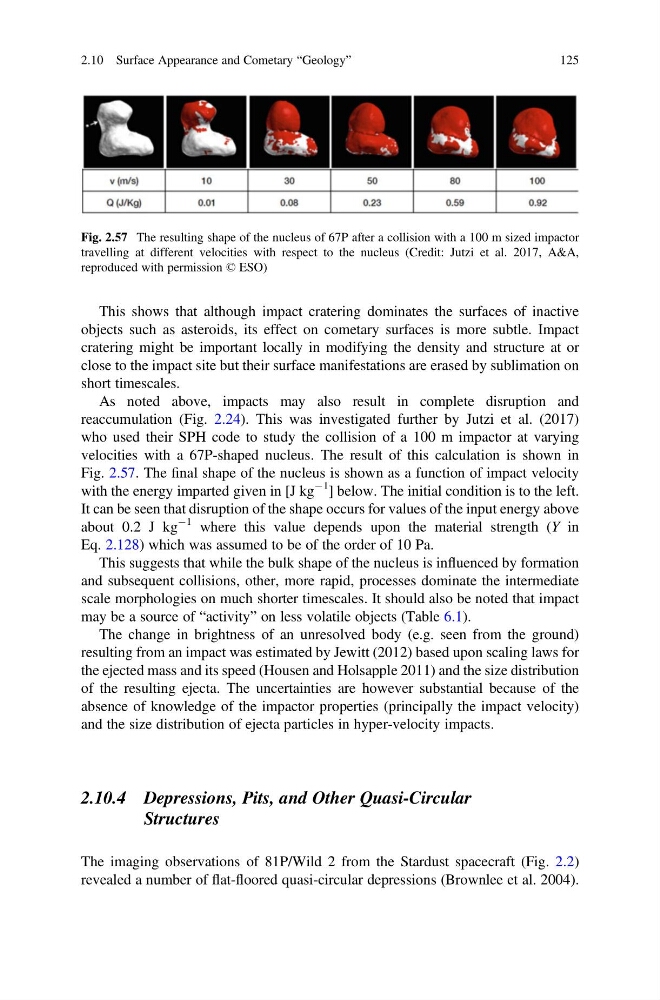
As noted above, impacts may also result in complete disruption and
reaccumulation (Fig. 2.24). This was investigated further by Jutzi et al. (2017)
who used their SPH code to study the collision of a 100 m impactor at varying
velocities with a 67P-shaped nucleus. The result of this calculation is shown in
Fig. 2.57. The final shape of the nucleus is shown as a function of impact velocity
with the energy imparted given in [J kg
À1 ] below. The initial condition is to the left.
It can be seen that disruption of the shape occurs for values of the input energy above
about 0.2 J kg
À1 where this value depends upon the material strength (Y in
Eq. 2.128) which was assumed to be of the order of 10 Pa.
This suggests that while the bulk shape of the nucleus is influenced by formation
and subsequent collisions, other, more rapid, processes dominate the intermediate
scale morphologies on much shorter timescales. It should also be noted that impact
may be a source of “activity” on less volatile objects (Table 6.1).
The change in brightness of an unresolved body (e.g. seen from the ground)
resulting from an impact was estimated by Jewitt (2012) based upon scaling laws for
the ejected mass and its speed (Housen and Holsapple 2011) and the size distribution
of the resulting ejecta. The uncertainties are however substantial because of the
absence of knowledge of the impactor properties (principally the impact velocity)
and the size distribution of ejecta particles in hyper-velocity impacts.
2.10.4 Depressions, Pits, and Other Quasi-Circular
Structures
The imaging observations of 81P/Wild 2 from the Stardust spacecraft (Fig. 2.2)
revealed a number of flat-floored quasi-circular depressions (Brownlee et al. 2004).
Fig. 2.57 The resulting shape of the nucleus of 67P after a collision with a 100 m sized impactor
travelling at different velocities with respect to the nucleus (Credit: Jutzi et al. 2017, A&A,
reproduced with permission © ESO)
2.10 Surface Appearance and Cometary “Geology”
125
objects such as asteroids, its effect on cometary surfaces is more subtle. Impact
cratering might be important locally in modifying the density and structure at or
close to the impact site but their surface manifestations are erased by sublimation on
short timescales.
As noted above, impacts may also result in complete disruption and
reaccumulation (Fig. 2.24). This was investigated further by Jutzi et al. (2017)
who used their SPH code to study the collision of a 100 m impactor at varying
velocities with a 67P-shaped nucleus. The result of this calculation is shown in
Fig. 2.57. The final shape of the nucleus is shown as a function of impact velocity
with the energy imparted given in [J kg
À1 ] below. The initial condition is to the left.
It can be seen that disruption of the shape occurs for values of the input energy above
about 0.2 J kg
À1 where this value depends upon the material strength (Y in
Eq. 2.128) which was assumed to be of the order of 10 Pa.
This suggests that while the bulk shape of the nucleus is influenced by formation
and subsequent collisions, other, more rapid, processes dominate the intermediate
scale morphologies on much shorter timescales. It should also be noted that impact
may be a source of “activity” on less volatile objects (Table 6.1).
The change in brightness of an unresolved body (e.g. seen from the ground)
resulting from an impact was estimated by Jewitt (2012) based upon scaling laws for
the ejected mass and its speed (Housen and Holsapple 2011) and the size distribution
of the resulting ejecta. The uncertainties are however substantial because of the
absence of knowledge of the impactor properties (principally the impact velocity)
and the size distribution of ejecta particles in hyper-velocity impacts.
2.10.4 Depressions, Pits, and Other Quasi-Circular
Structures
The imaging observations of 81P/Wild 2 from the Stardust spacecraft (Fig. 2.2)
revealed a number of flat-floored quasi-circular depressions (Brownlee et al. 2004).
Fig. 2.57 The resulting shape of the nucleus of 67P after a collision with a 100 m sized impactor
travelling at different velocities with respect to the nucleus (Credit: Jutzi et al. 2017, A&A,
reproduced with permission © ESO)
2.10 Surface Appearance and Cometary “Geology”
125