

κ e
κ g
¼
2 À D p
À
Á Ψ 1 À Ψ
D ÀDpþ1
2ÀDp
D t À D p þ 1
À
Á
1 À Ψ
ð
Þ
λ max
L 0
D t À1
þ 1 À Ψ
ð
Þ
κ s
κ g
ð2:119Þ
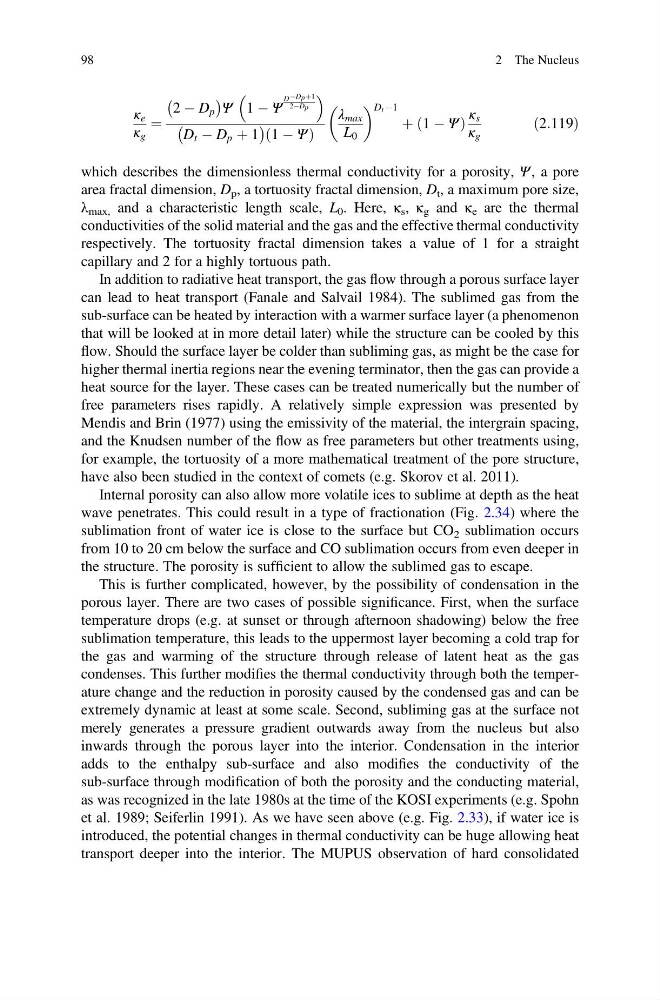
which describes the dimensionless thermal conductivity for a porosity, Ψ , a pore
area fractal dimension, D p , a tortuosity fractal dimension, D t , a maximum pore size,
λ max, and a characteristic length scale, L 0 . Here, κ s , κ g and κ e are the thermal
conductivities of the solid material and the gas and the effective thermal conductivity
respectively. The tortuosity fractal dimension takes a value of 1 for a straight
capillary and 2 for a highly tortuous path.
In addition to radiative heat transport, the gas flow through a porous surface layer
can lead to heat transport (Fanale and Salvail 1984). The sublimed gas from the
sub-surface can be heated by interaction with a warmer surface layer (a phenomenon
that will be looked at in more detail later) while the structure can be cooled by this
flow. Should the surface layer be colder than subliming gas, as might be the case for
higher thermal inertia regions near the evening terminator, then the gas can provide a
heat source for the layer. These cases can be treated numerically but the number of
free parameters rises rapidly. A relatively simple expression was presented by
Mendis and Brin (1977) using the emissivity of the material, the intergrain spacing,
and the Knudsen number of the flow as free parameters but other treatments using,
for example, the tortuosity of a more mathematical treatment of the pore structure,
have also been studied in the context of comets (e.g. Skorov et al. 2011).
Internal porosity can also allow more volatile ices to sublime at depth as the heat
wave penetrates. This could result in a type of fractionation (Fig. 2.34) where the
sublimation front of water ice is close to the surface but CO 2 sublimation occurs
from 10 to 20 cm below the surface and CO sublimation occurs from even deeper in
the structure. The porosity is sufficient to allow the sublimed gas to escape.
This is further complicated, however, by the possibility of condensation in the
porous layer. There are two cases of possible significance. First, when the surface
temperature drops (e.g. at sunset or through afternoon shadowing) below the free
sublimation temperature, this leads to the uppermost layer becoming a cold trap for
the gas and warming of the structure through release of latent heat as the gas
condenses. This further modifies the thermal conductivity through both the temperature change and the reduction in porosity caused by the condensed gas and can be
extremely dynamic at least at some scale. Second, subliming gas at the surface not
merely generates a pressure gradient outwards away from the nucleus but also
inwards through the porous layer into the interior. Condensation in the interior
adds to the enthalpy sub-surface and also modifies the conductivity of the
sub-surface through modification of both the porosity and the conducting material,
as was recognized in the late 1980s at the time of the KOSI experiments (e.g. Spohn
et al. 1989; Seiferlin 1991). As we have seen above (e.g. Fig. 2.33), if water ice is
introduced, the potential changes in thermal conductivity can be huge allowing heat
transport deeper into the interior. The MUPUS observation of hard consolidated
98
2 The Nucleus
κ g
¼
2 À D p
À
Á Ψ 1 À Ψ
D ÀDpþ1
2ÀDp
D t À D p þ 1
À
Á
1 À Ψ
ð
Þ
λ max
L 0
D t À1
þ 1 À Ψ
ð
Þ
κ s
κ g
ð2:119Þ
which describes the dimensionless thermal conductivity for a porosity, Ψ , a pore
area fractal dimension, D p , a tortuosity fractal dimension, D t , a maximum pore size,
λ max, and a characteristic length scale, L 0 . Here, κ s , κ g and κ e are the thermal
conductivities of the solid material and the gas and the effective thermal conductivity
respectively. The tortuosity fractal dimension takes a value of 1 for a straight
capillary and 2 for a highly tortuous path.
In addition to radiative heat transport, the gas flow through a porous surface layer
can lead to heat transport (Fanale and Salvail 1984). The sublimed gas from the
sub-surface can be heated by interaction with a warmer surface layer (a phenomenon
that will be looked at in more detail later) while the structure can be cooled by this
flow. Should the surface layer be colder than subliming gas, as might be the case for
higher thermal inertia regions near the evening terminator, then the gas can provide a
heat source for the layer. These cases can be treated numerically but the number of
free parameters rises rapidly. A relatively simple expression was presented by
Mendis and Brin (1977) using the emissivity of the material, the intergrain spacing,
and the Knudsen number of the flow as free parameters but other treatments using,
for example, the tortuosity of a more mathematical treatment of the pore structure,
have also been studied in the context of comets (e.g. Skorov et al. 2011).
Internal porosity can also allow more volatile ices to sublime at depth as the heat
wave penetrates. This could result in a type of fractionation (Fig. 2.34) where the
sublimation front of water ice is close to the surface but CO 2 sublimation occurs
from 10 to 20 cm below the surface and CO sublimation occurs from even deeper in
the structure. The porosity is sufficient to allow the sublimed gas to escape.
This is further complicated, however, by the possibility of condensation in the
porous layer. There are two cases of possible significance. First, when the surface
temperature drops (e.g. at sunset or through afternoon shadowing) below the free
sublimation temperature, this leads to the uppermost layer becoming a cold trap for
the gas and warming of the structure through release of latent heat as the gas
condenses. This further modifies the thermal conductivity through both the temperature change and the reduction in porosity caused by the condensed gas and can be
extremely dynamic at least at some scale. Second, subliming gas at the surface not
merely generates a pressure gradient outwards away from the nucleus but also
inwards through the porous layer into the interior. Condensation in the interior
adds to the enthalpy sub-surface and also modifies the conductivity of the
sub-surface through modification of both the porosity and the conducting material,
as was recognized in the late 1980s at the time of the KOSI experiments (e.g. Spohn
et al. 1989; Seiferlin 1991). As we have seen above (e.g. Fig. 2.33), if water ice is
introduced, the potential changes in thermal conductivity can be huge allowing heat
transport deeper into the interior. The MUPUS observation of hard consolidated
98
2 The Nucleus