

is a problem. The interior of the nucleus is expected to be very cold (e.g. 30 K). So
there is a negative temperature gradient from the surface to the interior. The
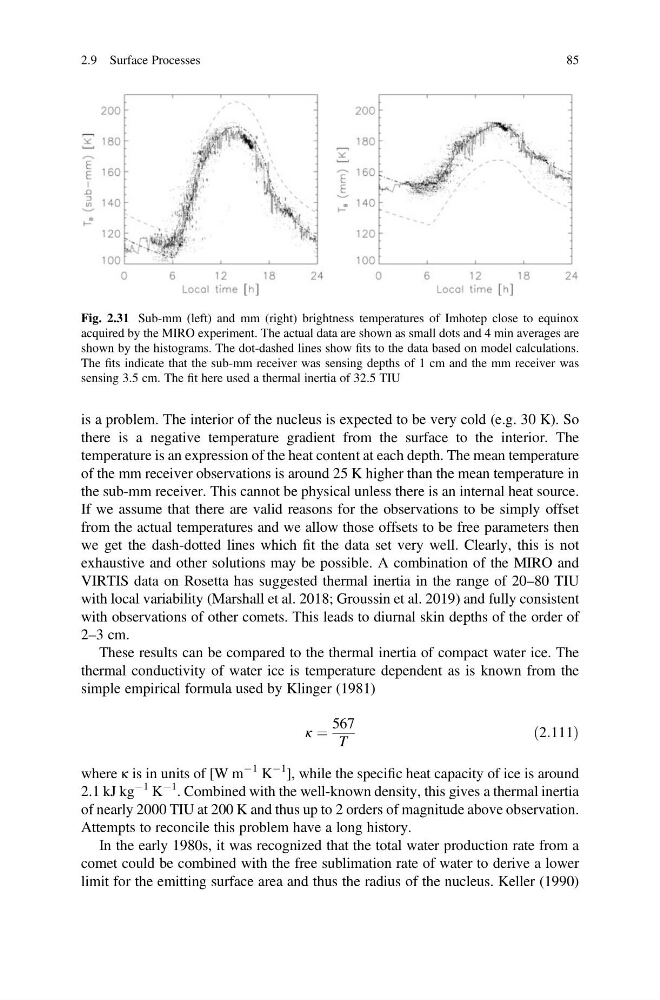
temperature is an expression of the heat content at each depth. The mean temperature
of the mm receiver observations is around 25 K higher than the mean temperature in
the sub-mm receiver. This cannot be physical unless there is an internal heat source.
If we assume that there are valid reasons for the observations to be simply offset
from the actual temperatures and we allow those offsets to be free parameters then
we get the dash-dotted lines which fit the data set very well. Clearly, this is not
exhaustive and other solutions may be possible. A combination of the MIRO and
VIRTIS data on Rosetta has suggested thermal inertia in the range of 20–80 TIU
with local variability (Marshall et al. 2018; Groussin et al. 2019) and fully consistent
with observations of other comets. This leads to diurnal skin depths of the order of
2–3 cm.
These results can be compared to the thermal inertia of compact water ice. The
thermal conductivity of water ice is temperature dependent as is known from the
simple empirical formula used by Klinger (1981)
κ ¼
567
T
ð2:111Þ
where κ is in units of [W m
À1 K
À1 ], while the specific heat capacity of ice is around
2.1 kJ kg
À1 K
À1 . Combined with the well-known density, this gives a thermal inertia
of nearly 2000 TIU at 200 K and thus up to 2 orders of magnitude above observation.
Attempts to reconcile this problem have a long history.
In the early 1980s, it was recognized that the total water production rate from a
comet could be combined with the free sublimation rate of water to derive a lower
limit for the emitting surface area and thus the radius of the nucleus. Keller (1990)
Fig. 2.31 Sub-mm (left) and mm (right) brightness temperatures of Imhotep close to equinox
acquired by the MIRO experiment. The actual data are shown as small dots and 4 min averages are
shown by the histograms. The dot-dashed lines show fits to the data based on model calculations.
The fits indicate that the sub-mm receiver was sensing depths of 1 cm and the mm receiver was
sensing 3.5 cm. The fit here used a thermal inertia of 32.5 TIU
2.9 Surface Processes
85
there is a negative temperature gradient from the surface to the interior. The
temperature is an expression of the heat content at each depth. The mean temperature
of the mm receiver observations is around 25 K higher than the mean temperature in
the sub-mm receiver. This cannot be physical unless there is an internal heat source.
If we assume that there are valid reasons for the observations to be simply offset
from the actual temperatures and we allow those offsets to be free parameters then
we get the dash-dotted lines which fit the data set very well. Clearly, this is not
exhaustive and other solutions may be possible. A combination of the MIRO and
VIRTIS data on Rosetta has suggested thermal inertia in the range of 20–80 TIU
with local variability (Marshall et al. 2018; Groussin et al. 2019) and fully consistent
with observations of other comets. This leads to diurnal skin depths of the order of
2–3 cm.
These results can be compared to the thermal inertia of compact water ice. The
thermal conductivity of water ice is temperature dependent as is known from the
simple empirical formula used by Klinger (1981)
κ ¼
567
T
ð2:111Þ
where κ is in units of [W m
À1 K
À1 ], while the specific heat capacity of ice is around
2.1 kJ kg
À1 K
À1 . Combined with the well-known density, this gives a thermal inertia
of nearly 2000 TIU at 200 K and thus up to 2 orders of magnitude above observation.
Attempts to reconcile this problem have a long history.
In the early 1980s, it was recognized that the total water production rate from a
comet could be combined with the free sublimation rate of water to derive a lower
limit for the emitting surface area and thus the radius of the nucleus. Keller (1990)
Fig. 2.31 Sub-mm (left) and mm (right) brightness temperatures of Imhotep close to equinox
acquired by the MIRO experiment. The actual data are shown as small dots and 4 min averages are
shown by the histograms. The dot-dashed lines show fits to the data based on model calculations.
The fits indicate that the sub-mm receiver was sensing depths of 1 cm and the mm receiver was
sensing 3.5 cm. The fit here used a thermal inertia of 32.5 TIU
2.9 Surface Processes
85