

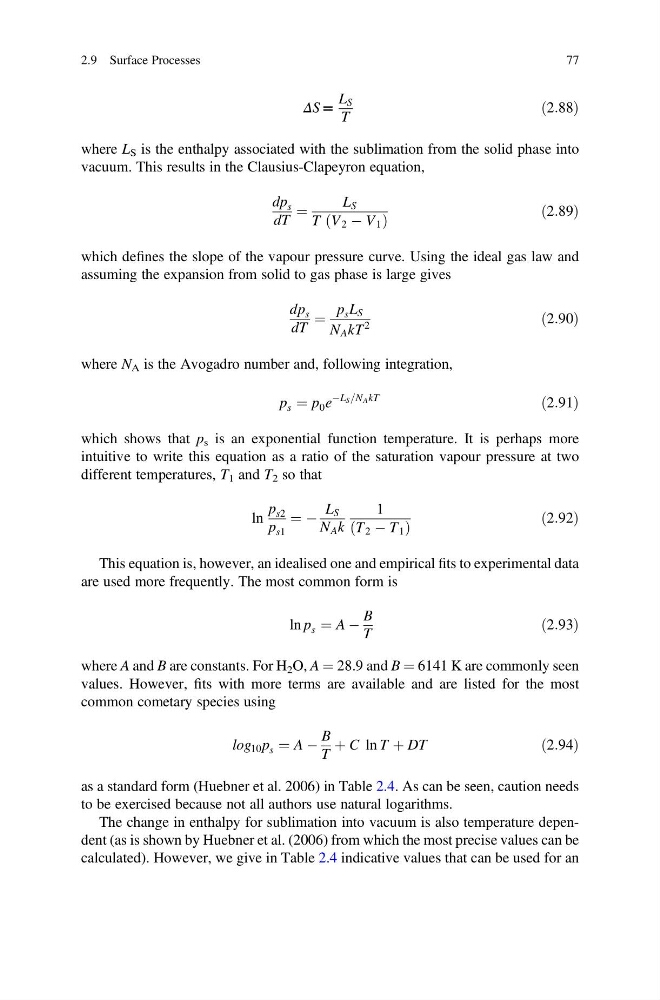
ΔS =
L S
T
ð2:88Þ
where L S is the enthalpy associated with the sublimation from the solid phase into
vacuum. This results in the Clausius-Clapeyron equation,
dp s
dT
¼
L S
T V 2 À V 1
ð
Þ
ð2:89Þ
which defines the slope of the vapour pressure curve. Using the ideal gas law and
assuming the expansion from solid to gas phase is large gives
dp s
dT
¼
p s L S
N A kT
2
ð2:90Þ
where N A is the Avogadro number and, following integration,
p s ¼ p 0 e
ÀL S =N A kT
ð2:91Þ
which shows that p s is an exponential function temperature. It is perhaps more
intuitive to write this equation as a ratio of the saturation vapour pressure at two
different temperatures, T 1 and T 2 so that
ln
p s2
p s1
¼ À
L S
N A k
1
T 2 À T 1
ð
Þ
ð2:92Þ
This equation is, however, an idealised one and empirical fits to experimental data
are used more frequently. The most common form is
ln p s ¼ A À
B
T
ð2:93Þ
where A and B are constants. For H 2 O, A ¼ 28.9 and B ¼ 6141 K are commonly seen
values. However, fits with more terms are available and are listed for the most
common cometary species using
log 10 p s ¼ A À
B
T
þ C ln T þ DT
ð2:94Þ
as a standard form (Huebner et al. 2006) in Table 2.4. As can be seen, caution needs
to be exercised because not all authors use natural logarithms.
The change in enthalpy for sublimation into vacuum is also temperature dependent (as is shown by Huebner et al. (2006) from which the most precise values can be
calculated). However, we give in Table 2.4 indicative values that can be used for an
2.9 Surface Processes
77
L S
T
ð2:88Þ
where L S is the enthalpy associated with the sublimation from the solid phase into
vacuum. This results in the Clausius-Clapeyron equation,
dp s
dT
¼
L S
T V 2 À V 1
ð
Þ
ð2:89Þ
which defines the slope of the vapour pressure curve. Using the ideal gas law and
assuming the expansion from solid to gas phase is large gives
dp s
dT
¼
p s L S
N A kT
2
ð2:90Þ
where N A is the Avogadro number and, following integration,
p s ¼ p 0 e
ÀL S =N A kT
ð2:91Þ
which shows that p s is an exponential function temperature. It is perhaps more
intuitive to write this equation as a ratio of the saturation vapour pressure at two
different temperatures, T 1 and T 2 so that
ln
p s2
p s1
¼ À
L S
N A k
1
T 2 À T 1
ð
Þ
ð2:92Þ
This equation is, however, an idealised one and empirical fits to experimental data
are used more frequently. The most common form is
ln p s ¼ A À
B
T
ð2:93Þ
where A and B are constants. For H 2 O, A ¼ 28.9 and B ¼ 6141 K are commonly seen
values. However, fits with more terms are available and are listed for the most
common cometary species using
log 10 p s ¼ A À
B
T
þ C ln T þ DT
ð2:94Þ
as a standard form (Huebner et al. 2006) in Table 2.4. As can be seen, caution needs
to be exercised because not all authors use natural logarithms.
The change in enthalpy for sublimation into vacuum is also temperature dependent (as is shown by Huebner et al. (2006) from which the most precise values can be
calculated). However, we give in Table 2.4 indicative values that can be used for an
2.9 Surface Processes
77