

drainage during the dry season, water pumps were set up to replenish water during
droughts. These measures were effective in keeping water level in the park at
approximately 50 cm above the ground (UMTNP 2012; Quoi 2010b). They prevent
forest fires in the following years. However, maintaining year-round high water
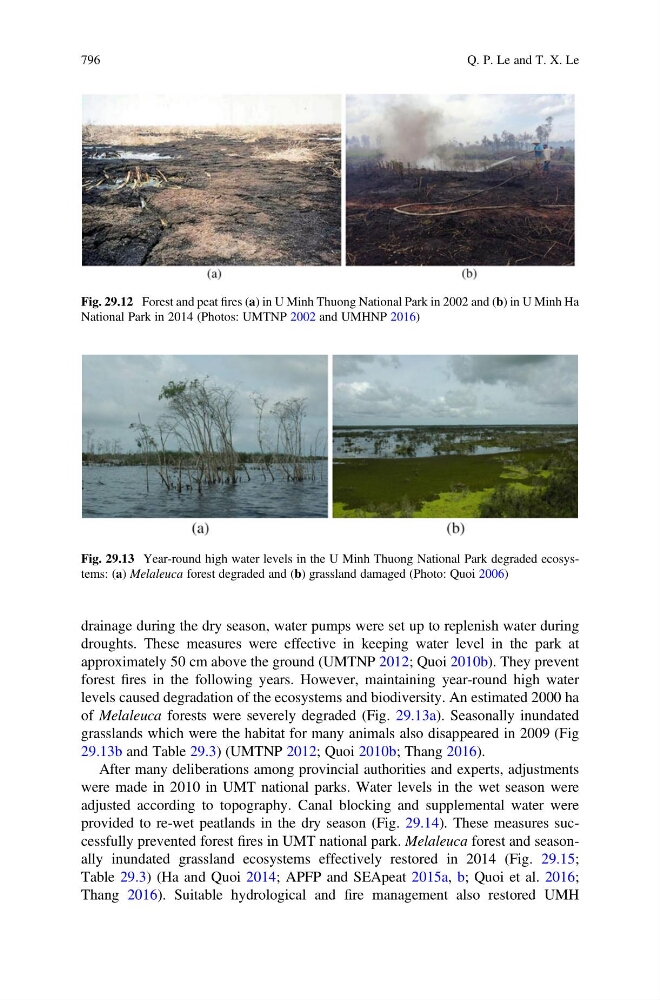
levels caused degradation of the ecosystems and biodiversity. An estimated 2000 ha
of Melaleuca forests were severely degraded (Fig. 29.13a). Seasonally inundated
grasslands which were the habitat for many animals also disappeared in 2009 (Fig
29.13b and Table 29.3) (UMTNP 2012; Quoi 2010b; Thang 2016).
After many deliberations among provincial authorities and experts, adjustments
were made in 2010 in UMT national parks. Water levels in the wet season were
adjusted according to topography. Canal blocking and supplemental water were
provided to re-wet peatlands in the dry season (Fig. 29.14). These measures successfully prevented forest fires in UMT national park. Melaleuca forest and seasonally inundated grassland ecosystems effectively restored in 2014 (Fig. 29.15;
Table 29.3) (Ha and Quoi 2014; APFP and SEApeat 2015a, b; Quoi et al. 2016;
Thang 2016). Suitable hydrological and fire management also restored UMH
Fig. 29.12 Forest and peat fires (a) in U Minh Thuong National Park in 2002 and (b) in U Minh Ha
National Park in 2014 (Photos: UMTNP 2002 and UMHNP 2016)
Fig. 29.13 Year-round high water levels in the U Minh Thuong National Park degraded ecosystems: (a) Melaleuca forest degraded and (b) grassland damaged (Photo: Quoi 2006)
796
Q. P. Le and T. X. Le