

28.4.3 Probiotic for Low Cholesterol Duck and Eliminating
Odor of Duck Cultivation
Probiotic is produced from good microorganisms from the intestine and improve the
quality of duck meat. In the action research conducted by Jambi University in 2018,
probiotic was produced from duck intestines. The ducks were cultivated in Seponjen
Village. In 2017, the ducks were cultivated from Day One Duck (DOD) state to
maturity. This means that the ducks were made adaptive to peat conditions (especially peat water). The intestines were collected and the microorganisms for probiotic production were selected and cultivated (personal communication with Fakhri
et al., 2018). An author of this paper was also involved in the entire process of the
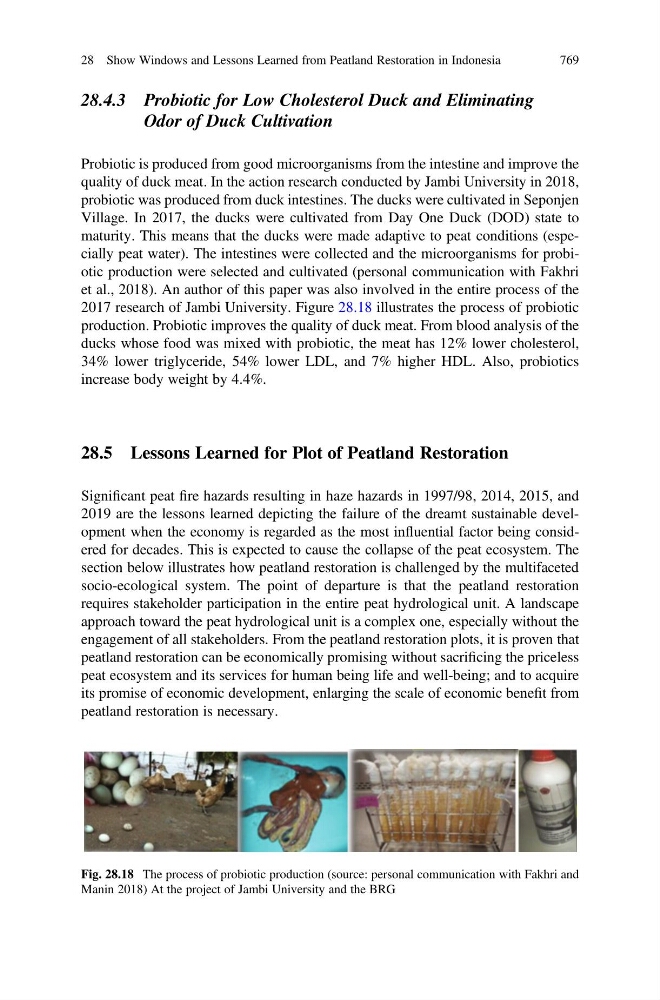
2017 research of Jambi University. Figure 28.18 illustrates the process of probiotic
production. Probiotic improves the quality of duck meat. From blood analysis of the
ducks whose food was mixed with probiotic, the meat has 12% lower cholesterol,
34% lower triglyceride, 54% lower LDL, and 7% higher HDL. Also, probiotics
increase body weight by 4.4%.
28.5 Lessons Learned for Plot of Peatland Restoration
Significant peat fire hazards resulting in haze hazards in 1997/98, 2014, 2015, and
2019 are the lessons learned depicting the failure of the dreamt sustainable development when the economy is regarded as the most influential factor being considered for decades. This is expected to cause the collapse of the peat ecosystem. The
section below illustrates how peatland restoration is challenged by the multifaceted
socio-ecological system. The point of departure is that the peatland restoration
requires stakeholder participation in the entire peat hydrological unit. A landscape
approach toward the peat hydrological unit is a complex one, especially without the
engagement of all stakeholders. From the peatland restoration plots, it is proven that
peatland restoration can be economically promising without sacrificing the priceless
peat ecosystem and its services for human being life and well-being; and to acquire
its promise of economic development, enlarging the scale of economic benefit from
peatland restoration is necessary.
Fig. 28.18 The process of probiotic production (source: personal communication with Fakhri and
Manin 2018) At the project of Jambi University and the BRG
28 Show Windows and Lessons Learned from Peatland Restoration in Indonesia
769