

28.4.2 Trigona apicalis and Trigona itama
Trigona apicalis and Trigona itama are two types of Trigona sp (kelulut bees). The
cultivation of Trigona apicalis was introduced in action researches in Tanjung Sari
Village and Lukun Village in Meranti Islands District, and in Liang Anggang, South
Kalimantan. In Rawa Mekar Jaya Village, Sungai Apit, Siak District, both Trigona
apicalis and Trigona itama are cultivated by Masyarakat Peduli Api (MPA/Fire
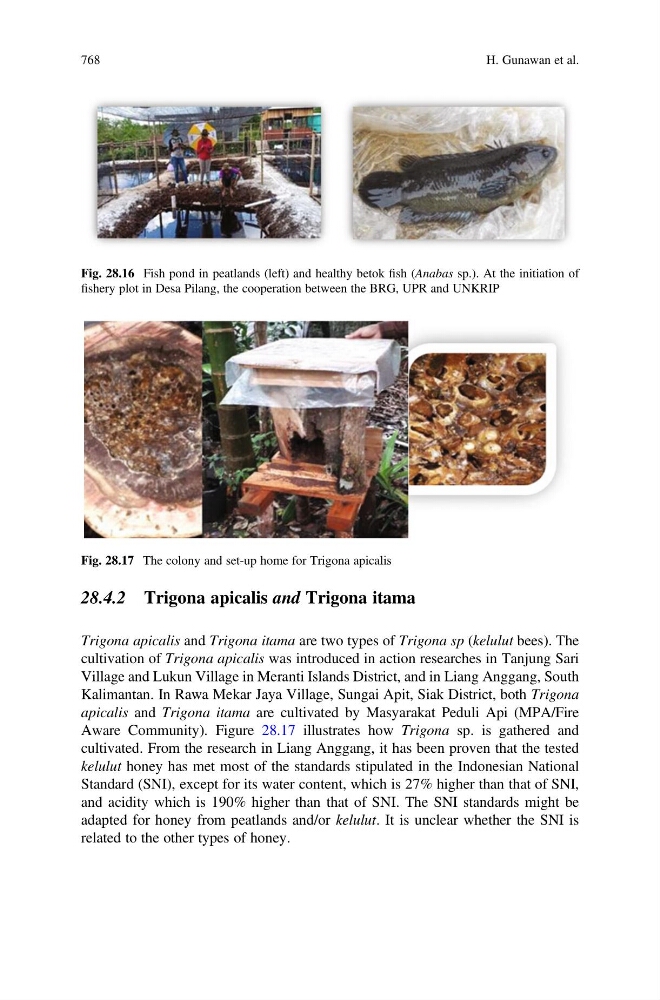
Aware Community). Figure 28.17 illustrates how Trigona sp. is gathered and
cultivated. From the research in Liang Anggang, it has been proven that the tested
kelulut honey has met most of the standards stipulated in the Indonesian National
Standard (SNI), except for its water content, which is 27% higher than that of SNI,
and acidity which is 190% higher than that of SNI. The SNI standards might be
adapted for honey from peatlands and/or kelulut. It is unclear whether the SNI is
related to the other types of honey.
Fig. 28.16 Fish pond in peatlands (left) and healthy betok fish (Anabas sp.). At the initiation of
fishery plot in Desa Pilang, the cooperation between the BRG, UPR and UNKRIP
Fig. 28.17 The colony and set-up home for Trigona apicalis
768
H. Gunawan et al.