

water holding capacity of these soils decreases greatly when burned. The water
holding capacity of the burnt ones is commonly <50%. Due to the fact that these
soils have high water holding capacity, there is the possibility of using some of the
peat swamps as a reservoir in the areas where there is inadequate water supply for
irrigation or ground water level maintenance. However, researches are required to
ascertain that the utilization of peat water will not incur problems to the crops grown.
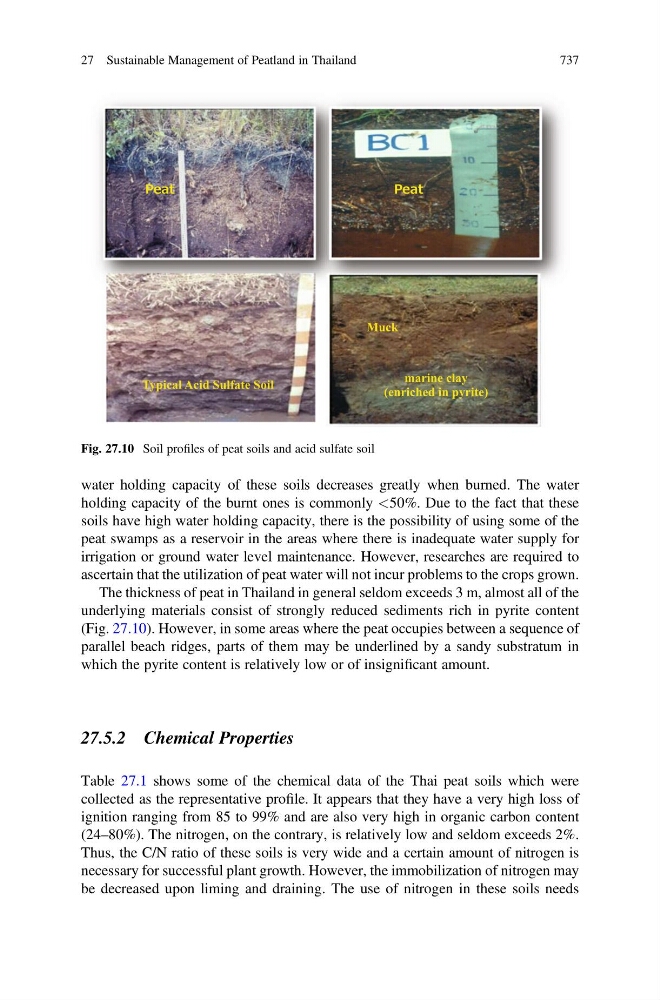
The thickness of peat in Thailand in general seldom exceeds 3 m, almost all of the
underlying materials consist of strongly reduced sediments rich in pyrite content
(Fig. 27.10). However, in some areas where the peat occupies between a sequence of
parallel beach ridges, parts of them may be underlined by a sandy substratum in
which the pyrite content is relatively low or of insignificant amount.
27.5.2 Chemical Properties
Table 27.1 shows some of the chemical data of the Thai peat soils which were
collected as the representative profile. It appears that they have a very high loss of
ignition ranging from 85 to 99% and are also very high in organic carbon content
(24–80%). The nitrogen, on the contrary, is relatively low and seldom exceeds 2%.
Thus, the C/N ratio of these soils is very wide and a certain amount of nitrogen is
necessary for successful plant growth. However, the immobilization of nitrogen may
be decreased upon liming and draining. The use of nitrogen in these soils needs
Typical Acid Sulfate Soil
Muck
marine clay
(enriched in pyrite)
Fig. 27.10 Soil profiles of peat soils and acid sulfate soil
27 Sustainable Management of Peatland in Thailand
737