

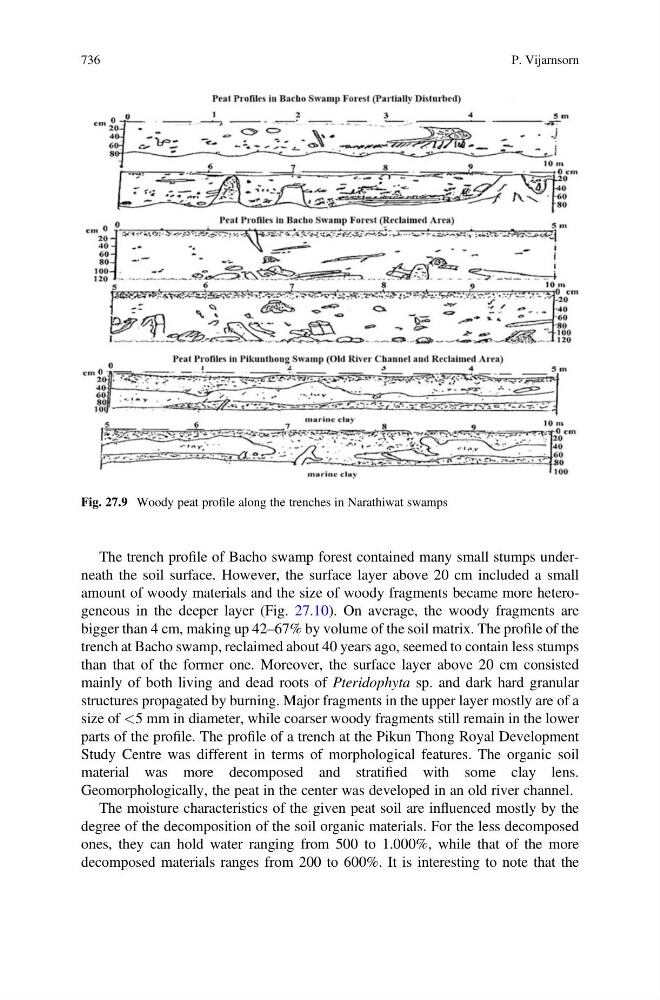
The trench profile of Bacho swamp forest contained many small stumps underneath the soil surface. However, the surface layer above 20 cm included a small
amount of woody materials and the size of woody fragments became more heterogeneous in the deeper layer (Fig. 27.10). On average, the woody fragments are
bigger than 4 cm, making up 42–67% by volume of the soil matrix. The profile of the
trench at Bacho swamp, reclaimed about 40 years ago, seemed to contain less stumps
than that of the former one. Moreover, the surface layer above 20 cm consisted
mainly of both living and dead roots of Pteridophyta sp. and dark hard granular
structures propagated by burning. Major fragments in the upper layer mostly are of a
size of <5 mm in diameter, while coarser woody fragments still remain in the lower
parts of the profile. The profile of a trench at the Pikun Thong Royal Development
Study Centre was different in terms of morphological features. The organic soil
material was more decomposed and stratified with some clay lens.
Geomorphologically, the peat in the center was developed in an old river channel.
The moisture characteristics of the given peat soil are influenced mostly by the
degree of the decomposition of the soil organic materials. For the less decomposed
ones, they can hold water ranging from 500 to 1.000%, while that of the more
decomposed materials ranges from 200 to 600%. It is interesting to note that the
Fig. 27.9 Woody peat profile along the trenches in Narathiwat swamps
736
P. Vijarnsorn