

is suggested that the plant succession began from Elaeocarpus spp., Illex spp.,
Hibiscus spp., and Meliaceae to the typical fresh-water swamp forest species.
According to the recent observation in a virgin swamp, Neesia altissima,
Stemonurus malaccensis, Elaeocarpus grandiflorus, Macaranga pruinosa,
Calophyllum inophylloide, Baccaurea bracteata, Dialium patens, and Eugenia
spp. are the dominant trees, whereas Calamus caesius, Daemonorops angustifolia,
Oncosperma tigillarium, and Cyrtostachys lakka represent palms and pandanus.
When these plants died and fell, the peat was easily developed because under
waterlogged condition, the rate of accumulation was greater than that of the decomposition. Since these peat swamps were normally flooded mainly by rain water and
no longer enriched by an influx of plant nutrients from outside, they became poor in
nutrients and accumulated high fiber contents.
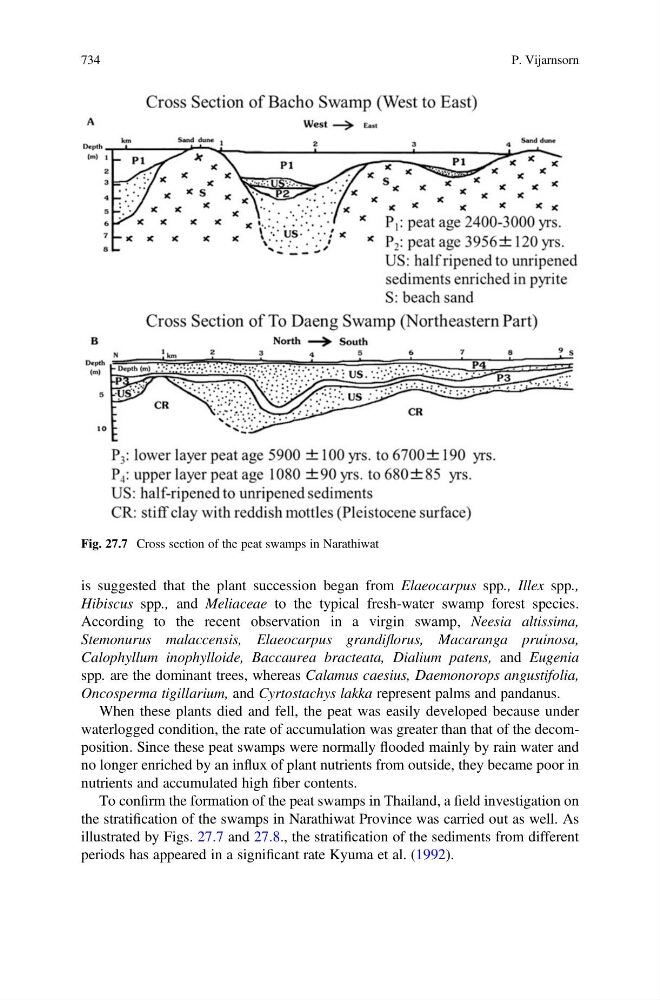
To confirm the formation of the peat swamps in Thailand, a field investigation on
the stratification of the swamps in Narathiwat Province was carried out as well. As
illustrated by Figs. 27.7 and 27.8., the stratification of the sediments from different
periods has appeared in a significant rate Kyuma et al. (1992).
Fig. 27.7 Cross section of the peat swamps in Narathiwat
734
P. Vijarnsorn