

beccarii Dans., Dendrophthoe pentandra Mig., and Helixanthera cylindrica (Jack)
Dans.
Ground floras are comparatively of poor condition. Normally, they are very
sparse but denser in the open spaces of the forest. The species include Aglaonema
marantifolium Bl., Homalomena griffithii Hook. f., and Hypolytrum nemorum
Spreng.
It is worth to mention that peat swamp forests also support many species of
primates, insects, and terrestrial animals. Under natural condition, abundant number
of Oribatid mite and Collembola has been observed (Kaneko and Aini 1991). They
certainly play an important role in litter decomposition. However, the abundance of
soil macrofaunal communities often decrease rapidly due to human activities,
particularly forest cutting, burning, drainage, and reclamation.
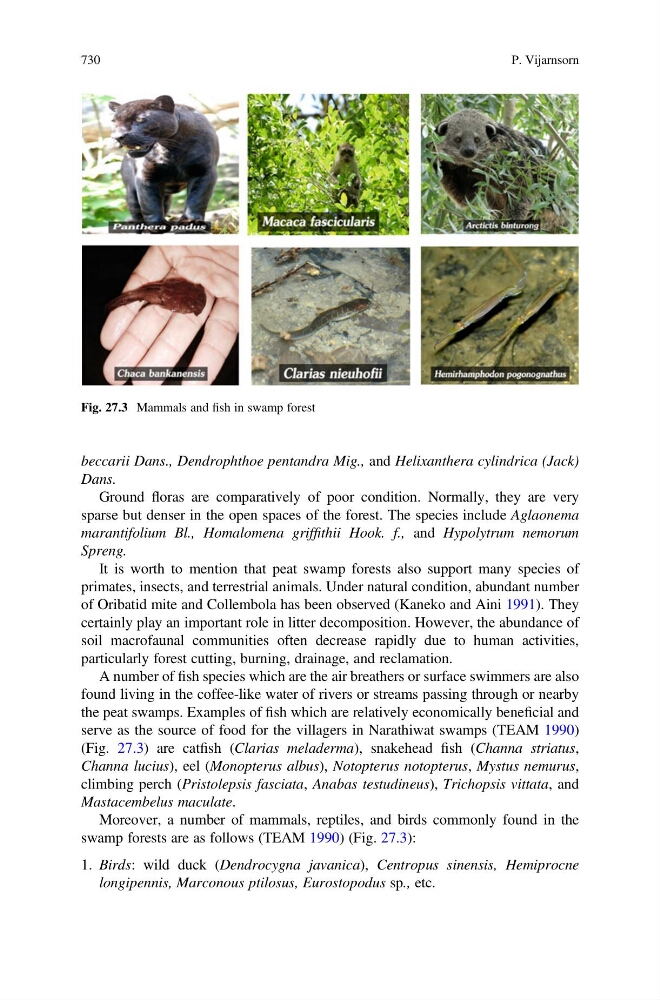
A number of fish species which are the air breathers or surface swimmers are also
found living in the coffee-like water of rivers or streams passing through or nearby
the peat swamps. Examples of fish which are relatively economically beneficial and
serve as the source of food for the villagers in Narathiwat swamps (TEAM 1990)
(Fig. 27.3) are catfish (Clarias meladerma), snakehead fish (Channa striatus,
Channa lucius), eel (Monopterus albus), Notopterus notopterus, Mystus nemurus,
climbing perch (Pristolepsis fasciata, Anabas testudineus), Trichopsis vittata, and
Mastacembelus maculate.
Moreover, a number of mammals, reptiles, and birds commonly found in the
swamp forests are as follows (TEAM 1990) (Fig. 27.3):
1. Birds: wild duck (Dendrocygna javanica), Centropus sinensis, Hemiprocne
longipennis, Marconous ptilosus, Eurostopodus sp., etc.
Fig. 27.3 Mammals and fish in swamp forest
730
P. Vijarnsorn