

Local people had begun living in this village in the 1930s and engaged in fishery,
dry-rice planting with shifting cultivation, pinang, rubber planting on a small scale.
After the independence, especially after the 1970s, because of the boom in
logging, Javanese from Medan flowed into the area. They gradually obtained land
near the Malay settlement, and some of them married Malays and settled there.
Around the 1980s when the HTI business (acacia timber plantation) and HGU
business (oil palm plantation) entered the area, the situation changed. At our research
site in the Bengkalis district, Riau Province, acacia timber plantation entered in
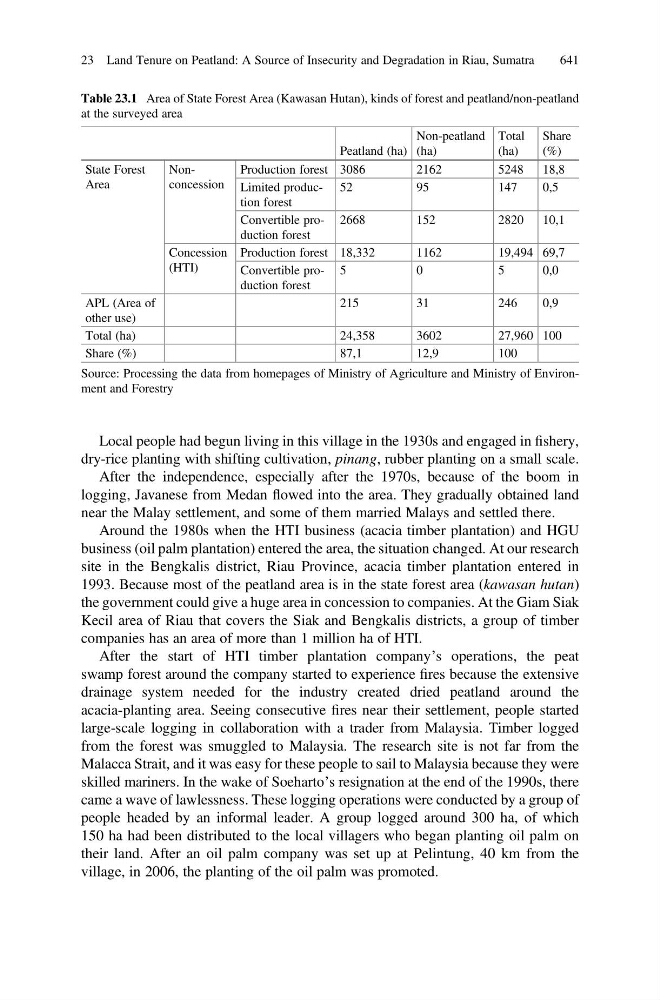
1993. Because most of the peatland area is in the state forest area (kawasan hutan)
the government could give a huge area in concession to companies. At the Giam Siak
Kecil area of Riau that covers the Siak and Bengkalis districts, a group of timber
companies has an area of more than 1 million ha of HTI.
After the start of HTI timber plantation company’s operations, the peat
swamp forest around the company started to experience fires because the extensive
drainage system needed for the industry created dried peatland around the
acacia-planting area. Seeing consecutive fires near their settlement, people started
large-scale logging in collaboration with a trader from Malaysia. Timber logged
from the forest was smuggled to Malaysia. The research site is not far from the
Malacca Strait, and it was easy for these people to sail to Malaysia because they were
skilled mariners. In the wake of Soeharto’s resignation at the end of the 1990s, there
came a wave of lawlessness. These logging operations were conducted by a group of
people headed by an informal leader. A group logged around 300 ha, of which
150 ha had been distributed to the local villagers who began planting oil palm on
their land. After an oil palm company was set up at Pelintung, 40 km from the
village, in 2006, the planting of the oil palm was promoted.
Table 23.1 Area of State Forest Area (Kawasan Hutan), kinds of forest and peatland/non-peatland
at the surveyed area
Peatland (ha)
Non-peatland
(ha)
Total
(ha)
Share
(%)
State Forest
Area
Nonconcession
Production forest 3086
2162
5248 18,8
Limited production forest
52
95
147
0,5
Convertible production forest
2668
152
2820 10,1
Concession
(HTI)
Production forest 18,332
1162
19,494 69,7
Convertible production forest
5
0
5
0,0
APL (Area of
other use)
215
31
246
0,9
Total (ha)
24,358
3602
27,960 100
Share (%)
87,1
12,9
100
Source: Processing the data from homepages of Ministry of Agriculture and Ministry of Environment and Forestry
23 Land Tenure on Peatland: A Source of Insecurity and Degradation in Riau, Sumatra
641