

22.3.3 Conclusion
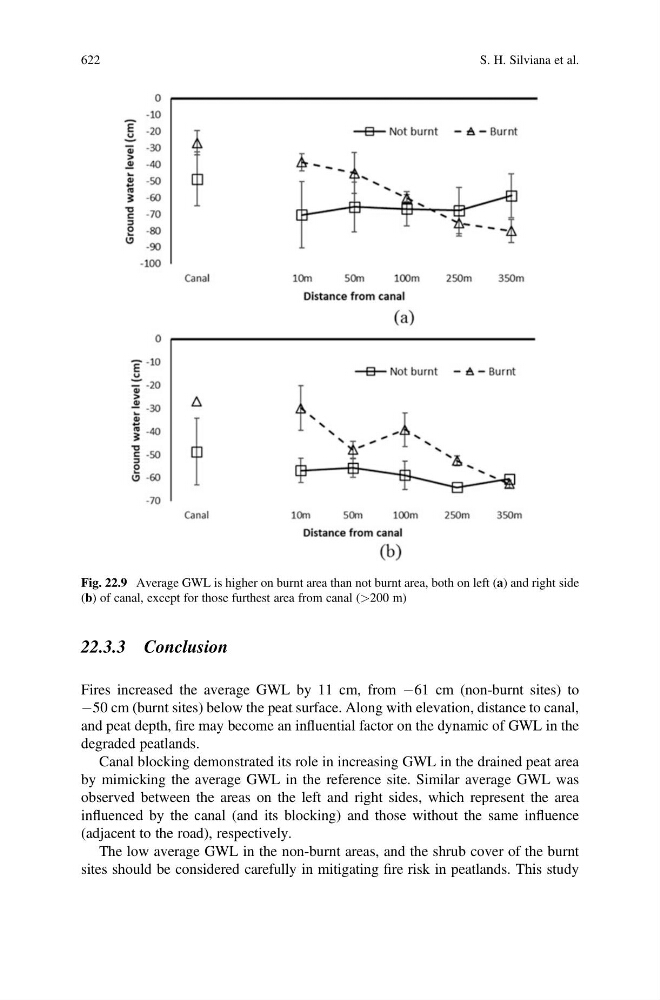
Fires increased the average GWL by 11 cm, from À61 cm (non-burnt sites) to
À50 cm (burnt sites) below the peat surface. Along with elevation, distance to canal,
and peat depth, fire may become an influential factor on the dynamic of GWL in the
degraded peatlands.
Canal blocking demonstrated its role in increasing GWL in the drained peat area
by mimicking the average GWL in the reference site. Similar average GWL was
observed between the areas on the left and right sides, which represent the area
influenced by the canal (and its blocking) and those without the same influence
(adjacent to the road), respectively.
The low average GWL in the non-burnt areas, and the shrub cover of the burnt
sites should be considered carefully in mitigating fire risk in peatlands. This study
Fig. 22.9 Average GWL is higher on burnt area than not burnt area, both on left (a) and right side
(b) of canal, except for those furthest area from canal (>200 m)
622
S. H. Silviana et al.
Fires increased the average GWL by 11 cm, from À61 cm (non-burnt sites) to
À50 cm (burnt sites) below the peat surface. Along with elevation, distance to canal,
and peat depth, fire may become an influential factor on the dynamic of GWL in the
degraded peatlands.
Canal blocking demonstrated its role in increasing GWL in the drained peat area
by mimicking the average GWL in the reference site. Similar average GWL was
observed between the areas on the left and right sides, which represent the area
influenced by the canal (and its blocking) and those without the same influence
(adjacent to the road), respectively.
The low average GWL in the non-burnt areas, and the shrub cover of the burnt
sites should be considered carefully in mitigating fire risk in peatlands. This study
Fig. 22.9 Average GWL is higher on burnt area than not burnt area, both on left (a) and right side
(b) of canal, except for those furthest area from canal (>200 m)
622
S. H. Silviana et al.