

by establishing canal blockings. The canal blocking is expected to, either entirely or
partially, increase the GWL.
Research on the role of hydrological management in tropical peatlands, which
have been restored by rewetting, is still lacking (Giessen and Sari 2018). It may be
due to the hydrological management efforts in peatlands that are still in the initial
stages, and the practice of peatland restoration after burning that is not yet wellexplored. Therefore, it is necessary to study intensively on interrelationship between
GWL and the condition of the groundwater level in the existing water structures/
canal blocking, and fire.
This study will assess the effect of canal blocking and fire in the peat ecosystem
restoration areas by analyzing the dynamic of GWL. The impact of canal blocking
will be assessed by periodically measuring GWL in a pair set of dipwells, contrasting
the peat areas affected by the canal (and blocking) with those without the same
influence. While the impact of fire will be tested by comparing the measured GWL
data from the sites with and without the burn scars.
22.2 Method
The study was conducted in Sungai Tohor Village, Kepulauan Meranti District, Riau
Province, in November 2018 to June 2019. The measurement of GWL was carried
out twice a month to represent wet months (November–December and March–April)
and dry months (January–February and May–June).
Research Field Design
GWL data collection was carried out around a single canal flow in the non-burnt and
burnt areas, each with three replications. The total number of monitoring piezometers was 66 comprising 33 sets both in the non-burnt and burnt areas, respectively.
The non-burnt areas were covered by sago, rubber, and secondary forest plantations,
while the burnt areas were covered by shrubs and marked as a burnt area-1, burnt
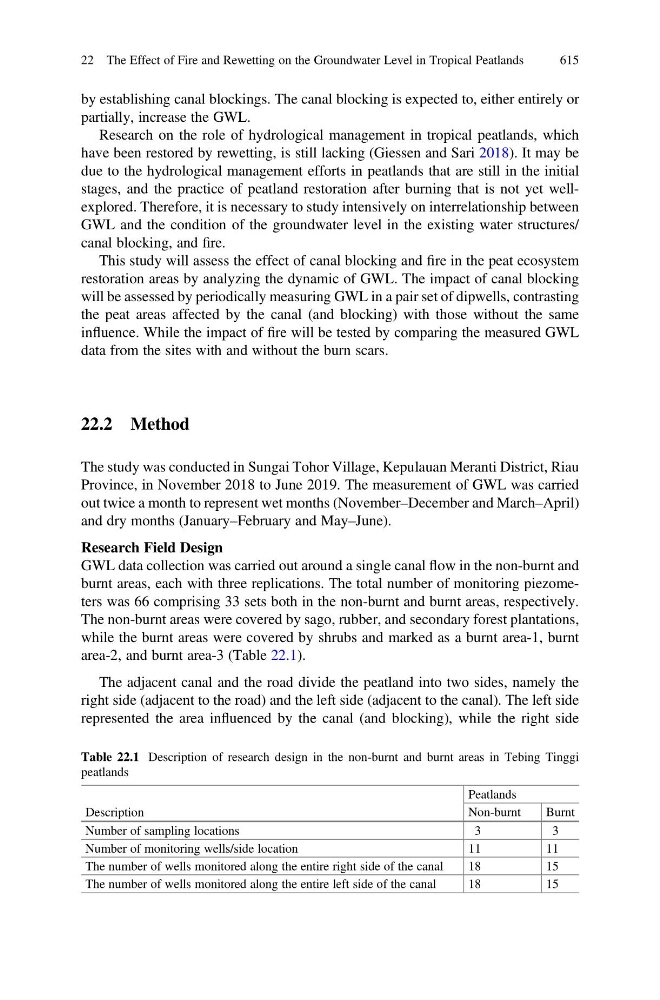
area-2, and burnt area-3 (Table 22.1).
The adjacent canal and the road divide the peatland into two sides, namely the
right side (adjacent to the road) and the left side (adjacent to the canal). The left side
represented the area influenced by the canal (and blocking), while the right side
Table 22.1 Description of research design in the non-burnt and burnt areas in Tebing Tinggi
peatlands
Description
Peatlands
Non-burnt
Burnt
Number of sampling locations
3
3
Number of monitoring wells/side location
11
11
The number of wells monitored along the entire right side of the canal
18
15
The number of wells monitored along the entire left side of the canal
18
15
22 The Effect of Fire and Rewetting on the Groundwater Level in Tropical Peatlands
615
partially, increase the GWL.
Research on the role of hydrological management in tropical peatlands, which
have been restored by rewetting, is still lacking (Giessen and Sari 2018). It may be
due to the hydrological management efforts in peatlands that are still in the initial
stages, and the practice of peatland restoration after burning that is not yet wellexplored. Therefore, it is necessary to study intensively on interrelationship between
GWL and the condition of the groundwater level in the existing water structures/
canal blocking, and fire.
This study will assess the effect of canal blocking and fire in the peat ecosystem
restoration areas by analyzing the dynamic of GWL. The impact of canal blocking
will be assessed by periodically measuring GWL in a pair set of dipwells, contrasting
the peat areas affected by the canal (and blocking) with those without the same
influence. While the impact of fire will be tested by comparing the measured GWL
data from the sites with and without the burn scars.
22.2 Method
The study was conducted in Sungai Tohor Village, Kepulauan Meranti District, Riau
Province, in November 2018 to June 2019. The measurement of GWL was carried
out twice a month to represent wet months (November–December and March–April)
and dry months (January–February and May–June).
Research Field Design
GWL data collection was carried out around a single canal flow in the non-burnt and
burnt areas, each with three replications. The total number of monitoring piezometers was 66 comprising 33 sets both in the non-burnt and burnt areas, respectively.
The non-burnt areas were covered by sago, rubber, and secondary forest plantations,
while the burnt areas were covered by shrubs and marked as a burnt area-1, burnt
area-2, and burnt area-3 (Table 22.1).
The adjacent canal and the road divide the peatland into two sides, namely the
right side (adjacent to the road) and the left side (adjacent to the canal). The left side
represented the area influenced by the canal (and blocking), while the right side
Table 22.1 Description of research design in the non-burnt and burnt areas in Tebing Tinggi
peatlands
Description
Peatlands
Non-burnt
Burnt
Number of sampling locations
3
3
Number of monitoring wells/side location
11
11
The number of wells monitored along the entire right side of the canal
18
15
The number of wells monitored along the entire left side of the canal
18
15
22 The Effect of Fire and Rewetting on the Groundwater Level in Tropical Peatlands
615