

upper adventitious root, as well as the axillary organs and the lower adventitious
root, which is adjacent to one of the nodes. The interrelationships among organs
from the strongest to the weakest are in the following order: (1) within the node unit
> (2) between the node unit in the same or adjacent phyllotaxy > (3) in the main root
or apical organs adjacent to the node unit.
Thus, root primordia are classified into two types according to the embryology of
the node unit: adventitious roots and main roots. Adventitious roots develop into
lateral roots underground, aerial roots in the air, or different types of mangrove roots
in saline water such as stilt roots, knee roots, pencil roots, peg roots, buttress roots,
spreading roots, and others. Thus, adventitious roots morphology varies according
to species and environmental condition; however, key metabolic function on water,
oxygen, and nutrients will be similar.
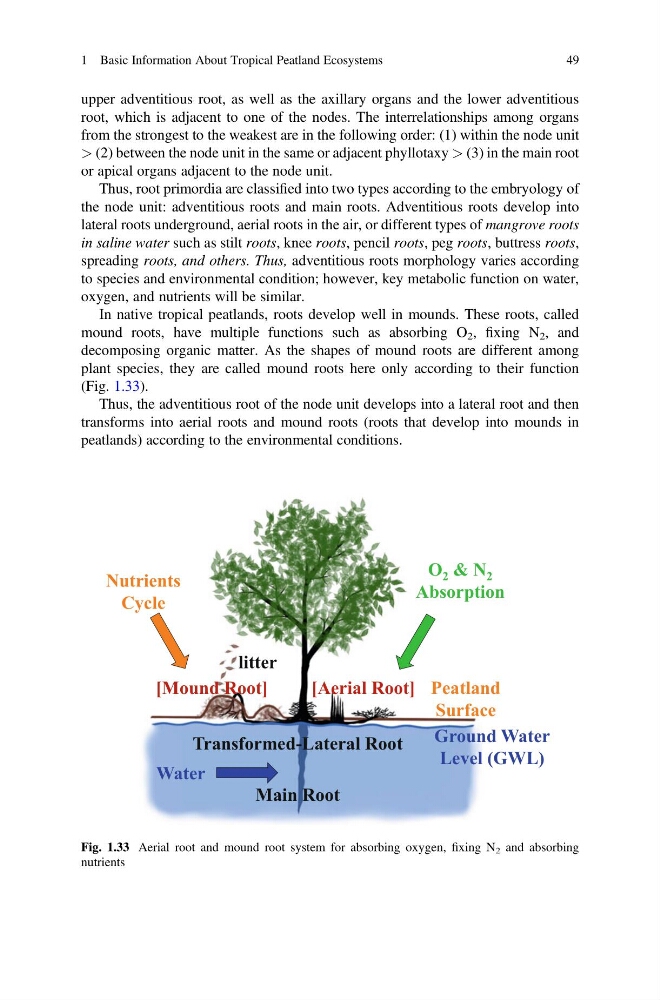
In native tropical peatlands, roots develop well in mounds. These roots, called
mound roots, have multiple functions such as absorbing O 2 , fixing N 2 , and
decomposing organic matter. As the shapes of mound roots are different among
plant species, they are called mound roots here only according to their function
(Fig. 1.33).
Thus, the adventitious root of the node unit develops into a lateral root and then
transforms into aerial roots and mound roots (roots that develop into mounds in
peatlands) according to the environmental conditions.
Transformed-Lateral Root
Main Root
[Mound Root]
[Aerial Root] Peatland
Surface
Ground Water
Level (GWL)
litter
Nutrients
Cycle
O 2 & N 2
Absorption
Water
Fig. 1.33 Aerial root and mound root system for absorbing oxygen, fixing N 2 and absorbing
nutrients
1 Basic Information About Tropical Peatland Ecosystems
49
root, which is adjacent to one of the nodes. The interrelationships among organs
from the strongest to the weakest are in the following order: (1) within the node unit
> (2) between the node unit in the same or adjacent phyllotaxy > (3) in the main root
or apical organs adjacent to the node unit.
Thus, root primordia are classified into two types according to the embryology of
the node unit: adventitious roots and main roots. Adventitious roots develop into
lateral roots underground, aerial roots in the air, or different types of mangrove roots
in saline water such as stilt roots, knee roots, pencil roots, peg roots, buttress roots,
spreading roots, and others. Thus, adventitious roots morphology varies according
to species and environmental condition; however, key metabolic function on water,
oxygen, and nutrients will be similar.
In native tropical peatlands, roots develop well in mounds. These roots, called
mound roots, have multiple functions such as absorbing O 2 , fixing N 2 , and
decomposing organic matter. As the shapes of mound roots are different among
plant species, they are called mound roots here only according to their function
(Fig. 1.33).
Thus, the adventitious root of the node unit develops into a lateral root and then
transforms into aerial roots and mound roots (roots that develop into mounds in
peatlands) according to the environmental conditions.
Transformed-Lateral Root
Main Root
[Mound Root]
[Aerial Root] Peatland
Surface
Ground Water
Level (GWL)
litter
Nutrients
Cycle
O 2 & N 2
Absorption
Water
Fig. 1.33 Aerial root and mound root system for absorbing oxygen, fixing N 2 and absorbing
nutrients
1 Basic Information About Tropical Peatland Ecosystems
49