

1.10 Root Water and Nutrient Uptake Functions
1.10.1 Root Morphology
Leaf–root interactions are a critical factor for plant growth during maturation, and
root activity is maintained by a sufficient supply of photosynthates.
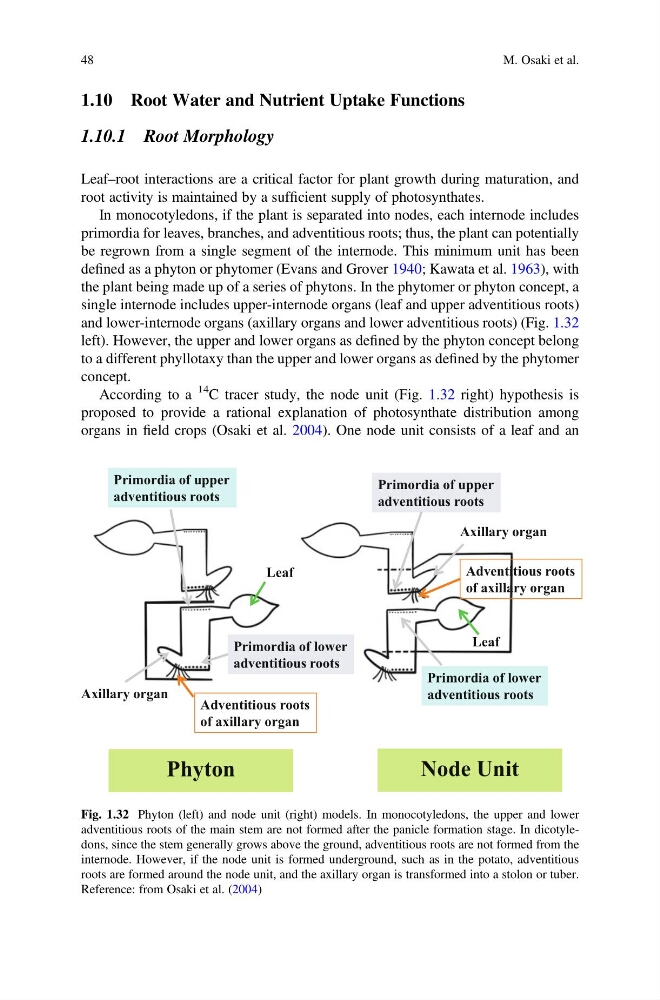
In monocotyledons, if the plant is separated into nodes, each internode includes
primordia for leaves, branches, and adventitious roots; thus, the plant can potentially
be regrown from a single segment of the internode. This minimum unit has been
defined as a phyton or phytomer (Evans and Grover 1940; Kawata et al. 1963), with
the plant being made up of a series of phytons. In the phytomer or phyton concept, a
single internode includes upper-internode organs (leaf and upper adventitious roots)
and lower-internode organs (axillary organs and lower adventitious roots) (Fig. 1.32
left). However, the upper and lower organs as defined by the phyton concept belong
to a different phyllotaxy than the upper and lower organs as defined by the phytomer
concept.
According to a
14 C tracer study, the node unit (Fig. 1.32 right) hypothesis is
proposed to provide a rational explanation of photosynthate distribution among
organs in field crops (Osaki et al. 2004). One node unit consists of a leaf and an
Leaf
Primordia of lower
adventitious roots
Axillary organ
Adventitious roots
of axillary organ
Primordia of upper
adventitious roots
Primordia of upper
adventitious roots
Leaf
Primordia of lower
adventitious roots
Axillary organ
Adventitious roots
of axillary organ
Node Unit
Phyton
Fig. 1.32 Phyton (left) and node unit (right) models. In monocotyledons, the upper and lower
adventitious roots of the main stem are not formed after the panicle formation stage. In dicotyledons, since the stem generally grows above the ground, adventitious roots are not formed from the
internode. However, if the node unit is formed underground, such as in the potato, adventitious
roots are formed around the node unit, and the axillary organ is transformed into a stolon or tuber.
Reference: from Osaki et al. (2004)
48
M. Osaki et al.
1.10.1 Root Morphology
Leaf–root interactions are a critical factor for plant growth during maturation, and
root activity is maintained by a sufficient supply of photosynthates.
In monocotyledons, if the plant is separated into nodes, each internode includes
primordia for leaves, branches, and adventitious roots; thus, the plant can potentially
be regrown from a single segment of the internode. This minimum unit has been
defined as a phyton or phytomer (Evans and Grover 1940; Kawata et al. 1963), with
the plant being made up of a series of phytons. In the phytomer or phyton concept, a
single internode includes upper-internode organs (leaf and upper adventitious roots)
and lower-internode organs (axillary organs and lower adventitious roots) (Fig. 1.32
left). However, the upper and lower organs as defined by the phyton concept belong
to a different phyllotaxy than the upper and lower organs as defined by the phytomer
concept.
According to a
14 C tracer study, the node unit (Fig. 1.32 right) hypothesis is
proposed to provide a rational explanation of photosynthate distribution among
organs in field crops (Osaki et al. 2004). One node unit consists of a leaf and an
Leaf
Primordia of lower
adventitious roots
Axillary organ
Adventitious roots
of axillary organ
Primordia of upper
adventitious roots
Primordia of upper
adventitious roots
Leaf
Primordia of lower
adventitious roots
Axillary organ
Adventitious roots
of axillary organ
Node Unit
Phyton
Fig. 1.32 Phyton (left) and node unit (right) models. In monocotyledons, the upper and lower
adventitious roots of the main stem are not formed after the panicle formation stage. In dicotyledons, since the stem generally grows above the ground, adventitious roots are not formed from the
internode. However, if the node unit is formed underground, such as in the potato, adventitious
roots are formed around the node unit, and the axillary organ is transformed into a stolon or tuber.
Reference: from Osaki et al. (2004)
48
M. Osaki et al.