

19.4.1.2 Paper Disk Type Groundwater Velocimeter (PDGV)
Paper disk type measurement device for the groundwater flow (PDGV) (Yamamoto
et al. 2017) was used to measure groundwater flow in Bengkalis Island, Riau. This
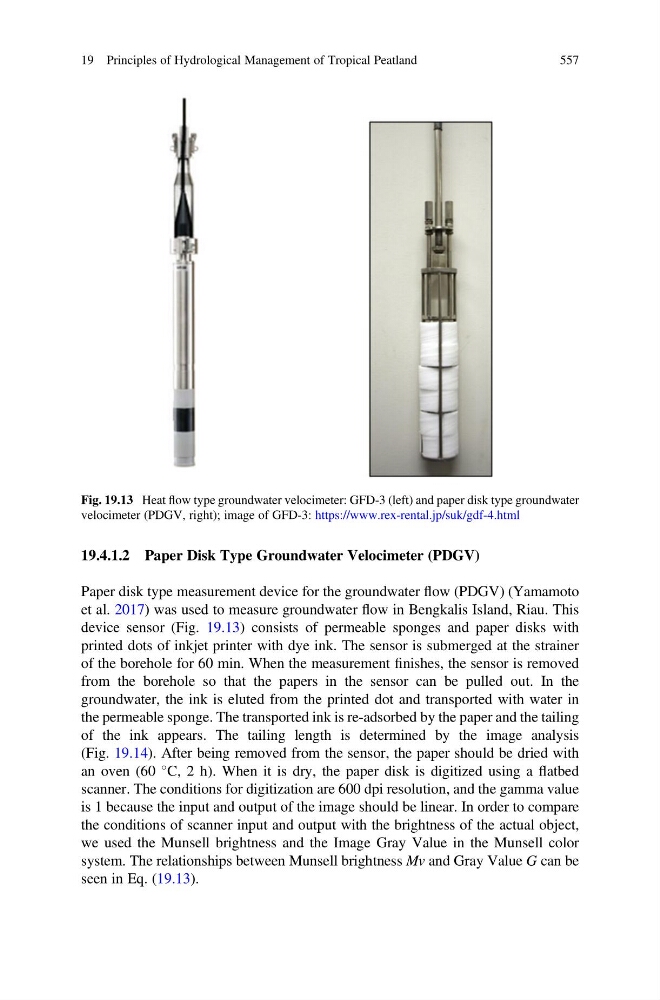
device sensor (Fig. 19.13) consists of permeable sponges and paper disks with
printed dots of inkjet printer with dye ink. The sensor is submerged at the strainer
of the borehole for 60 min. When the measurement finishes, the sensor is removed
from the borehole so that the papers in the sensor can be pulled out. In the
groundwater, the ink is eluted from the printed dot and transported with water in
the permeable sponge. The transported ink is re-adsorbed by the paper and the tailing
of the ink appears. The tailing length is determined by the image analysis
(Fig. 19.14). After being removed from the sensor, the paper should be dried with
an oven (60
C, 2 h). When it is dry, the paper disk is digitized using a flatbed
scanner. The conditions for digitization are 600 dpi resolution, and the gamma value
is 1 because the input and output of the image should be linear. In order to compare
the conditions of scanner input and output with the brightness of the actual object,
we used the Munsell brightness and the Image Gray Value in the Munsell color
system. The relationships between Munsell brightness Mv and Gray Value G can be
seen in Eq. (19.13).
Fig. 19.13 Heat flow type groundwater velocimeter: GFD-3 (left) and paper disk type groundwater
velocimeter (PDGV, right); image of GFD-3: https://www.rex-rental.jp/suk/gdf-4.html
19 Principles of Hydrological Management of Tropical Peatland
557
Paper disk type measurement device for the groundwater flow (PDGV) (Yamamoto
et al. 2017) was used to measure groundwater flow in Bengkalis Island, Riau. This
device sensor (Fig. 19.13) consists of permeable sponges and paper disks with
printed dots of inkjet printer with dye ink. The sensor is submerged at the strainer
of the borehole for 60 min. When the measurement finishes, the sensor is removed
from the borehole so that the papers in the sensor can be pulled out. In the
groundwater, the ink is eluted from the printed dot and transported with water in
the permeable sponge. The transported ink is re-adsorbed by the paper and the tailing
of the ink appears. The tailing length is determined by the image analysis
(Fig. 19.14). After being removed from the sensor, the paper should be dried with
an oven (60
C, 2 h). When it is dry, the paper disk is digitized using a flatbed
scanner. The conditions for digitization are 600 dpi resolution, and the gamma value
is 1 because the input and output of the image should be linear. In order to compare
the conditions of scanner input and output with the brightness of the actual object,
we used the Munsell brightness and the Image Gray Value in the Munsell color
system. The relationships between Munsell brightness Mv and Gray Value G can be
seen in Eq. (19.13).
Fig. 19.13 Heat flow type groundwater velocimeter: GFD-3 (left) and paper disk type groundwater
velocimeter (PDGV, right); image of GFD-3: https://www.rex-rental.jp/suk/gdf-4.html
19 Principles of Hydrological Management of Tropical Peatland
557