

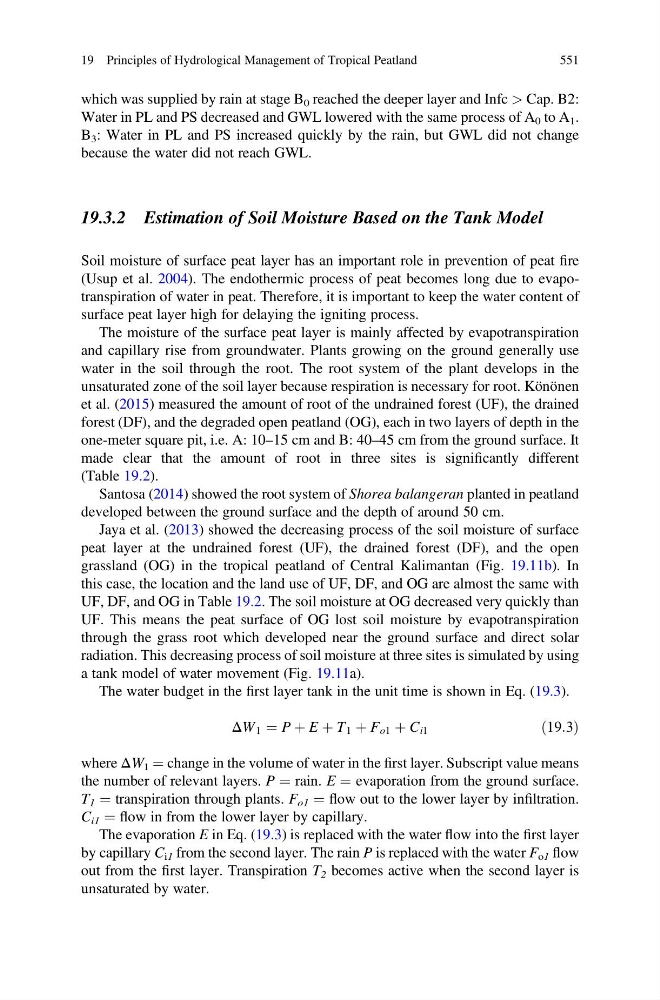
which was supplied by rain at stage B 0 reached the deeper layer and Infc > Cap. B2:
Water in PL and PS decreased and GWL lowered with the same process of A 0 to A 1 .
B 3 : Water in PL and PS increased quickly by the rain, but GWL did not change
because the water did not reach GWL.
19.3.2 Estimation of Soil Moisture Based on the Tank Model
Soil moisture of surface peat layer has an important role in prevention of peat fire
(Usup et al. 2004). The endothermic process of peat becomes long due to evapotranspiration of water in peat. Therefore, it is important to keep the water content of
surface peat layer high for delaying the igniting process.
The moisture of the surface peat layer is mainly affected by evapotranspiration
and capillary rise from groundwater. Plants growing on the ground generally use
water in the soil through the root. The root system of the plant develops in the
unsaturated zone of the soil layer because respiration is necessary for root. Könönen
et al. (2015) measured the amount of root of the undrained forest (UF), the drained
forest (DF), and the degraded open peatland (OG), each in two layers of depth in the
one-meter square pit, i.e. A: 10–15 cm and B: 40–45 cm from the ground surface. It
made clear that the amount of root in three sites is significantly different
(Table 19.2).
Santosa (2014) showed the root system of Shorea balangeran planted in peatland
developed between the ground surface and the depth of around 50 cm.
Jaya et al. (2013) showed the decreasing process of the soil moisture of surface
peat layer at the undrained forest (UF), the drained forest (DF), and the open
grassland (OG) in the tropical peatland of Central Kalimantan (Fig. 19.11b). In
this case, the location and the land use of UF, DF, and OG are almost the same with
UF, DF, and OG in Table 19.2. The soil moisture at OG decreased very quickly than
UF. This means the peat surface of OG lost soil moisture by evapotranspiration
through the grass root which developed near the ground surface and direct solar
radiation. This decreasing process of soil moisture at three sites is simulated by using
a tank model of water movement (Fig. 19.11a).
The water budget in the first layer tank in the unit time is shown in Eq. (19.3).
ΔW 1 ¼ P þ E þ T 1 þ F o1 þ C i1
ð19:3Þ
where ΔW 1 ¼ change in the volume of water in the first layer. Subscript value means
the number of relevant layers. P ¼ rain. E ¼ evaporation from the ground surface.
T 1 ¼ transpiration through plants. F o1 ¼ flow out to the lower layer by infiltration.
C i1 ¼ flow in from the lower layer by capillary.
The evaporation E in Eq. (19.3) is replaced with the water flow into the first layer
by capillary C i1 from the second layer. The rain P is replaced with the water F o1 flow
out from the first layer. Transpiration T 2 becomes active when the second layer is
unsaturated by water.
19 Principles of Hydrological Management of Tropical Peatland
551
Water in PL and PS decreased and GWL lowered with the same process of A 0 to A 1 .
B 3 : Water in PL and PS increased quickly by the rain, but GWL did not change
because the water did not reach GWL.
19.3.2 Estimation of Soil Moisture Based on the Tank Model
Soil moisture of surface peat layer has an important role in prevention of peat fire
(Usup et al. 2004). The endothermic process of peat becomes long due to evapotranspiration of water in peat. Therefore, it is important to keep the water content of
surface peat layer high for delaying the igniting process.
The moisture of the surface peat layer is mainly affected by evapotranspiration
and capillary rise from groundwater. Plants growing on the ground generally use
water in the soil through the root. The root system of the plant develops in the
unsaturated zone of the soil layer because respiration is necessary for root. Könönen
et al. (2015) measured the amount of root of the undrained forest (UF), the drained
forest (DF), and the degraded open peatland (OG), each in two layers of depth in the
one-meter square pit, i.e. A: 10–15 cm and B: 40–45 cm from the ground surface. It
made clear that the amount of root in three sites is significantly different
(Table 19.2).
Santosa (2014) showed the root system of Shorea balangeran planted in peatland
developed between the ground surface and the depth of around 50 cm.
Jaya et al. (2013) showed the decreasing process of the soil moisture of surface
peat layer at the undrained forest (UF), the drained forest (DF), and the open
grassland (OG) in the tropical peatland of Central Kalimantan (Fig. 19.11b). In
this case, the location and the land use of UF, DF, and OG are almost the same with
UF, DF, and OG in Table 19.2. The soil moisture at OG decreased very quickly than
UF. This means the peat surface of OG lost soil moisture by evapotranspiration
through the grass root which developed near the ground surface and direct solar
radiation. This decreasing process of soil moisture at three sites is simulated by using
a tank model of water movement (Fig. 19.11a).
The water budget in the first layer tank in the unit time is shown in Eq. (19.3).
ΔW 1 ¼ P þ E þ T 1 þ F o1 þ C i1
ð19:3Þ
where ΔW 1 ¼ change in the volume of water in the first layer. Subscript value means
the number of relevant layers. P ¼ rain. E ¼ evaporation from the ground surface.
T 1 ¼ transpiration through plants. F o1 ¼ flow out to the lower layer by infiltration.
C i1 ¼ flow in from the lower layer by capillary.
The evaporation E in Eq. (19.3) is replaced with the water flow into the first layer
by capillary C i1 from the second layer. The rain P is replaced with the water F o1 flow
out from the first layer. Transpiration T 2 becomes active when the second layer is
unsaturated by water.
19 Principles of Hydrological Management of Tropical Peatland
551