

19.3.1.4 Hysteresis in the Groundwater Table Change
Hayward and Clymo (1982) measured the profiles of water content and pore size in
the surface layer of Sphagnum peat by using core sample, 30 cm in diameter and
8–20 cm in depth, and the collimated beam of gamma radiation. They found the
hysteresis of water content in the lowering and rising processes of groundwater level.
The hysteresis process was also obtained by using the sponge sample, which has a
three-dimensional trabecular structure. They clarified the vertical distribution of pore
size, which is completely permeable to gas but impermeable to liquid water and
connected by a small channel, in peat layer affected the hysteresis process of water
table change.
Rezanezhad et al. (2016) mentioned that pore sizes in undecomposed peat can
exceed 5 mm, but significant shrinkage occurs during dewatering, compression, and
decomposition, which decrease the pore sizes. The structure of peat soil consists of
pores that are open and connected, dead ended, or isolated. Figure 19.10 shows the
drying and re-wetting processes of soil moisture at a peat swamp forest in Central
Kalimantan, Indonesia (a), the schematic diagram of the large and small pores and
channel in peat soil layers (b), the water flow process which estimated the water flow
and changing process of the amount of water in the pores (stage A 0 to B 3 ). More
detailed explanations of the water flow and condition are as follows. A 0 : PL and PS
are filled by water with long-time wetting. A 1 : Water in PL and PS decreased and
GWL lowered because (InfA+Cap) < (InfB+Ev). B 0 : Water in PL was filled because
(InfA+Cap) > (InfB+Ev) by rain. But enough water Inf C did not reach GW, then
GWL did not change. Air mass was trapped in PS because the small channel between
PL and PS was closed by quick increase of water in PL. B 1 : Water in PL and PS
decreased again because (InfA+Cap) < (InfB+Ev) and GWL rose because the water
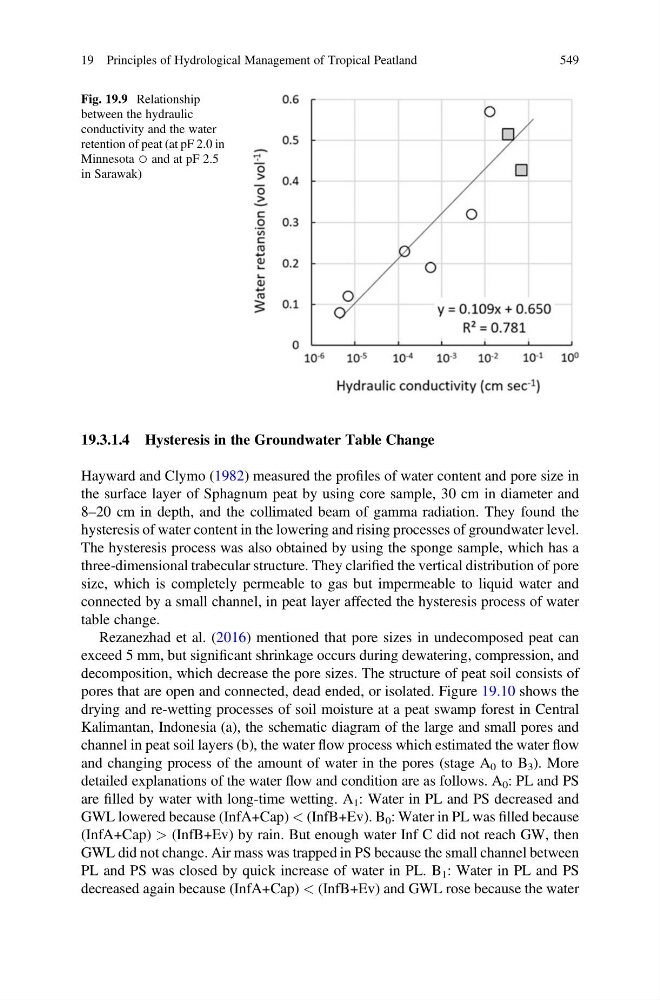
Fig. 19.9 Relationship
between the hydraulic
conductivity and the water
retention of peat (at pF 2.0 in
Minnesota ○ and at pF 2.5
in Sarawak)
19 Principles of Hydrological Management of Tropical Peatland
549
Hayward and Clymo (1982) measured the profiles of water content and pore size in
the surface layer of Sphagnum peat by using core sample, 30 cm in diameter and
8–20 cm in depth, and the collimated beam of gamma radiation. They found the
hysteresis of water content in the lowering and rising processes of groundwater level.
The hysteresis process was also obtained by using the sponge sample, which has a
three-dimensional trabecular structure. They clarified the vertical distribution of pore
size, which is completely permeable to gas but impermeable to liquid water and
connected by a small channel, in peat layer affected the hysteresis process of water
table change.
Rezanezhad et al. (2016) mentioned that pore sizes in undecomposed peat can
exceed 5 mm, but significant shrinkage occurs during dewatering, compression, and
decomposition, which decrease the pore sizes. The structure of peat soil consists of
pores that are open and connected, dead ended, or isolated. Figure 19.10 shows the
drying and re-wetting processes of soil moisture at a peat swamp forest in Central
Kalimantan, Indonesia (a), the schematic diagram of the large and small pores and
channel in peat soil layers (b), the water flow process which estimated the water flow
and changing process of the amount of water in the pores (stage A 0 to B 3 ). More
detailed explanations of the water flow and condition are as follows. A 0 : PL and PS
are filled by water with long-time wetting. A 1 : Water in PL and PS decreased and
GWL lowered because (InfA+Cap) < (InfB+Ev). B 0 : Water in PL was filled because
(InfA+Cap) > (InfB+Ev) by rain. But enough water Inf C did not reach GW, then
GWL did not change. Air mass was trapped in PS because the small channel between
PL and PS was closed by quick increase of water in PL. B 1 : Water in PL and PS
decreased again because (InfA+Cap) < (InfB+Ev) and GWL rose because the water
Fig. 19.9 Relationship
between the hydraulic
conductivity and the water
retention of peat (at pF 2.0 in
Minnesota ○ and at pF 2.5
in Sarawak)
19 Principles of Hydrological Management of Tropical Peatland
549