

19.3.1.3 Water Retention of Peat
Water in the mineral soil is mainly held and controlled by the size of soil matrix, soil
particles, and pores. The organic materials in the mineral soil have some effects on
the water retention of soil. But in the case of peat, the ash content of peat is lower
than 55% in grÁgr
À1 . Thus the water retention of peat is governed by the structure of
peat matrix. The undecomposed peat has large organic matrix and space. The size of
peat matrix becomes small as the decomposition of peat progresses. The effective
porosities of peat in the peat swamp forest decrease in a deeper layer in
Fig. 19.8b. This means peat matrix is getting smaller when the peat is decomposing.
Boelter (1968) showed the water content in the same water suction increased
significantly with the progress of decomposition in several Northern Minnesota
peat materials. Sayok et al. (2007) reported the high hydraulic conductivity values
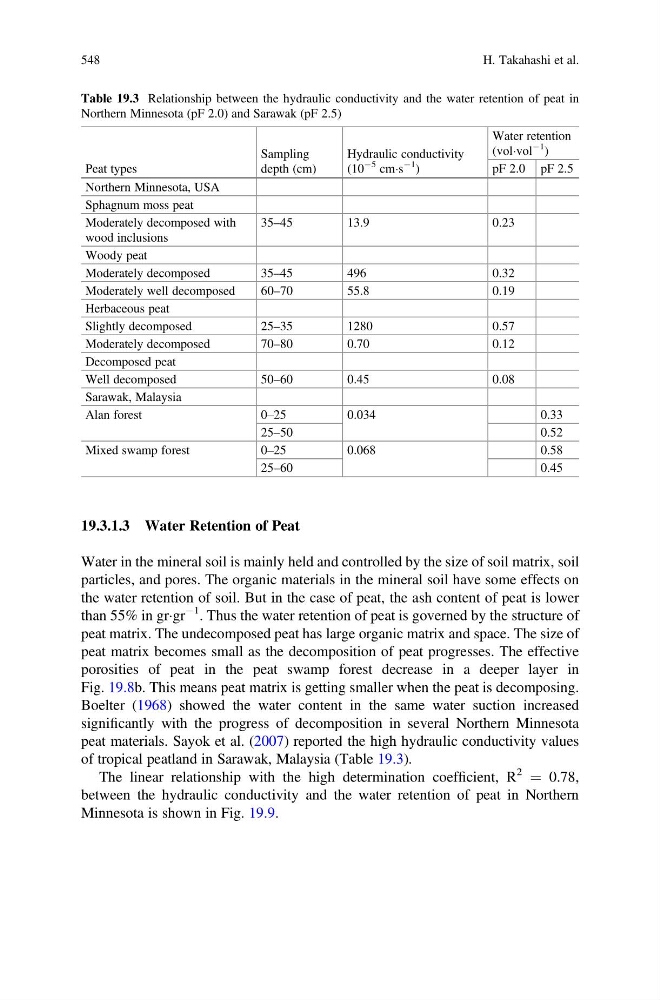
of tropical peatland in Sarawak, Malaysia (Table 19.3).
The linear relationship with the high determination coefficient, R
2
¼ 0.78,
between the hydraulic conductivity and the water retention of peat in Northern
Minnesota is shown in Fig. 19.9.
Table 19.3 Relationship between the hydraulic conductivity and the water retention of peat in
Northern Minnesota (pF 2.0) and Sarawak (pF 2.5)
Peat types
Sampling
depth (cm)
Hydraulic conductivity
(10
À5 cmÁs
À1
)
Water retention
(volÁvol
À1
)
pF 2.0 pF 2.5
Northern Minnesota, USA
Sphagnum moss peat
Moderately decomposed with
wood inclusions
35–45
13.9
0.23
Woody peat
Moderately decomposed
35–45
496
0.32
Moderately well decomposed
60–70
55.8
0.19
Herbaceous peat
Slightly decomposed
25–35
1280
0.57
Moderately decomposed
70–80
0.70
0.12
Decomposed peat
Well decomposed
50–60
0.45
0.08
Sarawak, Malaysia
Alan forest
0–25
0.034
0.33
25–50
0.52
Mixed swamp forest
0–25
0.068
0.58
25–60
0.45
548
H. Takahashi et al.
Water in the mineral soil is mainly held and controlled by the size of soil matrix, soil
particles, and pores. The organic materials in the mineral soil have some effects on
the water retention of soil. But in the case of peat, the ash content of peat is lower
than 55% in grÁgr
À1 . Thus the water retention of peat is governed by the structure of
peat matrix. The undecomposed peat has large organic matrix and space. The size of
peat matrix becomes small as the decomposition of peat progresses. The effective
porosities of peat in the peat swamp forest decrease in a deeper layer in
Fig. 19.8b. This means peat matrix is getting smaller when the peat is decomposing.
Boelter (1968) showed the water content in the same water suction increased
significantly with the progress of decomposition in several Northern Minnesota
peat materials. Sayok et al. (2007) reported the high hydraulic conductivity values
of tropical peatland in Sarawak, Malaysia (Table 19.3).
The linear relationship with the high determination coefficient, R
2
¼ 0.78,
between the hydraulic conductivity and the water retention of peat in Northern
Minnesota is shown in Fig. 19.9.
Table 19.3 Relationship between the hydraulic conductivity and the water retention of peat in
Northern Minnesota (pF 2.0) and Sarawak (pF 2.5)
Peat types
Sampling
depth (cm)
Hydraulic conductivity
(10
À5 cmÁs
À1
)
Water retention
(volÁvol
À1
)
pF 2.0 pF 2.5
Northern Minnesota, USA
Sphagnum moss peat
Moderately decomposed with
wood inclusions
35–45
13.9
0.23
Woody peat
Moderately decomposed
35–45
496
0.32
Moderately well decomposed
60–70
55.8
0.19
Herbaceous peat
Slightly decomposed
25–35
1280
0.57
Moderately decomposed
70–80
0.70
0.12
Decomposed peat
Well decomposed
50–60
0.45
0.08
Sarawak, Malaysia
Alan forest
0–25
0.034
0.33
25–50
0.52
Mixed swamp forest
0–25
0.068
0.58
25–60
0.45
548
H. Takahashi et al.