

18.5.9.2 Avoiding Elevated Water Levels
Avoiding GWL which is too high is as important as avoiding GWL which is too low.
The peat swamp forest (PSF) trees breathe through their roots. Although some
species have extensive prop or stilt roots and others have pneumatophores to help
them breathe in partly flooded environments—most tree species in the peat swamp
forest cannot survive in permanent inundation. Therefore, in developing infrastructure such as roads or bunds in and adjacent to the plantations, it is important that this
does not lead to GWL higher than normal. As a guide, the GWL in most PSFs is
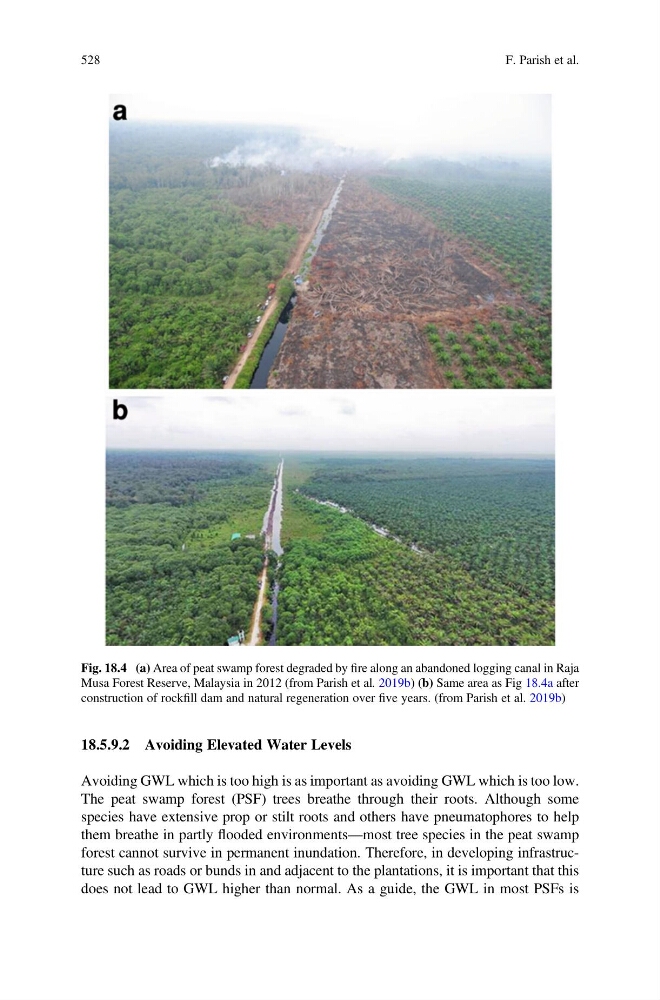
Fig. 18.4 (a) Area of peat swamp forest degraded by fire along an abandoned logging canal in Raja
Musa Forest Reserve, Malaysia in 2012 (from Parish et al. 2019b) (b) Same area as Fig 18.4a after
construction of rockfill dam and natural regeneration over five years. (from Parish et al. 2019b)
528
F. Parish et al.
Avoiding GWL which is too high is as important as avoiding GWL which is too low.
The peat swamp forest (PSF) trees breathe through their roots. Although some
species have extensive prop or stilt roots and others have pneumatophores to help
them breathe in partly flooded environments—most tree species in the peat swamp
forest cannot survive in permanent inundation. Therefore, in developing infrastructure such as roads or bunds in and adjacent to the plantations, it is important that this
does not lead to GWL higher than normal. As a guide, the GWL in most PSFs is
Fig. 18.4 (a) Area of peat swamp forest degraded by fire along an abandoned logging canal in Raja
Musa Forest Reserve, Malaysia in 2012 (from Parish et al. 2019b) (b) Same area as Fig 18.4a after
construction of rockfill dam and natural regeneration over five years. (from Parish et al. 2019b)
528
F. Parish et al.