

the communities that depend on these resources. But the primary concern is that
drainage via ditches and canals also results in the drying of the peatland, leaving the
peat vulnerable to fire as well as subsidence of the peat. Drainage of oil palm
plantations on peatland also impacts adjacent peatlands due to the high hydrological
conductivity of the water in the peat soil (Wetlands International 2016).
In some situations, oil palm plantations may wish to restore the hydrology of
peatland ecosystems in and adjacent to their plantations through the systematic
blocking of ditches and canals. By building blocks and dams, water and retention
levels of peatlands can be increased and hopefully restored. The RSPO BMP Manual
on Management and Rehabilitation of Peatlands (Parish et al. 2019b) elaborates on
methods of repairing the condition and hydrology of peatlands via blocking of canals
and ditches.
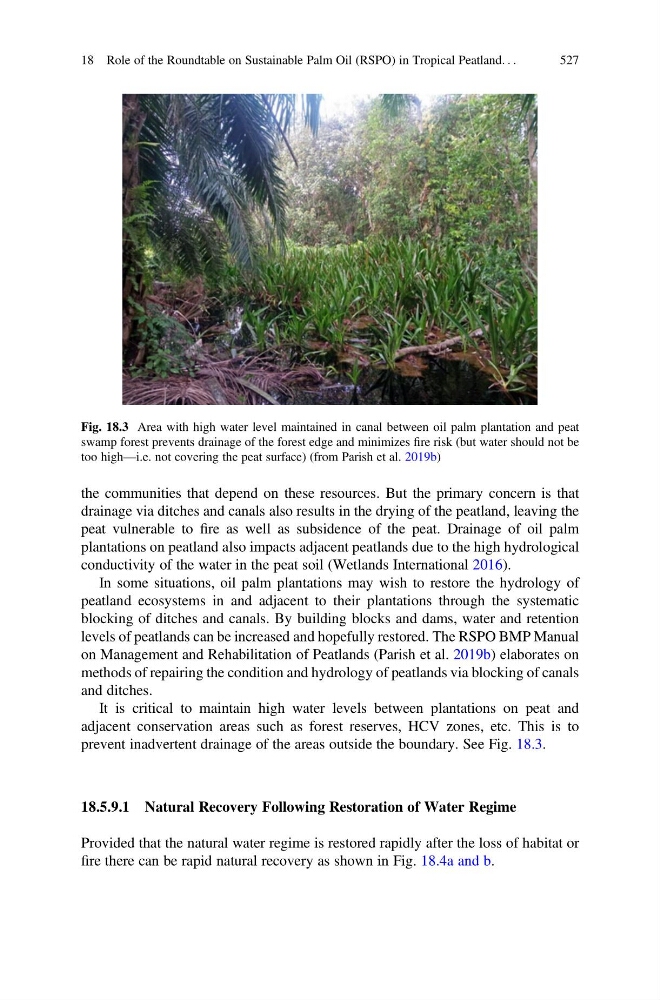
It is critical to maintain high water levels between plantations on peat and
adjacent conservation areas such as forest reserves, HCV zones, etc. This is to
prevent inadvertent drainage of the areas outside the boundary. See Fig. 18.3.
18.5.9.1 Natural Recovery Following Restoration of Water Regime
Provided that the natural water regime is restored rapidly after the loss of habitat or
fire there can be rapid natural recovery as shown in Fig. 18.4a and b.
Fig. 18.3 Area with high water level maintained in canal between oil palm plantation and peat
swamp forest prevents drainage of the forest edge and minimizes fire risk (but water should not be
too high—i.e. not covering the peat surface) (from Parish et al. 2019b)
18 Role of the Roundtable on Sustainable Palm Oil (RSPO) in Tropical Peatland. . .
527
drainage via ditches and canals also results in the drying of the peatland, leaving the
peat vulnerable to fire as well as subsidence of the peat. Drainage of oil palm
plantations on peatland also impacts adjacent peatlands due to the high hydrological
conductivity of the water in the peat soil (Wetlands International 2016).
In some situations, oil palm plantations may wish to restore the hydrology of
peatland ecosystems in and adjacent to their plantations through the systematic
blocking of ditches and canals. By building blocks and dams, water and retention
levels of peatlands can be increased and hopefully restored. The RSPO BMP Manual
on Management and Rehabilitation of Peatlands (Parish et al. 2019b) elaborates on
methods of repairing the condition and hydrology of peatlands via blocking of canals
and ditches.
It is critical to maintain high water levels between plantations on peat and
adjacent conservation areas such as forest reserves, HCV zones, etc. This is to
prevent inadvertent drainage of the areas outside the boundary. See Fig. 18.3.
18.5.9.1 Natural Recovery Following Restoration of Water Regime
Provided that the natural water regime is restored rapidly after the loss of habitat or
fire there can be rapid natural recovery as shown in Fig. 18.4a and b.
Fig. 18.3 Area with high water level maintained in canal between oil palm plantation and peat
swamp forest prevents drainage of the forest edge and minimizes fire risk (but water should not be
too high—i.e. not covering the peat surface) (from Parish et al. 2019b)
18 Role of the Roundtable on Sustainable Palm Oil (RSPO) in Tropical Peatland. . .
527