

there were no clear differences for above-ground growth. They also observed that
more roots developed near the ground surface and elongated horizontally in the soil
with a higher groundwater level. Referring to the study by Chinen et al. (2003), it is
reported that approximately 50% of the sago palm roots is found to be growing less
than 30 cm below the ground level. Kakuda et al. (2015) expressed that there is no
moisture stress and inhibition on root growth at the groundwater level below the
sago palm’s active root growth zone.
17.4.2 Photosynthesis and its Related Parameters under
Higher GWL
Kakuda et al. (2015) mentioned that there is no consistent relationship between the
growth of sago palms at the rosette stage and the groundwater level. Nevertheless, in
our laboratory level experiment, the photosynthetic rate (P N ) of sago palm seedlings
at the 12th leaf stage grown under waterlogged conditions (the water level was above
the soil surface) was higher than those of the controlled condition (allowed to drain
under the pots and the plants were watered every day to meet the soil water capacity
requirement) for the first 2 months (Azhar et al. 2020b). However, the P N of flooded
plants constantly decreased with prolonged waterlogged conditions by the end of the
experiment (day 107) (Fig. 17.8). The prolonged waterlogging also caused
-70 -65 -60 -55 -50
1.2
1.0
0.6
0.4
0.2
0
0.8
Trunk volume increase rate
(m 3
year -1
)
-90 -85 -80 -75
3.0
2.5
1.5
1.0
0.5
0
2.0
3.5
Trunk height increase rate
(m year -1
)
Groundwater level (cm)
r = 0.769 **
r = 0.746 **
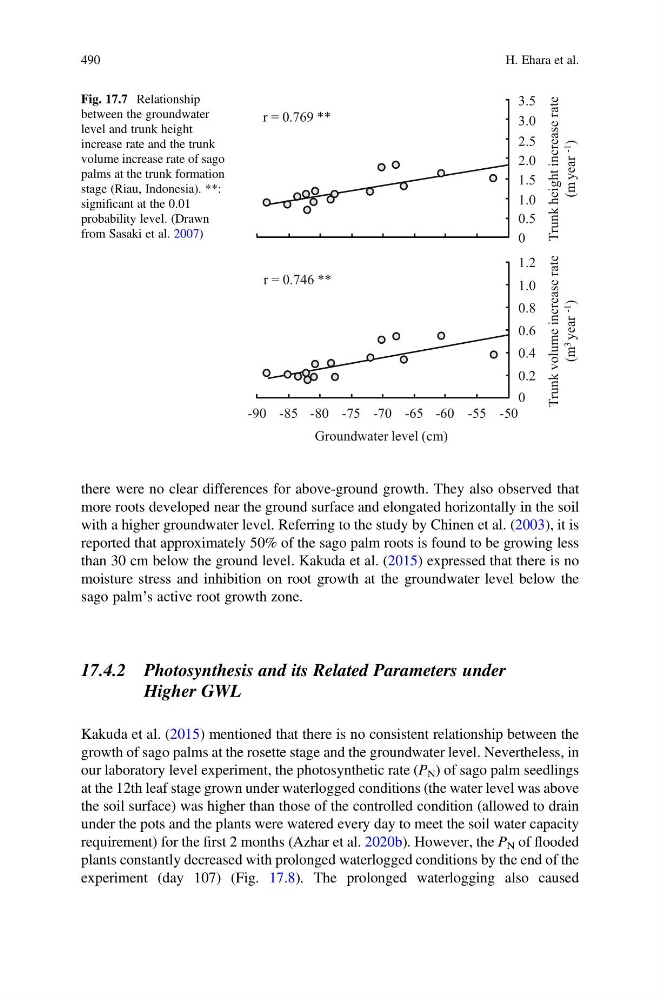
Fig. 17.7 Relationship
between the groundwater
level and trunk height
increase rate and the trunk
volume increase rate of sago
palms at the trunk formation
stage (Riau, Indonesia). **:
significant at the 0.01
probability level. (Drawn
from Sasaki et al. 2007)
490
H. Ehara et al.
more roots developed near the ground surface and elongated horizontally in the soil
with a higher groundwater level. Referring to the study by Chinen et al. (2003), it is
reported that approximately 50% of the sago palm roots is found to be growing less
than 30 cm below the ground level. Kakuda et al. (2015) expressed that there is no
moisture stress and inhibition on root growth at the groundwater level below the
sago palm’s active root growth zone.
17.4.2 Photosynthesis and its Related Parameters under
Higher GWL
Kakuda et al. (2015) mentioned that there is no consistent relationship between the
growth of sago palms at the rosette stage and the groundwater level. Nevertheless, in
our laboratory level experiment, the photosynthetic rate (P N ) of sago palm seedlings
at the 12th leaf stage grown under waterlogged conditions (the water level was above
the soil surface) was higher than those of the controlled condition (allowed to drain
under the pots and the plants were watered every day to meet the soil water capacity
requirement) for the first 2 months (Azhar et al. 2020b). However, the P N of flooded
plants constantly decreased with prolonged waterlogged conditions by the end of the
experiment (day 107) (Fig. 17.8). The prolonged waterlogging also caused
-70 -65 -60 -55 -50
1.2
1.0
0.6
0.4
0.2
0
0.8
Trunk volume increase rate
(m 3
year -1
)
-90 -85 -80 -75
3.0
2.5
1.5
1.0
0.5
0
2.0
3.5
Trunk height increase rate
(m year -1
)
Groundwater level (cm)
r = 0.769 **
r = 0.746 **
Fig. 17.7 Relationship
between the groundwater
level and trunk height
increase rate and the trunk
volume increase rate of sago
palms at the trunk formation
stage (Riau, Indonesia). **:
significant at the 0.01
probability level. (Drawn
from Sasaki et al. 2007)
490
H. Ehara et al.