

is estimated that about nine million hectares are drained or equal to 60% of
Indonesia’s total peatland area.
Efforts to manage the degradation of tropical peat swamp forest ecosystem have
been recently executed since 2016. The government formed the National Peatland
Restoration Agency, known as Badan Restorasi Gambut (BRG), with a primary
function as a national coordinator to manage 2.4 million ha of degraded peats in
seven provinces. Restoration priority consists of the 2015 burnt area, drained peat
dome of protected peats, undrained peat dome of protected peats, and drained peats
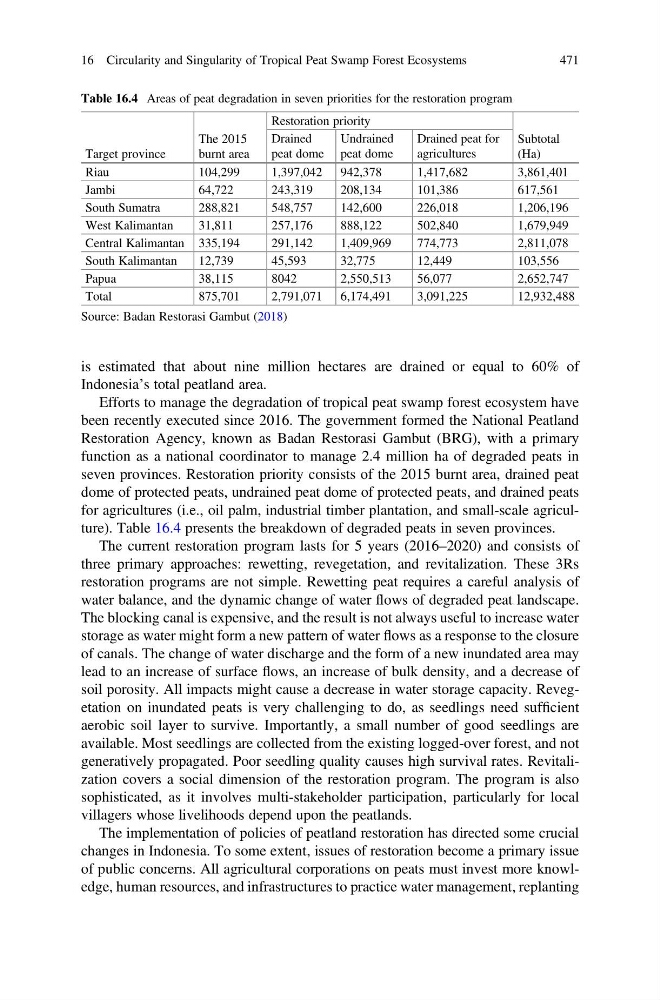
for agricultures (i.e., oil palm, industrial timber plantation, and small-scale agriculture). Table 16.4 presents the breakdown of degraded peats in seven provinces.
The current restoration program lasts for 5 years (2016–2020) and consists of
three primary approaches: rewetting, revegetation, and revitalization. These 3Rs
restoration programs are not simple. Rewetting peat requires a careful analysis of
water balance, and the dynamic change of water flows of degraded peat landscape.
The blocking canal is expensive, and the result is not always useful to increase water
storage as water might form a new pattern of water flows as a response to the closure
of canals. The change of water discharge and the form of a new inundated area may
lead to an increase of surface flows, an increase of bulk density, and a decrease of
soil porosity. All impacts might cause a decrease in water storage capacity. Revegetation on inundated peats is very challenging to do, as seedlings need sufficient
aerobic soil layer to survive. Importantly, a small number of good seedlings are
available. Most seedlings are collected from the existing logged-over forest, and not
generatively propagated. Poor seedling quality causes high survival rates. Revitalization covers a social dimension of the restoration program. The program is also
sophisticated, as it involves multi-stakeholder participation, particularly for local
villagers whose livelihoods depend upon the peatlands.
The implementation of policies of peatland restoration has directed some crucial
changes in Indonesia. To some extent, issues of restoration become a primary issue
of public concerns. All agricultural corporations on peats must invest more knowledge, human resources, and infrastructures to practice water management, replanting
Table 16.4 Areas of peat degradation in seven priorities for the restoration program
Target province
The 2015
burnt area
Restoration priority
Subtotal
(Ha)
Drained
peat dome
Undrained
peat dome
Drained peat for
agricultures
Riau
104,299
1,397,042 942,378
1,417,682
3,861,401
Jambi
64,722
243,319
208,134
101,386
617,561
South Sumatra
288,821
548,757
142,600
226,018
1,206,196
West Kalimantan
31,811
257,176
888,122
502,840
1,679,949
Central Kalimantan 335,194
291,142
1,409,969
774,773
2,811,078
South Kalimantan
12,739
45,593
32,775
12,449
103,556
Papua
38,115
8042
2,550,513
56,077
2,652,747
Total
875,701
2,791,071 6,174,491
3,091,225
12,932,488
Source: Badan Restorasi Gambut (2018)
16 Circularity and Singularity of Tropical Peat Swamp Forest Ecosystems
471
Indonesia’s total peatland area.
Efforts to manage the degradation of tropical peat swamp forest ecosystem have
been recently executed since 2016. The government formed the National Peatland
Restoration Agency, known as Badan Restorasi Gambut (BRG), with a primary
function as a national coordinator to manage 2.4 million ha of degraded peats in
seven provinces. Restoration priority consists of the 2015 burnt area, drained peat
dome of protected peats, undrained peat dome of protected peats, and drained peats
for agricultures (i.e., oil palm, industrial timber plantation, and small-scale agriculture). Table 16.4 presents the breakdown of degraded peats in seven provinces.
The current restoration program lasts for 5 years (2016–2020) and consists of
three primary approaches: rewetting, revegetation, and revitalization. These 3Rs
restoration programs are not simple. Rewetting peat requires a careful analysis of
water balance, and the dynamic change of water flows of degraded peat landscape.
The blocking canal is expensive, and the result is not always useful to increase water
storage as water might form a new pattern of water flows as a response to the closure
of canals. The change of water discharge and the form of a new inundated area may
lead to an increase of surface flows, an increase of bulk density, and a decrease of
soil porosity. All impacts might cause a decrease in water storage capacity. Revegetation on inundated peats is very challenging to do, as seedlings need sufficient
aerobic soil layer to survive. Importantly, a small number of good seedlings are
available. Most seedlings are collected from the existing logged-over forest, and not
generatively propagated. Poor seedling quality causes high survival rates. Revitalization covers a social dimension of the restoration program. The program is also
sophisticated, as it involves multi-stakeholder participation, particularly for local
villagers whose livelihoods depend upon the peatlands.
The implementation of policies of peatland restoration has directed some crucial
changes in Indonesia. To some extent, issues of restoration become a primary issue
of public concerns. All agricultural corporations on peats must invest more knowledge, human resources, and infrastructures to practice water management, replanting
Table 16.4 Areas of peat degradation in seven priorities for the restoration program
Target province
The 2015
burnt area
Restoration priority
Subtotal
(Ha)
Drained
peat dome
Undrained
peat dome
Drained peat for
agricultures
Riau
104,299
1,397,042 942,378
1,417,682
3,861,401
Jambi
64,722
243,319
208,134
101,386
617,561
South Sumatra
288,821
548,757
142,600
226,018
1,206,196
West Kalimantan
31,811
257,176
888,122
502,840
1,679,949
Central Kalimantan 335,194
291,142
1,409,969
774,773
2,811,078
South Kalimantan
12,739
45,593
32,775
12,449
103,556
Papua
38,115
8042
2,550,513
56,077
2,652,747
Total
875,701
2,791,071 6,174,491
3,091,225
12,932,488
Source: Badan Restorasi Gambut (2018)
16 Circularity and Singularity of Tropical Peat Swamp Forest Ecosystems
471