

distribution at shrub 1 (non-forest), shrub 2, forest 1, and forest 2 were À55 cm,
À21 cm, À1 cm, and 4 cm, respectively. Shrub 1 plot, which is the nearest plot
towards the canal, showed relatively lower water table distribution compared to the
water table in the forest area. As the shrub area cannot protect the peat surface from
solar radiation, it leads to the higher evaporation. Coupled with drainage, this
phenomenon would increase the water loss.
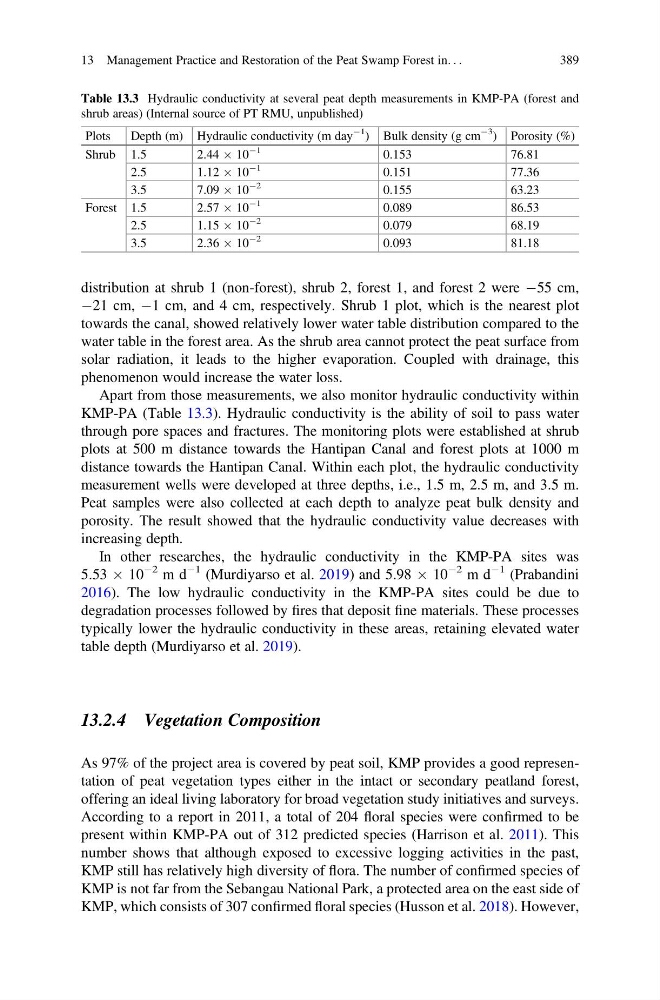
Apart from those measurements, we also monitor hydraulic conductivity within
KMP-PA (Table 13.3). Hydraulic conductivity is the ability of soil to pass water
through pore spaces and fractures. The monitoring plots were established at shrub
plots at 500 m distance towards the Hantipan Canal and forest plots at 1000 m
distance towards the Hantipan Canal. Within each plot, the hydraulic conductivity
measurement wells were developed at three depths, i.e., 1.5 m, 2.5 m, and 3.5 m.
Peat samples were also collected at each depth to analyze peat bulk density and
porosity. The result showed that the hydraulic conductivity value decreases with
increasing depth.
In other researches, the hydraulic conductivity in the KMP-PA sites was
5.53 Â 10
À2 m d
À1 (Murdiyarso et al. 2019) and 5.98 Â 10
À2 m d
À1 (Prabandini
2016). The low hydraulic conductivity in the KMP-PA sites could be due to
degradation processes followed by fires that deposit fine materials. These processes
typically lower the hydraulic conductivity in these areas, retaining elevated water
table depth (Murdiyarso et al. 2019).
13.2.4 Vegetation Composition
As 97% of the project area is covered by peat soil, KMP provides a good representation of peat vegetation types either in the intact or secondary peatland forest,
offering an ideal living laboratory for broad vegetation study initiatives and surveys.
According to a report in 2011, a total of 204 floral species were confirmed to be
present within KMP-PA out of 312 predicted species (Harrison et al. 2011). This
number shows that although exposed to excessive logging activities in the past,
KMP still has relatively high diversity of flora. The number of confirmed species of
KMP is not far from the Sebangau National Park, a protected area on the east side of
KMP, which consists of 307 confirmed floral species (Husson et al. 2018). However,
Table 13.3 Hydraulic conductivity at several peat depth measurements in KMP-PA (forest and
shrub areas) (Internal source of PT RMU, unpublished)
Plots
Depth (m) Hydraulic conductivity (m day
À1
) Bulk density (g cm
À3
) Porosity (%)
Shrub 1.5
2.44 Â 10
À1
0.153
76.81
2.5
1.12 Â 10
À1
0.151
77.36
3.5
7.09 Â 10
À2
0.155
63.23
Forest 1.5
2.57 Â 10
À1
0.089
86.53
2.5
1.15 Â 10
À2
0.079
68.19
3.5
2.36 Â 10
À2
0.093
81.18
13 Management Practice and Restoration of the Peat Swamp Forest in. . .
389
À21 cm, À1 cm, and 4 cm, respectively. Shrub 1 plot, which is the nearest plot
towards the canal, showed relatively lower water table distribution compared to the
water table in the forest area. As the shrub area cannot protect the peat surface from
solar radiation, it leads to the higher evaporation. Coupled with drainage, this
phenomenon would increase the water loss.
Apart from those measurements, we also monitor hydraulic conductivity within
KMP-PA (Table 13.3). Hydraulic conductivity is the ability of soil to pass water
through pore spaces and fractures. The monitoring plots were established at shrub
plots at 500 m distance towards the Hantipan Canal and forest plots at 1000 m
distance towards the Hantipan Canal. Within each plot, the hydraulic conductivity
measurement wells were developed at three depths, i.e., 1.5 m, 2.5 m, and 3.5 m.
Peat samples were also collected at each depth to analyze peat bulk density and
porosity. The result showed that the hydraulic conductivity value decreases with
increasing depth.
In other researches, the hydraulic conductivity in the KMP-PA sites was
5.53 Â 10
À2 m d
À1 (Murdiyarso et al. 2019) and 5.98 Â 10
À2 m d
À1 (Prabandini
2016). The low hydraulic conductivity in the KMP-PA sites could be due to
degradation processes followed by fires that deposit fine materials. These processes
typically lower the hydraulic conductivity in these areas, retaining elevated water
table depth (Murdiyarso et al. 2019).
13.2.4 Vegetation Composition
As 97% of the project area is covered by peat soil, KMP provides a good representation of peat vegetation types either in the intact or secondary peatland forest,
offering an ideal living laboratory for broad vegetation study initiatives and surveys.
According to a report in 2011, a total of 204 floral species were confirmed to be
present within KMP-PA out of 312 predicted species (Harrison et al. 2011). This
number shows that although exposed to excessive logging activities in the past,
KMP still has relatively high diversity of flora. The number of confirmed species of
KMP is not far from the Sebangau National Park, a protected area on the east side of
KMP, which consists of 307 confirmed floral species (Husson et al. 2018). However,
Table 13.3 Hydraulic conductivity at several peat depth measurements in KMP-PA (forest and
shrub areas) (Internal source of PT RMU, unpublished)
Plots
Depth (m) Hydraulic conductivity (m day
À1
) Bulk density (g cm
À3
) Porosity (%)
Shrub 1.5
2.44 Â 10
À1
0.153
76.81
2.5
1.12 Â 10
À1
0.151
77.36
3.5
7.09 Â 10
À2
0.155
63.23
Forest 1.5
2.57 Â 10
À1
0.089
86.53
2.5
1.15 Â 10
À2
0.079
68.19
3.5
2.36 Â 10
À2
0.093
81.18
13 Management Practice and Restoration of the Peat Swamp Forest in. . .
389