

N: 10 units
P: 1 unit
K: 10 units
Ca, Mg: 0.1–1 unit
Micronutrients (Fe, Mn, Cu, Zn, Ni, Mo, Bo): 0.001–0.1 unit
For field crops, as N, P, and K are generally applied as fertilizer at a ratio of
10 (N): 10 (P 2 O 5 ): 10 (K 2 O), it is a common misconception that plants require large
amounts of P (phosphorus). Once P (PO 4
À ) is applied to mineral soil, P (PO 4
À ) is
available only within a small pH range (6.0). If the soil pH is low (less than 5.5), P
(PO 4
À
) binds with Fe and Al, which are insoluble forms. If the soil pH is high (more
than 6.5), P (PO 4
À
) binds with Ca, which is also insoluble. Therefore, excess P
fertilizer is applied to mineral soils. Additionally, starch crops require a large amount
of P because starch crops accumulate large amounts of P compounds such as phytin.
However, except in field crops such as rice, wheat, maize, soybean, potato, etc., the P
requirement of crop plants is low.
The leaf has several functions such as providing carbon assimilation, water usage
regulation, nitrogen metabolism, phosphorus circulation, potassium function
enhancement, electron transportation using micronutrients, etc. Under nutrientlimited conditions, the total design of the plant metabolism is highly important.
Burned in
2002
Burned in
1997 & 2002
Sengon: Albizia chinensis
(Legume Tree)
Acaia mangium
(Legume Tree)
a) Vegetation Recovery
b) Micronutrient Deficiency
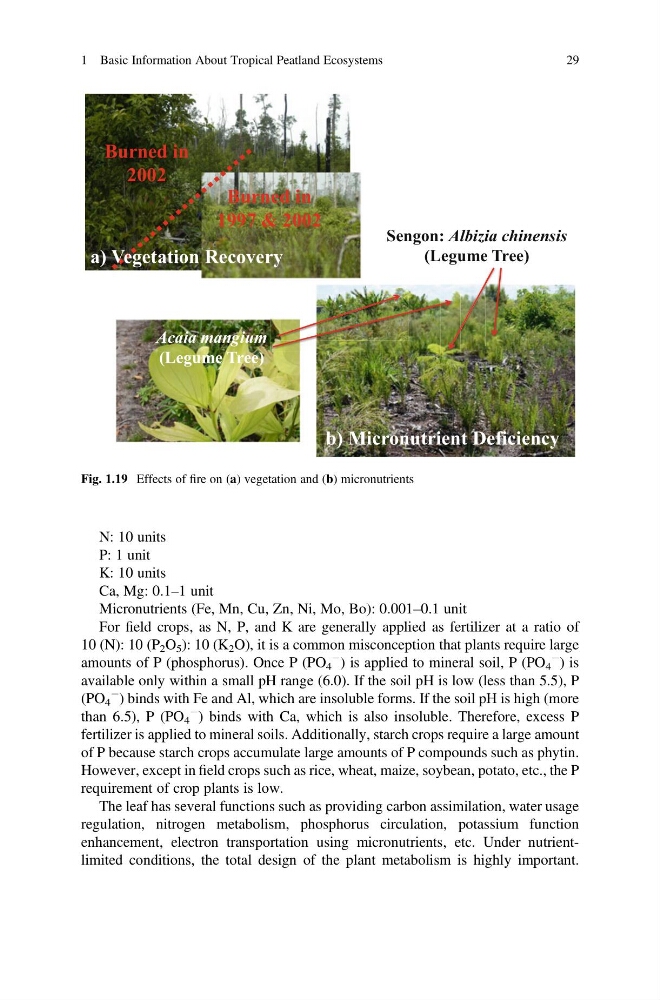
Fig. 1.19 Effects of fire on (a) vegetation and (b) micronutrients
1 Basic Information About Tropical Peatland Ecosystems
29
P: 1 unit
K: 10 units
Ca, Mg: 0.1–1 unit
Micronutrients (Fe, Mn, Cu, Zn, Ni, Mo, Bo): 0.001–0.1 unit
For field crops, as N, P, and K are generally applied as fertilizer at a ratio of
10 (N): 10 (P 2 O 5 ): 10 (K 2 O), it is a common misconception that plants require large
amounts of P (phosphorus). Once P (PO 4
À ) is applied to mineral soil, P (PO 4
À ) is
available only within a small pH range (6.0). If the soil pH is low (less than 5.5), P
(PO 4
À
) binds with Fe and Al, which are insoluble forms. If the soil pH is high (more
than 6.5), P (PO 4
À
) binds with Ca, which is also insoluble. Therefore, excess P
fertilizer is applied to mineral soils. Additionally, starch crops require a large amount
of P because starch crops accumulate large amounts of P compounds such as phytin.
However, except in field crops such as rice, wheat, maize, soybean, potato, etc., the P
requirement of crop plants is low.
The leaf has several functions such as providing carbon assimilation, water usage
regulation, nitrogen metabolism, phosphorus circulation, potassium function
enhancement, electron transportation using micronutrients, etc. Under nutrientlimited conditions, the total design of the plant metabolism is highly important.
Burned in
2002
Burned in
1997 & 2002
Sengon: Albizia chinensis
(Legume Tree)
Acaia mangium
(Legume Tree)
a) Vegetation Recovery
b) Micronutrient Deficiency
Fig. 1.19 Effects of fire on (a) vegetation and (b) micronutrients
1 Basic Information About Tropical Peatland Ecosystems
29