

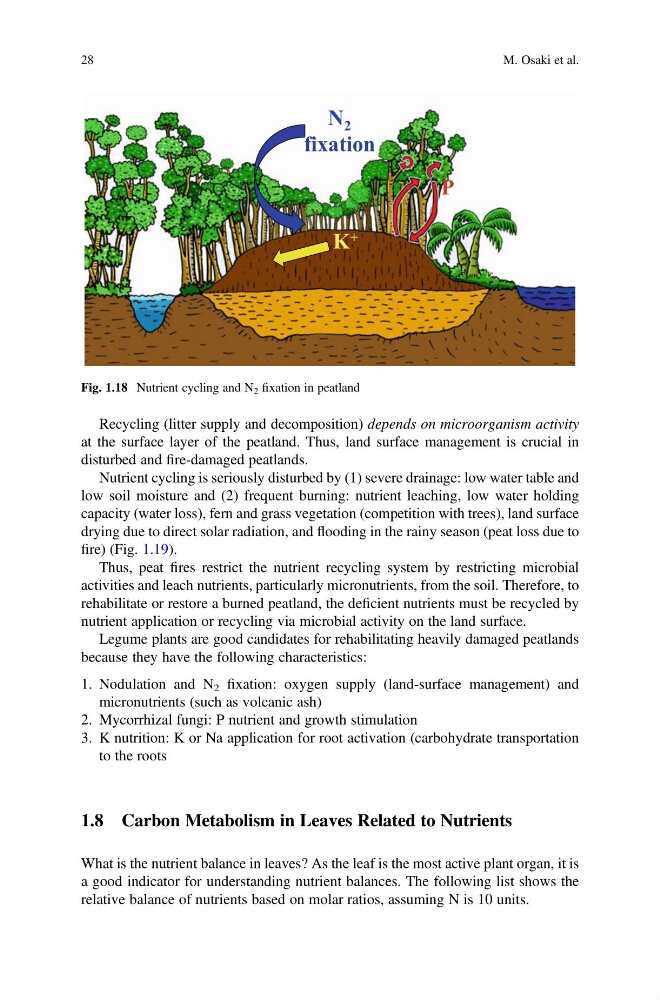
Recycling (litter supply and decomposition) depends on microorganism activity
at the surface layer of the peatland. Thus, land surface management is crucial in
disturbed and fire-damaged peatlands.
Nutrient cycling is seriously disturbed by (1) severe drainage: low water table and
low soil moisture and (2) frequent burning: nutrient leaching, low water holding
capacity (water loss), fern and grass vegetation (competition with trees), land surface
drying due to direct solar radiation, and flooding in the rainy season (peat loss due to
fire) (Fig. 1.19).
Thus, peat fires restrict the nutrient recycling system by restricting microbial
activities and leach nutrients, particularly micronutrients, from the soil. Therefore, to
rehabilitate or restore a burned peatland, the deficient nutrients must be recycled by
nutrient application or recycling via microbial activity on the land surface.
Legume plants are good candidates for rehabilitating heavily damaged peatlands
because they have the following characteristics:
1. Nodulation and N 2 fixation: oxygen supply (land-surface management) and
micronutrients (such as volcanic ash)
2. Mycorrhizal fungi: P nutrient and growth stimulation
3. K nutrition: K or Na application for root activation (carbohydrate transportation
to the roots
1.8 Carbon Metabolism in Leaves Related to Nutrients
What is the nutrient balance in leaves? As the leaf is the most active plant organ, it is
a good indicator for understanding nutrient balances. The following list shows the
relative balance of nutrients based on molar ratios, assuming N is 10 units.
P
N 2
fixation
K +
Fig. 1.18 Nutrient cycling and N 2 fixation in peatland
28
M. Osaki et al.
at the surface layer of the peatland. Thus, land surface management is crucial in
disturbed and fire-damaged peatlands.
Nutrient cycling is seriously disturbed by (1) severe drainage: low water table and
low soil moisture and (2) frequent burning: nutrient leaching, low water holding
capacity (water loss), fern and grass vegetation (competition with trees), land surface
drying due to direct solar radiation, and flooding in the rainy season (peat loss due to
fire) (Fig. 1.19).
Thus, peat fires restrict the nutrient recycling system by restricting microbial
activities and leach nutrients, particularly micronutrients, from the soil. Therefore, to
rehabilitate or restore a burned peatland, the deficient nutrients must be recycled by
nutrient application or recycling via microbial activity on the land surface.
Legume plants are good candidates for rehabilitating heavily damaged peatlands
because they have the following characteristics:
1. Nodulation and N 2 fixation: oxygen supply (land-surface management) and
micronutrients (such as volcanic ash)
2. Mycorrhizal fungi: P nutrient and growth stimulation
3. K nutrition: K or Na application for root activation (carbohydrate transportation
to the roots
1.8 Carbon Metabolism in Leaves Related to Nutrients
What is the nutrient balance in leaves? As the leaf is the most active plant organ, it is
a good indicator for understanding nutrient balances. The following list shows the
relative balance of nutrients based on molar ratios, assuming N is 10 units.
P
N 2
fixation
K +
Fig. 1.18 Nutrient cycling and N 2 fixation in peatland
28
M. Osaki et al.