

greenhouse gas emissions due to decomposition processes in aerobic condition
which releases greenhouse gasses, mainly carbon dioxide. For example, the GWL
decrease in oil palm plantations as high as 80 cm may release 20 ton C/ha/year. In
fact, with the subsidence causing peat degradation, the water holding capacity of
peat particles will come to very low. Accordingly, the flood usually makes steady in
the downstream which is no longer a peatland ecosystem. This flooding can cause
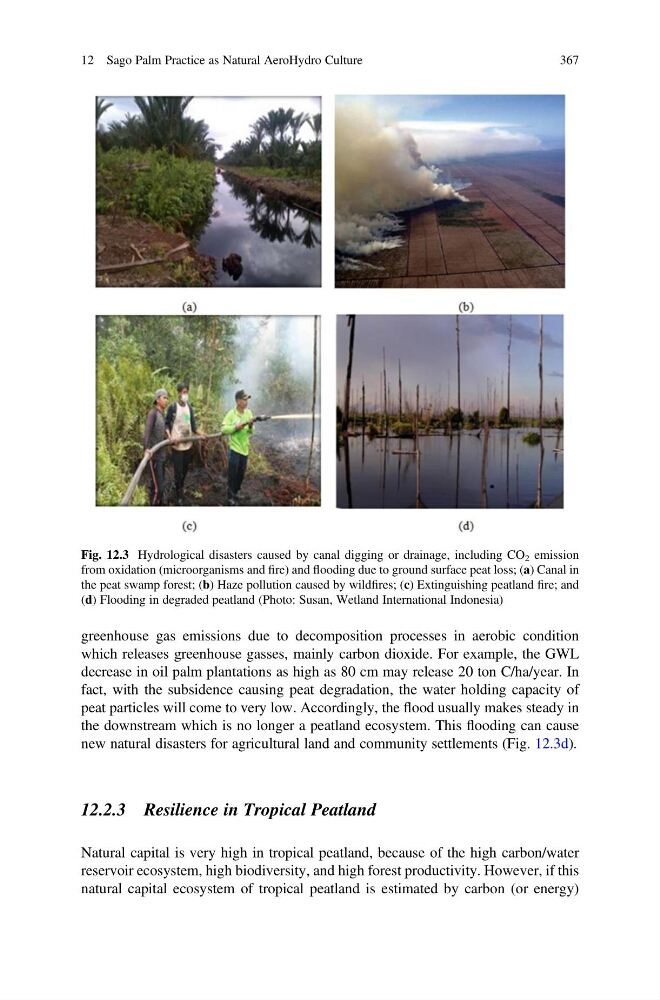
new natural disasters for agricultural land and community settlements (Fig. 12.3d).
12.2.3 Resilience in Tropical Peatland
Natural capital is very high in tropical peatland, because of the high carbon/water
reservoir ecosystem, high biodiversity, and high forest productivity. However, if this
natural capital ecosystem of tropical peatland is estimated by carbon (or energy)
Fig. 12.3 Hydrological disasters caused by canal digging or drainage, including CO 2 emission
from oxidation (microorganisms and fire) and flooding due to ground surface peat loss; (a) Canal in
the peat swamp forest; (b) Haze pollution caused by wildfires; (c) Extinguishing peatland fire; and
(d) Flooding in degraded peatland (Photo: Susan, Wetland International Indonesia)
12 Sago Palm Practice as Natural AeroHydro Culture
367
which releases greenhouse gasses, mainly carbon dioxide. For example, the GWL
decrease in oil palm plantations as high as 80 cm may release 20 ton C/ha/year. In
fact, with the subsidence causing peat degradation, the water holding capacity of
peat particles will come to very low. Accordingly, the flood usually makes steady in
the downstream which is no longer a peatland ecosystem. This flooding can cause
new natural disasters for agricultural land and community settlements (Fig. 12.3d).
12.2.3 Resilience in Tropical Peatland
Natural capital is very high in tropical peatland, because of the high carbon/water
reservoir ecosystem, high biodiversity, and high forest productivity. However, if this
natural capital ecosystem of tropical peatland is estimated by carbon (or energy)
Fig. 12.3 Hydrological disasters caused by canal digging or drainage, including CO 2 emission
from oxidation (microorganisms and fire) and flooding due to ground surface peat loss; (a) Canal in
the peat swamp forest; (b) Haze pollution caused by wildfires; (c) Extinguishing peatland fire; and
(d) Flooding in degraded peatland (Photo: Susan, Wetland International Indonesia)
12 Sago Palm Practice as Natural AeroHydro Culture
367