

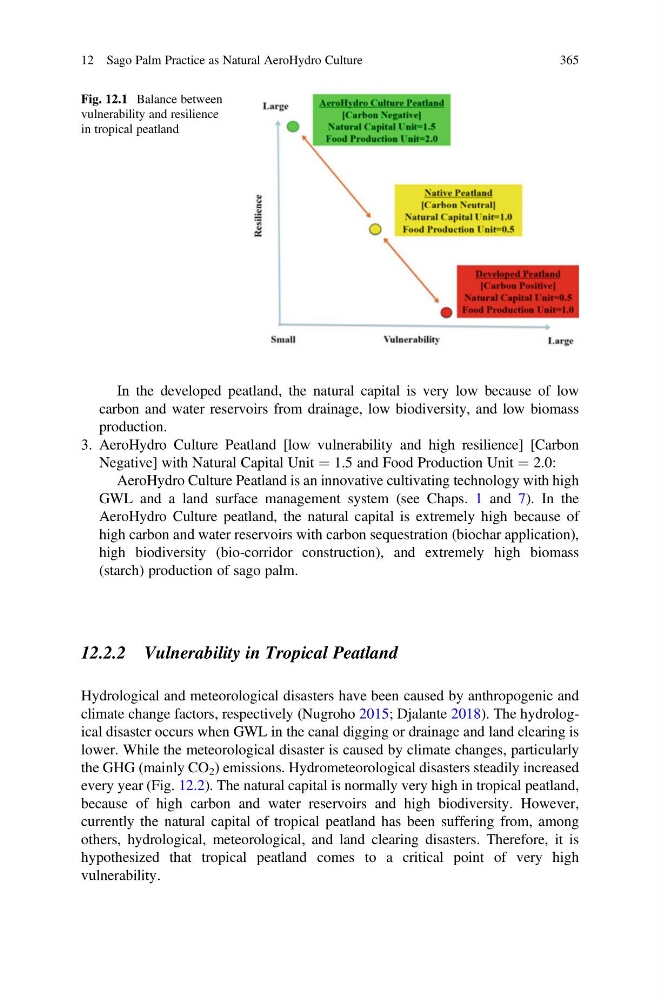
In the developed peatland, the natural capital is very low because of low
carbon and water reservoirs from drainage, low biodiversity, and low biomass
production.
3. AeroHydro Culture Peatland [low vulnerability and high resilience] [Carbon
Negative] with Natural Capital Unit ¼ 1.5 and Food Production Unit ¼ 2.0:
AeroHydro Culture Peatland is an innovative cultivating technology with high
GWL and a land surface management system (see Chaps. 1 and 7). In the
AeroHydro Culture peatland, the natural capital is extremely high because of
high carbon and water reservoirs with carbon sequestration (biochar application),
high biodiversity (bio-corridor construction), and extremely high biomass
(starch) production of sago palm.
12.2.2 Vulnerability in Tropical Peatland
Hydrological and meteorological disasters have been caused by anthropogenic and
climate change factors, respectively (Nugroho 2015; Djalante 2018). The hydrological disaster occurs when GWL in the canal digging or drainage and land clearing is
lower. While the meteorological disaster is caused by climate changes, particularly
the GHG (mainly CO 2 ) emissions. Hydrometeorological disasters steadily increased
every year (Fig. 12.2). The natural capital is normally very high in tropical peatland,
because of high carbon and water reservoirs and high biodiversity. However,
currently the natural capital of tropical peatland has been suffering from, among
others, hydrological, meteorological, and land clearing disasters. Therefore, it is
hypothesized that tropical peatland comes to a critical point of very high
vulnerability.
Fig. 12.1 Balance between
vulnerability and resilience
in tropical peatland
12 Sago Palm Practice as Natural AeroHydro Culture
365
carbon and water reservoirs from drainage, low biodiversity, and low biomass
production.
3. AeroHydro Culture Peatland [low vulnerability and high resilience] [Carbon
Negative] with Natural Capital Unit ¼ 1.5 and Food Production Unit ¼ 2.0:
AeroHydro Culture Peatland is an innovative cultivating technology with high
GWL and a land surface management system (see Chaps. 1 and 7). In the
AeroHydro Culture peatland, the natural capital is extremely high because of
high carbon and water reservoirs with carbon sequestration (biochar application),
high biodiversity (bio-corridor construction), and extremely high biomass
(starch) production of sago palm.
12.2.2 Vulnerability in Tropical Peatland
Hydrological and meteorological disasters have been caused by anthropogenic and
climate change factors, respectively (Nugroho 2015; Djalante 2018). The hydrological disaster occurs when GWL in the canal digging or drainage and land clearing is
lower. While the meteorological disaster is caused by climate changes, particularly
the GHG (mainly CO 2 ) emissions. Hydrometeorological disasters steadily increased
every year (Fig. 12.2). The natural capital is normally very high in tropical peatland,
because of high carbon and water reservoirs and high biodiversity. However,
currently the natural capital of tropical peatland has been suffering from, among
others, hydrological, meteorological, and land clearing disasters. Therefore, it is
hypothesized that tropical peatland comes to a critical point of very high
vulnerability.
Fig. 12.1 Balance between
vulnerability and resilience
in tropical peatland
12 Sago Palm Practice as Natural AeroHydro Culture
365