

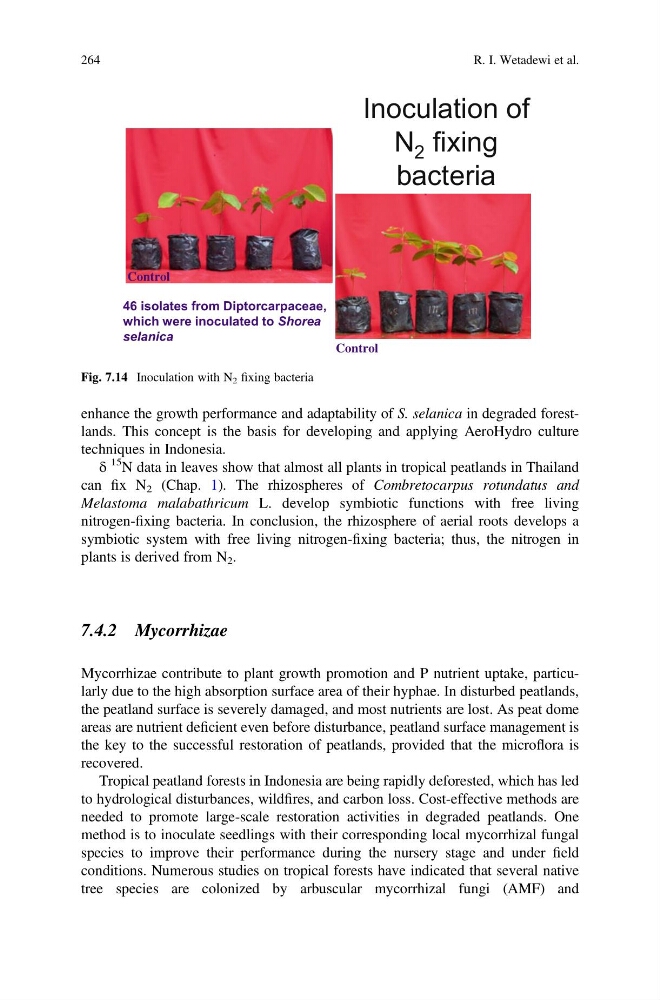
enhance the growth performance and adaptability of S. selanica in degraded forestlands. This concept is the basis for developing and applying AeroHydro culture
techniques in Indonesia.
δ
15 N data in leaves show that almost all plants in tropical peatlands in Thailand
can fix N 2 (Chap. 1). The rhizospheres of Combretocarpus rotundatus and
Melastoma malabathricum L. develop symbiotic functions with free living
nitrogen-fixing bacteria. In conclusion, the rhizosphere of aerial roots develops a
symbiotic system with free living nitrogen-fixing bacteria; thus, the nitrogen in
plants is derived from N 2 .
7.4.2 Mycorrhizae
Mycorrhizae contribute to plant growth promotion and P nutrient uptake, particularly due to the high absorption surface area of their hyphae. In disturbed peatlands,
the peatland surface is severely damaged, and most nutrients are lost. As peat dome
areas are nutrient deficient even before disturbance, peatland surface management is
the key to the successful restoration of peatlands, provided that the microflora is
recovered.
Tropical peatland forests in Indonesia are being rapidly deforested, which has led
to hydrological disturbances, wildfires, and carbon loss. Cost-effective methods are
needed to promote large-scale restoration activities in degraded peatlands. One
method is to inoculate seedlings with their corresponding local mycorrhizal fungal
species to improve their performance during the nursery stage and under field
conditions. Numerous studies on tropical forests have indicated that several native
tree species are colonized by arbuscular mycorrhizal fungi (AMF) and
Inoculation of
N 2 fixing
bacteria
46 isolates from Diptorcarpaceae,
which were inoculated to Shorea
selanica
Control
Control
Fig. 7.14 Inoculation with N 2 fixing bacteria
264
R. I. Wetadewi et al.
techniques in Indonesia.
δ
15 N data in leaves show that almost all plants in tropical peatlands in Thailand
can fix N 2 (Chap. 1). The rhizospheres of Combretocarpus rotundatus and
Melastoma malabathricum L. develop symbiotic functions with free living
nitrogen-fixing bacteria. In conclusion, the rhizosphere of aerial roots develops a
symbiotic system with free living nitrogen-fixing bacteria; thus, the nitrogen in
plants is derived from N 2 .
7.4.2 Mycorrhizae
Mycorrhizae contribute to plant growth promotion and P nutrient uptake, particularly due to the high absorption surface area of their hyphae. In disturbed peatlands,
the peatland surface is severely damaged, and most nutrients are lost. As peat dome
areas are nutrient deficient even before disturbance, peatland surface management is
the key to the successful restoration of peatlands, provided that the microflora is
recovered.
Tropical peatland forests in Indonesia are being rapidly deforested, which has led
to hydrological disturbances, wildfires, and carbon loss. Cost-effective methods are
needed to promote large-scale restoration activities in degraded peatlands. One
method is to inoculate seedlings with their corresponding local mycorrhizal fungal
species to improve their performance during the nursery stage and under field
conditions. Numerous studies on tropical forests have indicated that several native
tree species are colonized by arbuscular mycorrhizal fungi (AMF) and
Inoculation of
N 2 fixing
bacteria
46 isolates from Diptorcarpaceae,
which were inoculated to Shorea
selanica
Control
Control
Fig. 7.14 Inoculation with N 2 fixing bacteria
264
R. I. Wetadewi et al.