

transportation processes. We need energy derived from renewable cycles and reservoirs, such as biomass, solar, wind, and hydroelectricity, instead of fossil fuels (e.g.,
oil, coal, and gas). What is the optimal renewable energy source in the humid tropical
region? The answer to this question is biomass.
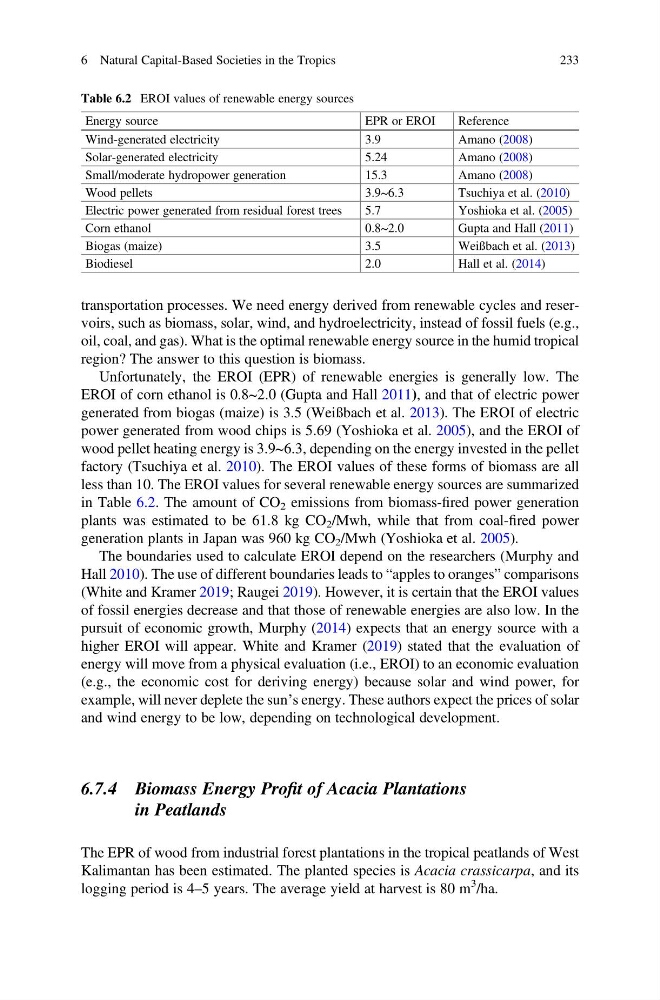
Unfortunately, the EROI (EPR) of renewable energies is generally low. The
EROI of corn ethanol is 0.8~2.0 (Gupta and Hall 2011), and that of electric power
generated from biogas (maize) is 3.5 (Weißbach et al. 2013). The EROI of electric
power generated from wood chips is 5.69 (Yoshioka et al. 2005), and the EROI of
wood pellet heating energy is 3.9~6.3, depending on the energy invested in the pellet
factory (Tsuchiya et al. 2010). The EROI values of these forms of biomass are all
less than 10. The EROI values for several renewable energy sources are summarized
in Table 6.2. The amount of CO 2 emissions from biomass-fired power generation
plants was estimated to be 61.8 kg CO 2 /Mwh, while that from coal-fired power
generation plants in Japan was 960 kg CO 2 /Mwh (Yoshioka et al. 2005).
The boundaries used to calculate EROI depend on the researchers (Murphy and
Hall 2010). The use of different boundaries leads to “apples to oranges” comparisons
(White and Kramer 2019; Raugei 2019). However, it is certain that the EROI values
of fossil energies decrease and that those of renewable energies are also low. In the
pursuit of economic growth, Murphy (2014) expects that an energy source with a
higher EROI will appear. White and Kramer (2019) stated that the evaluation of
energy will move from a physical evaluation (i.e., EROI) to an economic evaluation
(e.g., the economic cost for deriving energy) because solar and wind power, for
example, will never deplete the sun’s energy. These authors expect the prices of solar
and wind energy to be low, depending on technological development.
6.7.4 Biomass Energy Profit of Acacia Plantations
in Peatlands
The EPR of wood from industrial forest plantations in the tropical peatlands of West
Kalimantan has been estimated. The planted species is Acacia crassicarpa, and its
logging period is 4–5 years. The average yield at harvest is 80 m
3 /ha.
Table 6.2 EROI values of renewable energy sources
Energy source
EPR or EROI
Reference
Wind-generated electricity
3.9
Amano (2008)
Solar-generated electricity
5.24
Amano (2008)
Small/moderate hydropower generation
15.3
Amano (2008)
Wood pellets
3.9~6.3
Tsuchiya et al. (2010)
Electric power generated from residual forest trees
5.7
Yoshioka et al. (2005)
Corn ethanol
0.8~2.0
Gupta and Hall (2011)
Biogas (maize)
3.5
Weißbach et al. (2013)
Biodiesel
2.0
Hall et al. (2014)
6 Natural Capital-Based Societies in the Tropics
233
oil, coal, and gas). What is the optimal renewable energy source in the humid tropical
region? The answer to this question is biomass.
Unfortunately, the EROI (EPR) of renewable energies is generally low. The
EROI of corn ethanol is 0.8~2.0 (Gupta and Hall 2011), and that of electric power
generated from biogas (maize) is 3.5 (Weißbach et al. 2013). The EROI of electric
power generated from wood chips is 5.69 (Yoshioka et al. 2005), and the EROI of
wood pellet heating energy is 3.9~6.3, depending on the energy invested in the pellet
factory (Tsuchiya et al. 2010). The EROI values of these forms of biomass are all
less than 10. The EROI values for several renewable energy sources are summarized
in Table 6.2. The amount of CO 2 emissions from biomass-fired power generation
plants was estimated to be 61.8 kg CO 2 /Mwh, while that from coal-fired power
generation plants in Japan was 960 kg CO 2 /Mwh (Yoshioka et al. 2005).
The boundaries used to calculate EROI depend on the researchers (Murphy and
Hall 2010). The use of different boundaries leads to “apples to oranges” comparisons
(White and Kramer 2019; Raugei 2019). However, it is certain that the EROI values
of fossil energies decrease and that those of renewable energies are also low. In the
pursuit of economic growth, Murphy (2014) expects that an energy source with a
higher EROI will appear. White and Kramer (2019) stated that the evaluation of
energy will move from a physical evaluation (i.e., EROI) to an economic evaluation
(e.g., the economic cost for deriving energy) because solar and wind power, for
example, will never deplete the sun’s energy. These authors expect the prices of solar
and wind energy to be low, depending on technological development.
6.7.4 Biomass Energy Profit of Acacia Plantations
in Peatlands
The EPR of wood from industrial forest plantations in the tropical peatlands of West
Kalimantan has been estimated. The planted species is Acacia crassicarpa, and its
logging period is 4–5 years. The average yield at harvest is 80 m
3 /ha.
Table 6.2 EROI values of renewable energy sources
Energy source
EPR or EROI
Reference
Wind-generated electricity
3.9
Amano (2008)
Solar-generated electricity
5.24
Amano (2008)
Small/moderate hydropower generation
15.3
Amano (2008)
Wood pellets
3.9~6.3
Tsuchiya et al. (2010)
Electric power generated from residual forest trees
5.7
Yoshioka et al. (2005)
Corn ethanol
0.8~2.0
Gupta and Hall (2011)
Biogas (maize)
3.5
Weißbach et al. (2013)
Biodiesel
2.0
Hall et al. (2014)
6 Natural Capital-Based Societies in the Tropics
233