

Koppen classified the low latitude regions of South America and Africa and most
of the East Indies as Af climate regions, defined by a minimum monthly rainfall
!60 mm/month (total annual rainfall > > 720 mm/year). However, the inland areas
of Sumatera, Kalimantan and Papua, as well as those of South America and Africa
(except for the Amazon and Congo River basins) were excluded, so that Köppen’s
idealized land classification had Af climate along the equator, including in inland
areas. This view, in which rainfall was concentrated in the equatorial coastal areas,
was still accepted after some revisions and up to the development of the updated
climate classification (Köppen and Geiger 1954); however, it is not consistent with
recent descriptions (Peel et al. 2007) (Fig 6.1). The smaller islands between Java and
Papua (e.g., Lesser Sunda) were also excluded from the Af classification, which was
recognized as a westÀeast difference in the Indonesian Maritime Continent (IMC).
At present, a detailed gridded rainfall distribution based on rain gauge data (Yatagai
et al. 2012) shows differences between coastal and inland regions.
6.1.1.2 Maritime Continent (MC) in the Global Climate
Within the tropical zone, the Maritime Continent is the most sensitive and highly
uncertain element. The Maritime Continent is described primarily by Ramage
(1968); it consists of the warm ocean region (called the tropical warm pool (TWP)
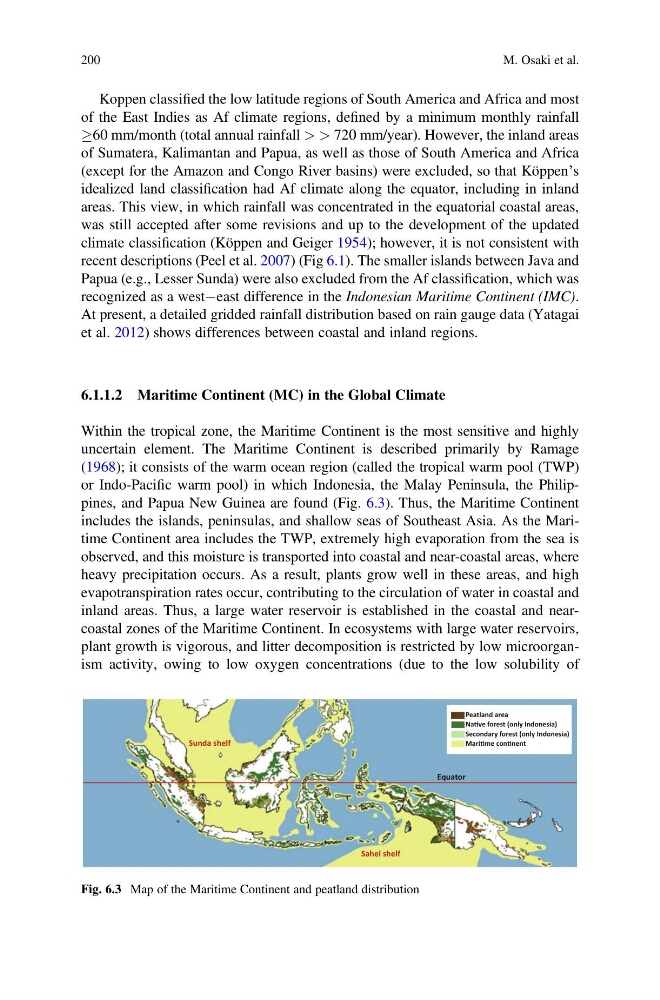
or Indo-Pacific warm pool) in which Indonesia, the Malay Peninsula, the Philippines, and Papua New Guinea are found (Fig. 6.3). Thus, the Maritime Continent
includes the islands, peninsulas, and shallow seas of Southeast Asia. As the Maritime Continent area includes the TWP, extremely high evaporation from the sea is
observed, and this moisture is transported into coastal and near-coastal areas, where
heavy precipitation occurs. As a result, plants grow well in these areas, and high
evapotranspiration rates occur, contributing to the circulation of water in coastal and
inland areas. Thus, a large water reservoir is established in the coastal and nearcoastal zones of the Maritime Continent. In ecosystems with large water reservoirs,
plant growth is vigorous, and litter decomposition is restricted by low microorganism activity, owing to low oxygen concentrations (due to the low solubility of
Sunda shelf
Sahel shelf
Equator
Peatland area
NaƟve forest (only Indonesia)
Secondary forest (only Indonesia)
MariƟme conƟnent
Fig. 6.3 Map of the Maritime Continent and peatland distribution
200
M. Osaki et al.
of the East Indies as Af climate regions, defined by a minimum monthly rainfall
!60 mm/month (total annual rainfall > > 720 mm/year). However, the inland areas
of Sumatera, Kalimantan and Papua, as well as those of South America and Africa
(except for the Amazon and Congo River basins) were excluded, so that Köppen’s
idealized land classification had Af climate along the equator, including in inland
areas. This view, in which rainfall was concentrated in the equatorial coastal areas,
was still accepted after some revisions and up to the development of the updated
climate classification (Köppen and Geiger 1954); however, it is not consistent with
recent descriptions (Peel et al. 2007) (Fig 6.1). The smaller islands between Java and
Papua (e.g., Lesser Sunda) were also excluded from the Af classification, which was
recognized as a westÀeast difference in the Indonesian Maritime Continent (IMC).
At present, a detailed gridded rainfall distribution based on rain gauge data (Yatagai
et al. 2012) shows differences between coastal and inland regions.
6.1.1.2 Maritime Continent (MC) in the Global Climate
Within the tropical zone, the Maritime Continent is the most sensitive and highly
uncertain element. The Maritime Continent is described primarily by Ramage
(1968); it consists of the warm ocean region (called the tropical warm pool (TWP)
or Indo-Pacific warm pool) in which Indonesia, the Malay Peninsula, the Philippines, and Papua New Guinea are found (Fig. 6.3). Thus, the Maritime Continent
includes the islands, peninsulas, and shallow seas of Southeast Asia. As the Maritime Continent area includes the TWP, extremely high evaporation from the sea is
observed, and this moisture is transported into coastal and near-coastal areas, where
heavy precipitation occurs. As a result, plants grow well in these areas, and high
evapotranspiration rates occur, contributing to the circulation of water in coastal and
inland areas. Thus, a large water reservoir is established in the coastal and nearcoastal zones of the Maritime Continent. In ecosystems with large water reservoirs,
plant growth is vigorous, and litter decomposition is restricted by low microorganism activity, owing to low oxygen concentrations (due to the low solubility of
Sunda shelf
Sahel shelf
Equator
Peatland area
NaƟve forest (only Indonesia)
Secondary forest (only Indonesia)
MariƟme conƟnent
Fig. 6.3 Map of the Maritime Continent and peatland distribution
200
M. Osaki et al.